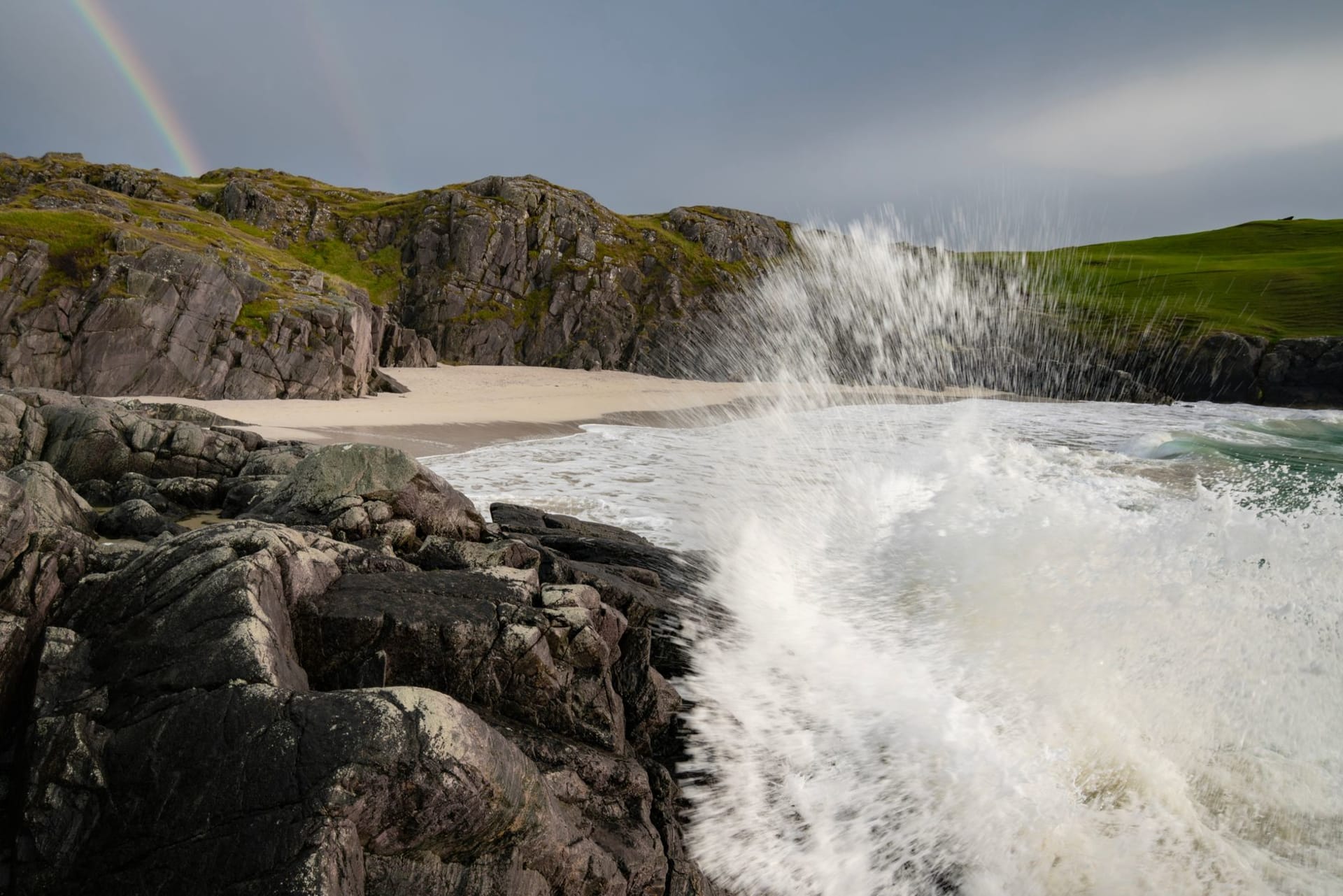
South Uist
"The machair in June on South Uist smells better than any perfume I've ever paid money for."
The road south from Benbecula crosses onto South Uist over a causeway and for a while nothing dramatic announces itself: peat moorland to the east, the low hump of the spine hills, grey cloud moving in from the Atlantic. And then the road passes through a gap and the west side opens up, and you see for the first time what a machair landscape actually looks like in June — a carpet of wildflowers running from the road edge to the dune line that, if you stop the car and walk into it, smells of clover and orchids and something sweeter beneath that I couldn’t name, the wind carrying it back over you every few seconds like someone repeatedly reminding you of a fact you keep forgetting.
The machair is Europe’s rarest coastal grassland, and South Uist has one of the longest unbroken stretches anywhere — thirty kilometres along the Atlantic coast, managed by crofters who have been grazing cattle on it for centuries without ruining it. In June it holds pyramidal orchids, lesser butterfly orchids, yellow rattle, bird’s-foot trefoil, sea pinks, and dozens of other species whose names I had to look up in a field guide borrowed from the hostel. Walking it is slow work in the best sense. You spend ten minutes per square metre if you’re paying attention.

The interior of South Uist is a different landscape entirely — a chain of freshwater lochs running north-south between the mountains and the machair, connected by narrow channels and home to red-throated divers and whooper swans and a population of corncrakes that has been declining everywhere else in Britain and is hanging on here in the rough grass at the machair edge. I heard one at dawn on my second morning from outside my tent and spent ten minutes convinced I was hearing something mechanical before I placed it: that rasping two-note call, as if the bird had learned to sing by studying a broken mechanism.

On the hillside above the village of Rueval stands Our Lady of the Isles — a nine-metre concrete statue of the Virgin and Child erected in 1957, visible from most of the island. South Uist, unusually for the Outer Hebrides, is predominantly Catholic, and has been since the Reformation failed to reach this far. There are roadside shrines in the verges. The priest’s house in Bornish has the same domestic curtains as everyone else’s and a Celtic cross in the garden. The faith sits lightly and practically on the island — not performed, not institutional. It just is, the way the machair just is.
When to go: June is almost non-negotiable for the machair flowers at their peak. Early July is still good but the orchids begin to go over. August and September are quieter and the light on the lochs in the long autumn evenings is exceptional. Midges are a serious inconvenience in still, warm conditions from June through August — bring repellent and, on still evenings near the loch, a head net you are not embarrassed by.