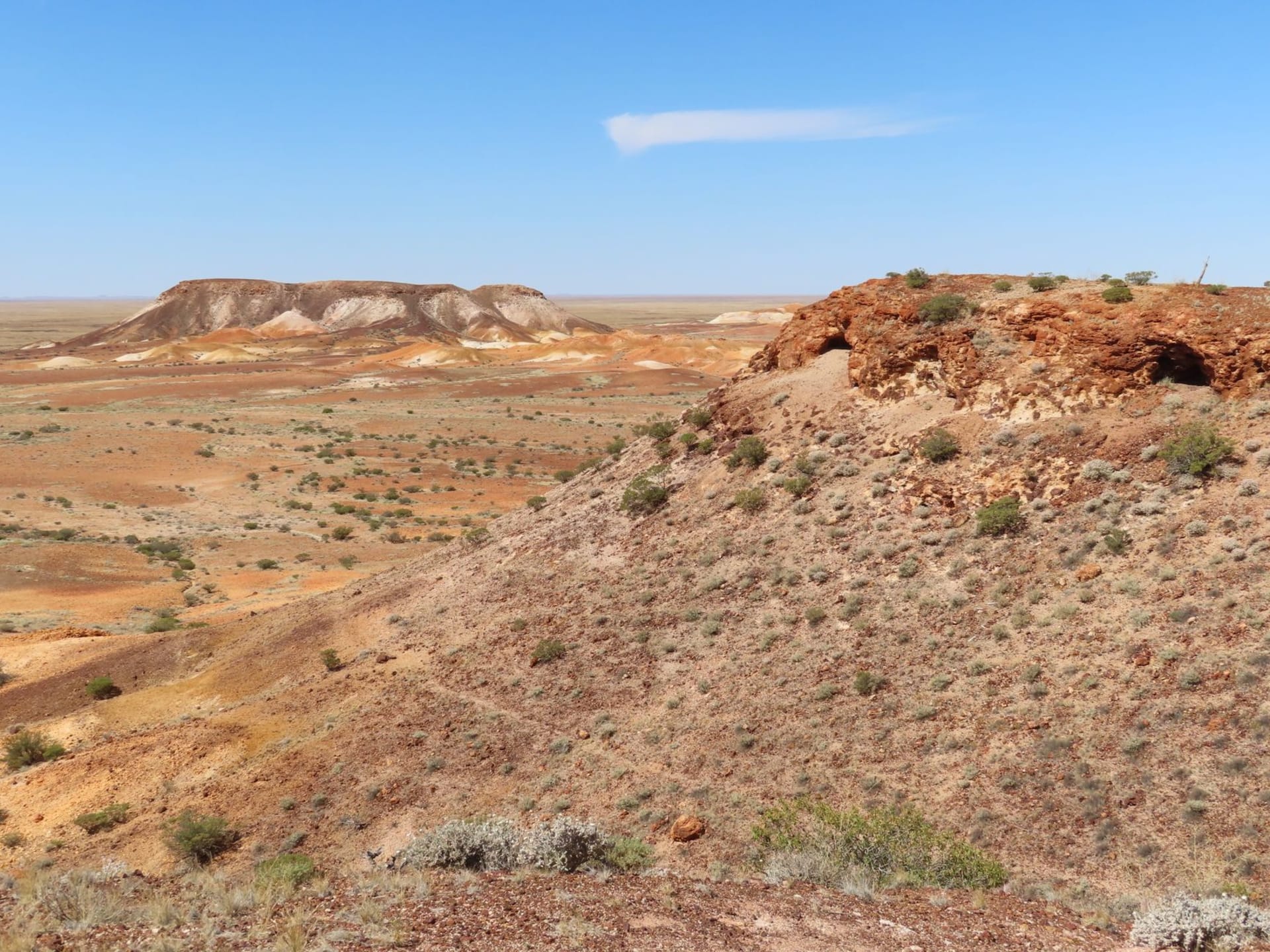
Coober Pedy
"Coober Pedy is the only town I've visited where the most comfortable rooms have no windows."
The first thing you notice approaching Coober Pedy from the south is that the ground has been turned over. Mounds of pale ochre earth spread across the plain in every direction — the tailings from decades of opal mining — and among them, holes. Hundreds of holes. Some with shafts going straight down into the earth, some covered with boards, some marked with flags, some with nothing at all to warn you. The whole landscape looks like a surface that has been methodically disassembled by people looking for something specific and not particularly concerned with the mess they left. I stopped at the edge of town and got out to stand in it. The wind was warm and mineral. A dog wandered past from nowhere and disappeared in the direction of a mound. The sign at the edge of town says: “Watch your step.” It is not a suggestion.
Coober Pedy produces roughly sixty percent of the world’s opal, and to avoid temperatures that regularly exceed 45°C in summer, roughly half of the population lives underground in dugouts — homes carved directly into the sandstone hillside. The dugouts are a remarkable solution to an extreme environment. They maintain a steady temperature of around 23°C year-round regardless of what happens above, they are quiet in the specific way that rock is quiet, and they are completely sealed from outside light in a way that makes time collapse. I stayed two nights in an underground hostel — my room was a carved cave with a door and a power outlet — and slept better than I have almost anywhere, though I lost all sense of whether it was day or night until I opened the door.

The underground Serbian Orthodox Church is worth finding. It sits inside a carved chamber with a vaulted ceiling and religious icons on the walls, holding services for the Serbian miners who have worked here since the 1970s. The commitment to going below is total in Coober Pedy — there is an underground catacomb tour, an underground art gallery, an underground bookshop, and more than one underground pub. After a day in the surface heat, this all makes complete sense.
I found opals by rummaging through the mullock heaps — the public piles of mine spoil where anyone can fossick freely. After forty minutes of turning over pale rock in the afternoon sun, I found a small piece with a faint blue-green fire in it. It was worth maybe ten Australian dollars and I have been carrying it in my pocket since, which tells you something about what this town does to you.

The pub at the Desert Cave Hotel, also underground, serves cold beer and a very reasonable steak. The staff are weathered and dry-humoured in the way of people who have decided, consciously, to live in extreme heat at the edge of a desert and regard passing tourists with an amused patience that borders on pity. The Drive-in Coober Pedy is an outdoor cinema operating in the cool of desert evenings, films playing to an audience sitting in and on their cars. I watched something I can no longer remember and thought about the opals formed 100 million years ago in a shallow inland sea that used to cover all of this.
When to go: May through September. Even in May the days can hit 30°C, but nights are cooler and the light on the mullock heaps at dusk is extraordinary. The midsummer heat is not tourism — arriving in January is a genuinely different kind of experience, and not a comfortable one.