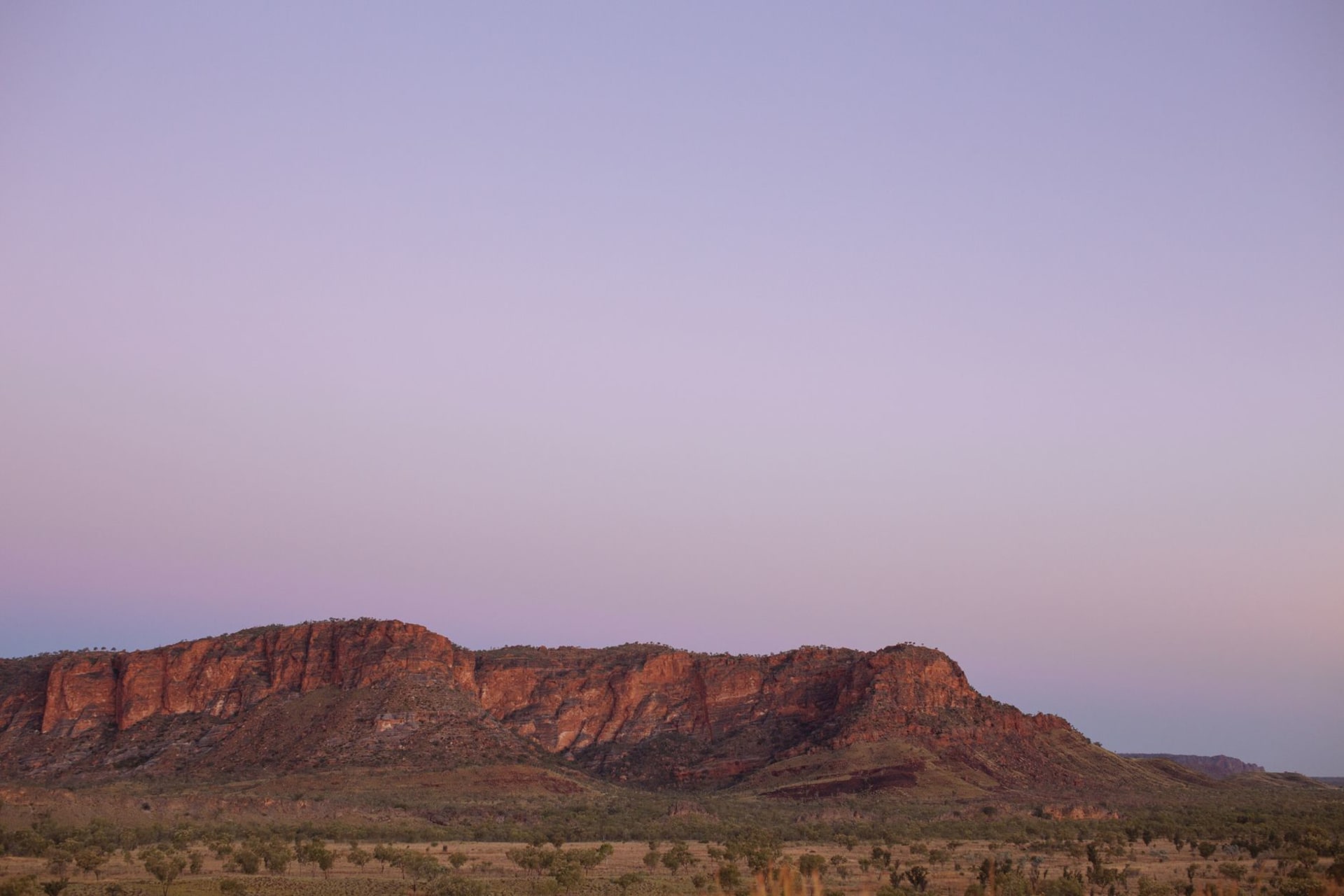
The Bungle Bungles
"The Bungles look like something a planet made while still learning how to make planets."
Getting to the Bungle Bungles requires commitment. From Kununurra in the far north of Western Australia, you drive 53 kilometres south on the Great Northern Highway, then turn off onto a 53-kilometre dirt track that is firmly 4WD-only and takes two hours in dry conditions and considerably longer otherwise. There is no other way in unless you fly. In 1983, when a filmmaker working on a documentary about the Kimberley took aerial footage of the domes and the images were broadcast nationally, most Australians had never seen them before. The Kija and Jaru people, who have lived in and around this country for thousands of years, knew them well. What was new was the outside world’s attention.
The Bungle Bungles — formally Purnululu, which means “sandstone” in Kija — are a mass of beehive-shaped domes rising up to 250 metres above the plain, striped in alternating bands of orange and dark grey. The orange bands are sandstone stained with oxidised iron; the dark bands are cyanobacteria, ancient microorganisms that have colonised the shaded and moisture-retaining layers of the formation. The whole structure is about 350 million years old and was created by uplift, erosion, and a specific geological sequence that exists in essentially this form nowhere else on Earth.

The park divides into two walking areas. The northern section holds Echidna Chasm — a slot canyon between walls 200 metres high and in places barely a metre apart, the rock above closing to a thin strip of sky that turns gold at midday when the light bounces between the orange walls and fills the slot from below. I went in the early afternoon, which is the recommended hour for this specific light, and spent twenty minutes in the chasm’s silence listening to the rock. The sound inside a narrow slot canyon is its own thing: the world contracts to the dimensions of your body and everything that happens acoustically happens close.
Cathedral Gorge in the southern section is the other essential walk — a trail that ends at a vast natural amphitheatre, a dome-roofed cave above a sandy floor where sound curves back on itself strangely and the scale is hard to establish at first. I sat in the cave for half an hour and watched light move across the curved ceiling above me. Other visitors came and went. Nobody spoke above a murmur. There is something about the proportions that discourages noise, the way a cathedral does.

A helicopter flight over the domes is expensive and worth it without reservation: from the air, the density and scale of the formations becomes comprehensible in a way the ground walks cannot achieve. The striping is visible across hundreds of domes simultaneously, the entire arrangement looking less like geology and more like something made intentionally, by something with a strong design sensibility and no interest in subtlety.
When to go: April through October only. The park closes entirely November through March due to flooding — the creek systems that drain the gorges can run metres deep in the wet season. Book the Bellburn Airstrip campground well in advance; sites are limited, fill fast, and this is not a place to arrive hoping for the best.