Standing Stones of Stenness
"I sat here at eleven at night in something close to daylight. Whatever ceremony this was built for, it still works on me."
Orkney's oldest standing stones — four tall sentinels from 3100 BC on a causeway between lochs that still exert some quiet, impossible-to-explain pressure on everyone who approaches.

The Standing Stones of Stenness are easy to underestimate when you first see them from the road. Four stones — there were originally twelve — rising from flat ground beside the loch, visible across the fields as you drive west from Kirkwall. Easy to think: small site, pass quickly. But then you stop and walk to them, and the stones are tall — the tallest is nearly six metres, which is higher than a double-decker bus — and they are extremely thin, blade-like, angled slightly from vertical in a way that makes them look as though they are leaning in to hear something. They are among the oldest standing stones in Britain, built around 3100 BC, older than the Ring of Brodgar and older than Stonehenge by several centuries.

The site sits on a headland — more precisely, on a causeway — between the Loch of Stenness and the Loch of Harray. This location, with water on both sides, appears to have been deliberate and significant, echoing the placement of the Ring of Brodgar a few kilometres away on the same narrow isthmus. Excavations in 1973 found a central hearth and the bones of cattle and sheep — evidence of feasting, of ceremony, of people gathering here for purposes that combined the practical and the sacred in a way we no longer easily separate. The Watchstone, a single standing stone near the bridge, stands at the edge of the site and appears to have been part of a larger stone avenue. The Barnhouse Neolithic settlement, a short walk north, was occupied by the same community who raised the stones. Walking between the two sites, you are walking through someone’s daily geography from five thousand years ago.
I came back in the evening of my second day on Orkney, around ten-thirty at night in late June, and the light was still there — not daylight exactly, but not dark either, a grey-blue luminosity that flattened shadows and made the surface of the loch absolutely still. The stones were black against it. There was no one else there. I sat on the grass for a long time and found that I couldn’t quite think in a linear way — the place has that effect, or I was tired, or the strangeness of the light was doing something to my sense of time. The distance between then and now is supposed to feel larger than it does at Stenness. Standing between those blade-like stones, the loch mirror-flat in both directions, it feels much closer than it should.
When to go: Open year-round with no admission charge. June for the extraordinary simmer dim light — come at ten or eleven at night and stay as long as you can manage. The site receives fewer visitors than the Ring of Brodgar, which adds to its quality. Winter visits under dramatic Orkney skies have their own intensity if you dress for it.
Keep exploring
More from Orkney Islands
 orkney-islands
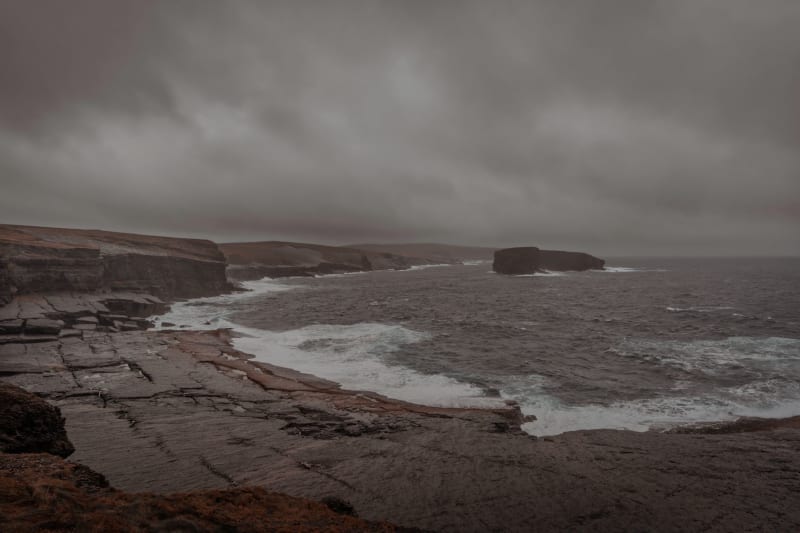
 Stromness
Orkney's westernmost port town, where a single flagstoned street unchanged since the whaling era runs beside a harbour that still smells of the sea.
Explore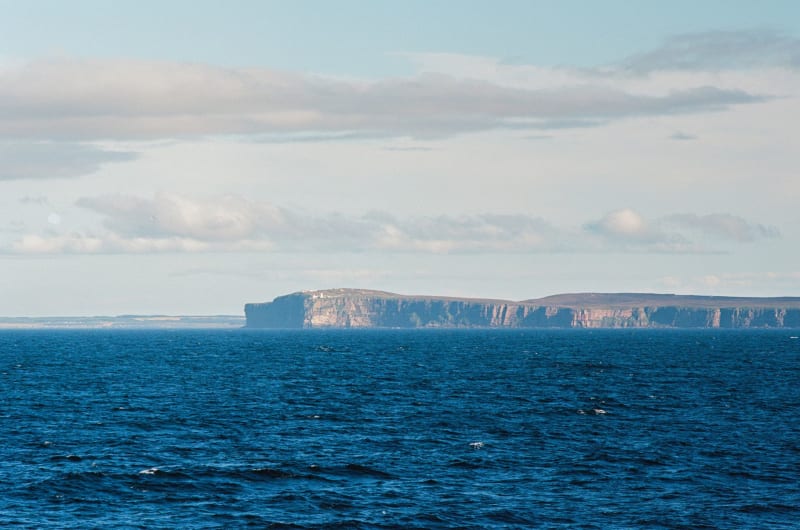 orkney-islands
 Westray
An outer Orkney island where puffins nest at arm's length at Noup Head, a medieval tower house stands half-ruined above the fields, and the pace of life belongs to a different kind of time.
Explore orkney-islands
 Brough of Birsay
A tidal island of Pictish stones and Norse ruins, reachable only when the sea steps back twice a day.
Explore orkney-islands
 Hoy
Orkney's most dramatic island — steep hills, dark valleys, and the 137-metre Old Man of Hoy sea stack, a landscape that looks more Norse saga than Scottish guidebook.
Explore orkney-islands
 Italian Chapel
A corrugated iron Nissen hut that Italian prisoners of war transformed into an ornate baroque chapel using paint, scrap metal, and an intensity of homesickness that made something beautiful.
Explore orkney-islands
 Kirkwall
Orkney's Norse-named capital, where a twelfth-century sandstone cathedral of improbable grandeur presides over a town that takes its crab and its whisky with equal seriousness.
Explore