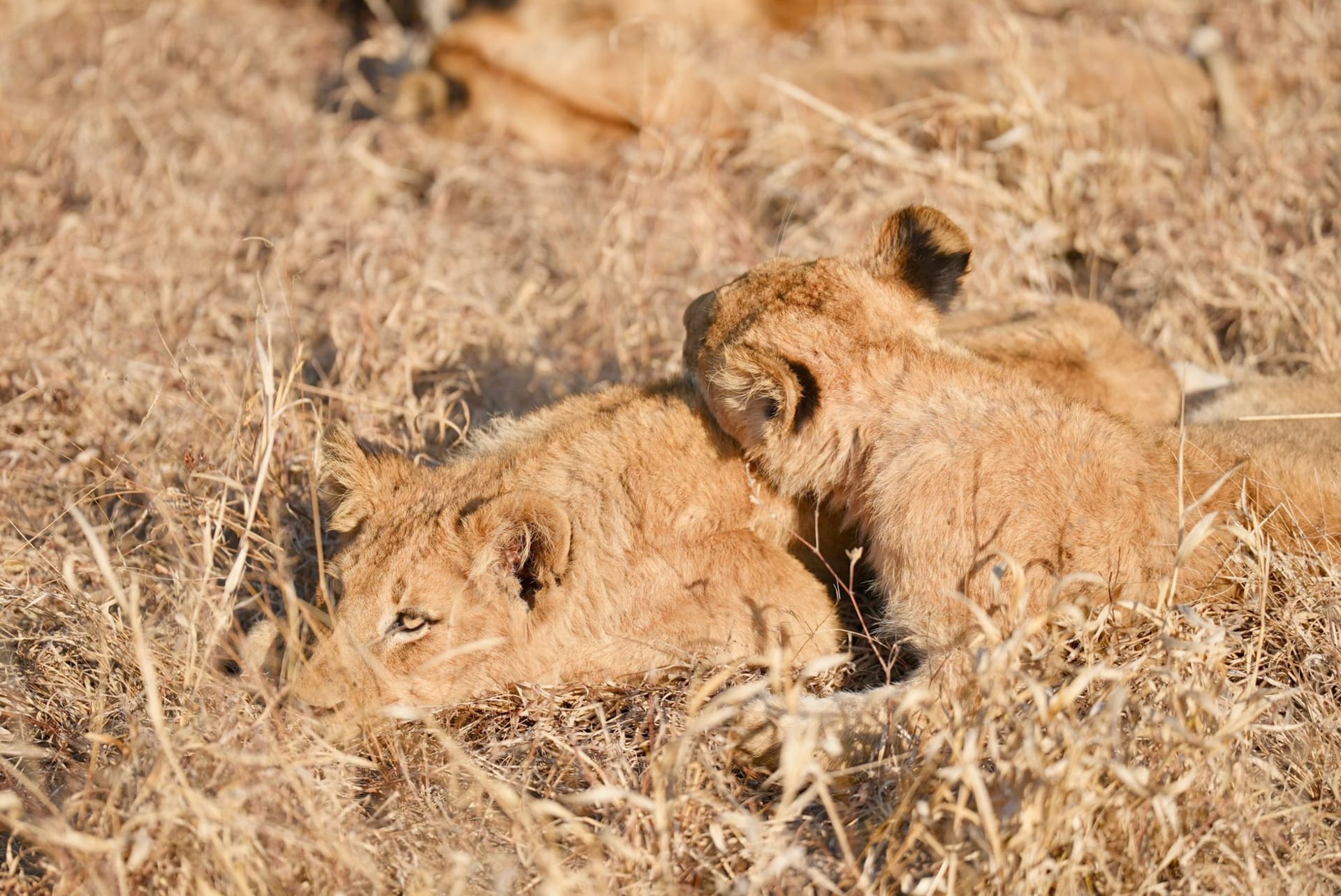
Duba Plains
"Out here the lions have learned to swim, and the buffalo have learned not to forgive. Nobody told me predators could be this patient."
Duba Plains sits at the top of the Okavango, a private concession reachable only by a small plane that banks low over a maze of channels and islands before dropping onto a strip of dried mud. We were met by our guide, who introduced himself, looked at the sky, and said we should hurry because the lions had crossed water at dawn and he wanted to find them before the heat shut everything down. That was the first hour. I understood very quickly that this was not a place that eased you in.
The famous war
What makes Duba Duba is the relationship between its lions and its buffalo. The filmmakers Dereck and Beverly Joubert spent years here documenting it, and the short version is this: the floodwater traps a large buffalo herd on the same islands as a pride of unusually large, water-adapted lionesses, and the two have been fighting an attritional, multi-generational war ever since. The lions here hunt in daylight, in water, which lions are not supposed to do. We watched a pride lying up in the shade of a fan palm, bellies heaving, and our guide pointed out the scars — long pale rake marks down flanks and faces where horns had found them.

Late that afternoon it actually happened in front of us. The herd, several hundred strong, came down to drink, and the lionesses peeled off the edge of it like something choreographed. The dust, the noise, the sheer mass of buffalo wheeling — it lasted perhaps ninety seconds and ended in a stalemate, the lions backing off, one of them limping. Lia did not take a single photograph. She told me afterward she forgot the camera was in her hands. I believe her, because so did I.
Water everywhere, and the small hours
The other thing about Duba is the water itself. This far north the flood is generous, and a great deal of the game viewing happens with the vehicle axle-deep in it, pushing a bow-wave through flooded grassland while red lechwe explode away in spray. We did a mokoro one morning — the dugout canoe poled through reed channels — and the change of scale was the point: from the high drama of the lion plains to a frog the size of a thumbnail clinging to a papyrus stem, six inches from my face.

At night the camp is unfenced, and that is when the place truly lands. I lay awake the first night listening to lions calling across the water, the sound carrying flat and enormous over the flooded plains, and a hippo grazing somewhere uncomfortably close to the tent. Lia slept through all of it. I did not. I have rarely been so happy to be awake.
When to go: May to September is the dry season and the peak of the annual flood — counterintuitively, the water is highest when the rains have stopped, because it has travelled down from the Angolan highlands. This is when the predator-prey concentration is at its most intense. It is remote, fly-in only, and not cheap, but few places on earth deliver wildlife this raw.