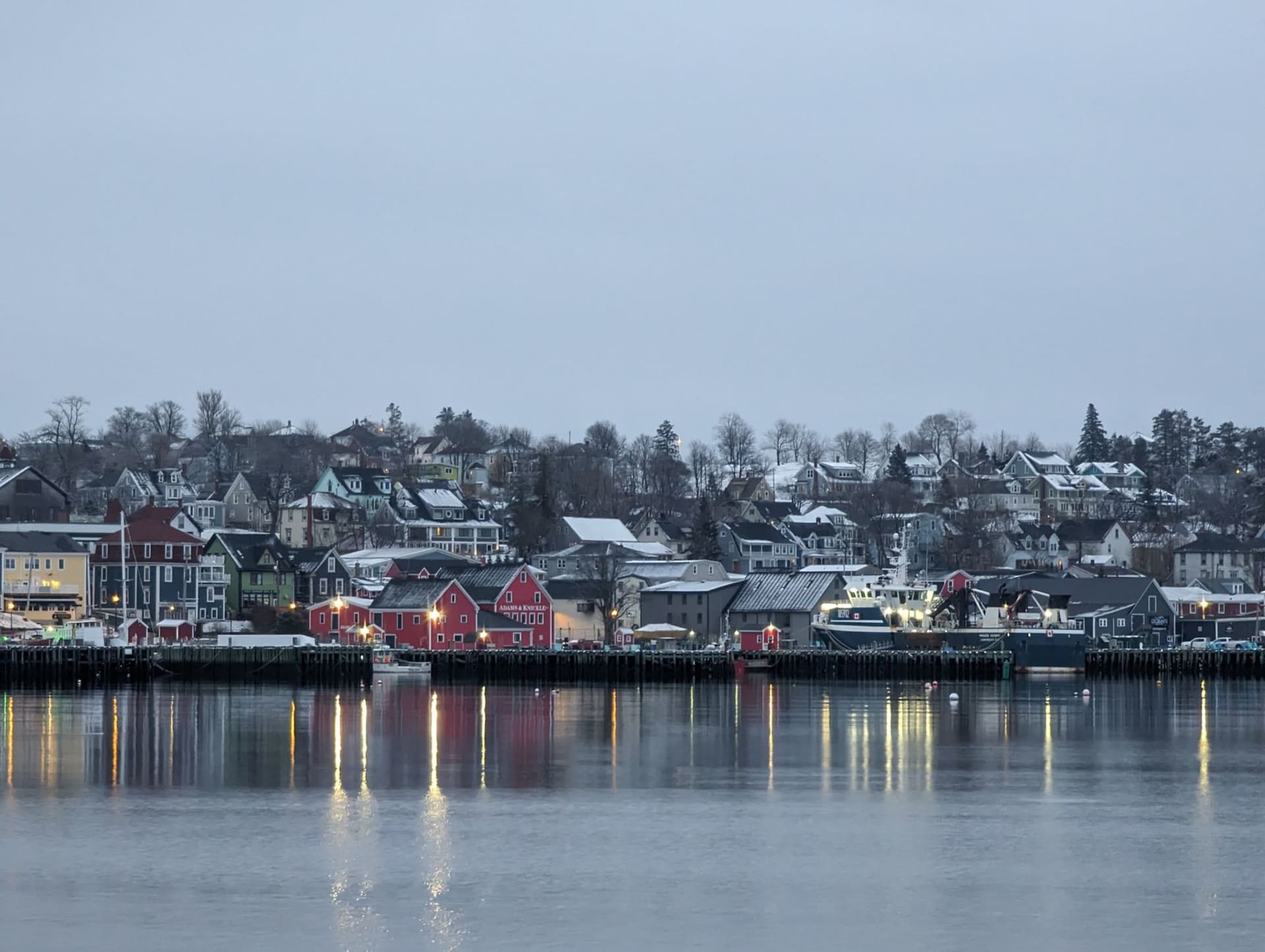
Lunenburg
"The Bluenose II is docked here when she's not at sea, and I walked around her twice before I noticed I was doing so."
I came over the hill on the approach from Bridgewater and the town appeared below me like an argument for colour — red houses, yellow houses, green houses, deep blue trim, all of them climbing the ridge from the harbour in a cascade that managed to look both Victorian and almost Scandinavian at the same time. Lunenburg is a UNESCO World Heritage Site and it has earned that designation not through preservation but through a kind of collective agreement among its residents to keep building and painting as their German Protestant ancestors did when they arrived here in 1753. The result is the most beautiful small town on the Atlantic coast, and it knows it, and you forgive it for knowing it because the thing itself is genuinely extraordinary.

The Fisheries Museum of the Atlantic sits on the waterfront and is one of those museums that makes three hours feel like thirty minutes. The exhibits on the Grand Banks cod fishery — the dories, the trawl lines, the photographs of men hauling ice-stiffened nets at four in the morning — carry the particular weight of an industry that destroyed itself through its own success. Downstairs, you can walk through a restored saltbank schooner and understand how men lived at sea for weeks at a time in spaces not much larger than a generous wardrobe. The Bluenose II, the replica of Nova Scotia’s famous racing schooner, is sometimes docked here when not on tour — a 143-foot wooden vessel of such sheer elegance that I walked around it twice before I noticed I was doing so.
The food in Lunenburg is unpretentious and excellent. Lunenburg sausage is a local institution — a dense, heavily spiced smoked sausage of German origin that you can buy at the fishmonger in vacuum bags or order at any diner in town, usually with eggs and rye toast. Solomon Gundy — pickled herring with onions — appears on every menu and rewards the adventurous. The smokehouse on the harbour road does finnan haddie, smoked haddock that tastes like it was invented specifically to eat with a cup of strong tea on a grey morning, which is most mornings here. At night, the restaurants along Montague Street fill with local fishers and visiting sailors, and the conversations tend toward the ocean.

The architecture rewards prolonged attention. The “Lunenburg bump” — the five-sided dormer window that protrudes from the second storey of the oldest houses — is a local idiosyncrasy that appears on dozens of buildings, and walking the streets looking for variations on it is an excellent way to spend a slow morning. The colour combinations are not accidental: the original settlers brought Germanic colour traditions with them, and successive generations have been updating rather than departing from them, which gives the town a chromatic coherence that no heritage committee could have engineered.
When to go: June through September offers the best weather and the town at its most alive. The Folk Harbour Festival in August draws musicians from across the Maritime provinces and turns the waterfront into a weekend of unexpected late-night sessions. September is quieter but deeply pleasant — the tour buses thin and you can walk the streets at your own pace.