
Grand Pré
"Some places don't need ruins to make you feel the weight of what happened there."
A windswept UNESCO landscape of reclaimed marshland and a memorial church where I felt Acadian history under my feet.
I almost drove past Grand Pré. There’s no dramatic sign, no crowd pulling you off the highway — just a turn into the Annapolis Valley and suddenly Lia and I were parked beside a field so flat and so green it looked unreal, like someone had ironed the landscape. We didn’t know yet that we were standing on top of three centuries of human engineering. The dykelands here were built starting in the 1680s, when Acadian settlers used a technique called aboiteau — wooden sluices that let fresh water out at low tide but kept the Bay of Fundy’s brutal tides from flooding back in. I’d read about it before coming, but it’s the kind of thing you only really understand once you’re standing on the dyke itself, watching the marsh grass ripple in a wind that never seems to stop.
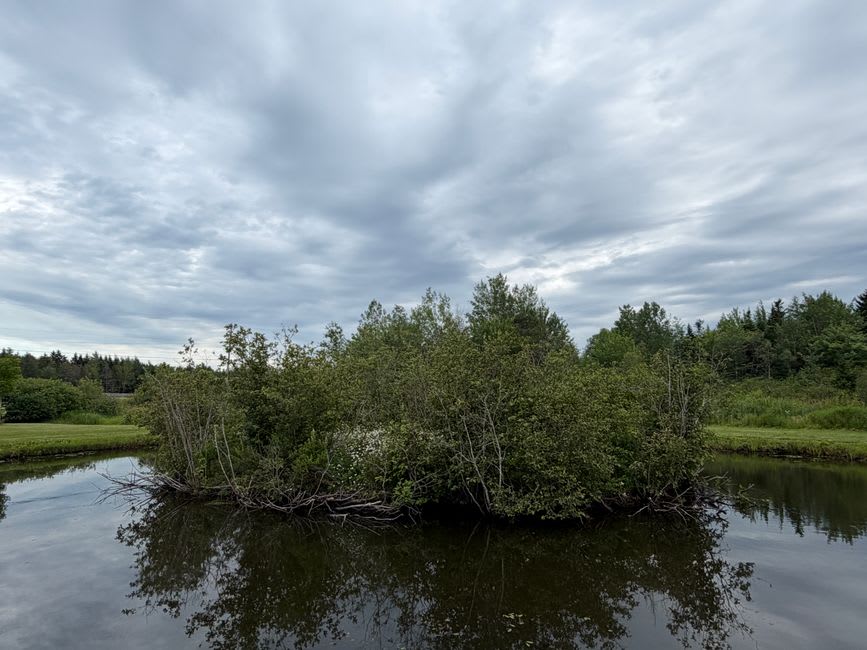
We walked the trails for almost two hours, and it was quiet in a way that felt deliberate, like the land itself was asking for it. That quiet made sense once we reached the memorial church, built in 1922 on the site of the old Acadian village. It’s not a real church — no services are held there — it’s a memorial, and inside it, the story of the Grand Dérangement is laid out plainly: in 1755, British forces expelled thousands of Acadians from this exact ground, tearing families apart and scattering them across the Atlantic world. Lia stood a long time in front of the Evangeline statue outside, the character Longfellow invented in his 1847 poem to give the expulsion a human face for readers who’d never heard of Nova Scotia. I’m French, and I’ll admit I hadn’t grown up with this story at all — it hit differently learning it standing on the actual soil.
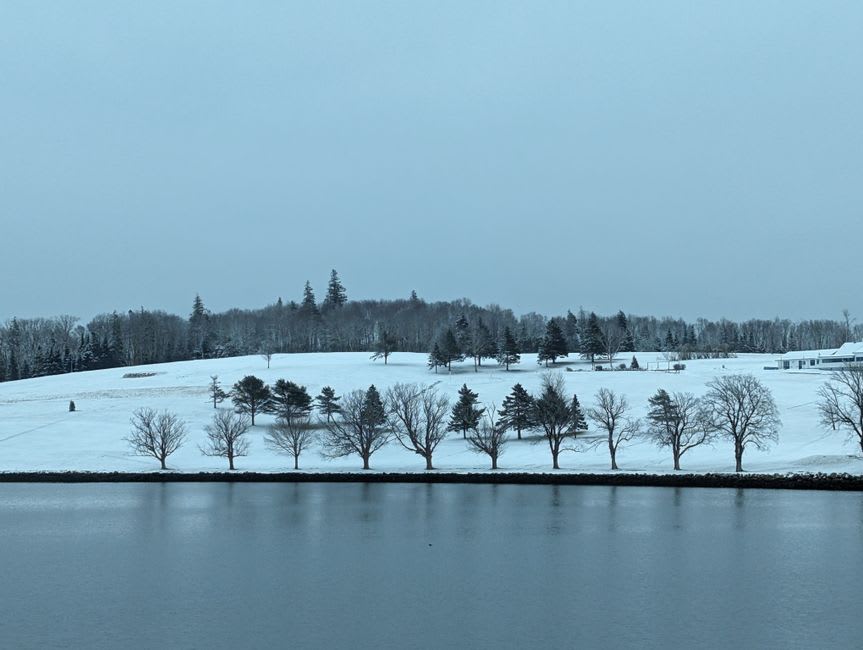
What stayed with me most, though, wasn’t the church or even the statue — it was realizing that parts of those same dykelands are still farmed today. This isn’t a preserved museum landscape; it’s one of the oldest continuously worked reclaimed marshlands in North America, still doing exactly what it was built to do. We ate a picnic lunch near the gardens, bread and cheese we’d bought that morning in Wolfville, and talked about how strange it is that a farming technique from the 1680s outlived the very community that invented it.
When to go: I’d aim for June through September, when the gardens are in full bloom and the dykeland trails are dry and easy to walk — Nova Scotia’s shoulder seasons here can be wet and the wind off the Fundy tides turns sharp fast.