Philae
"They moved an entire temple to save it from a lake, and it still feels exactly like it belongs where it is."
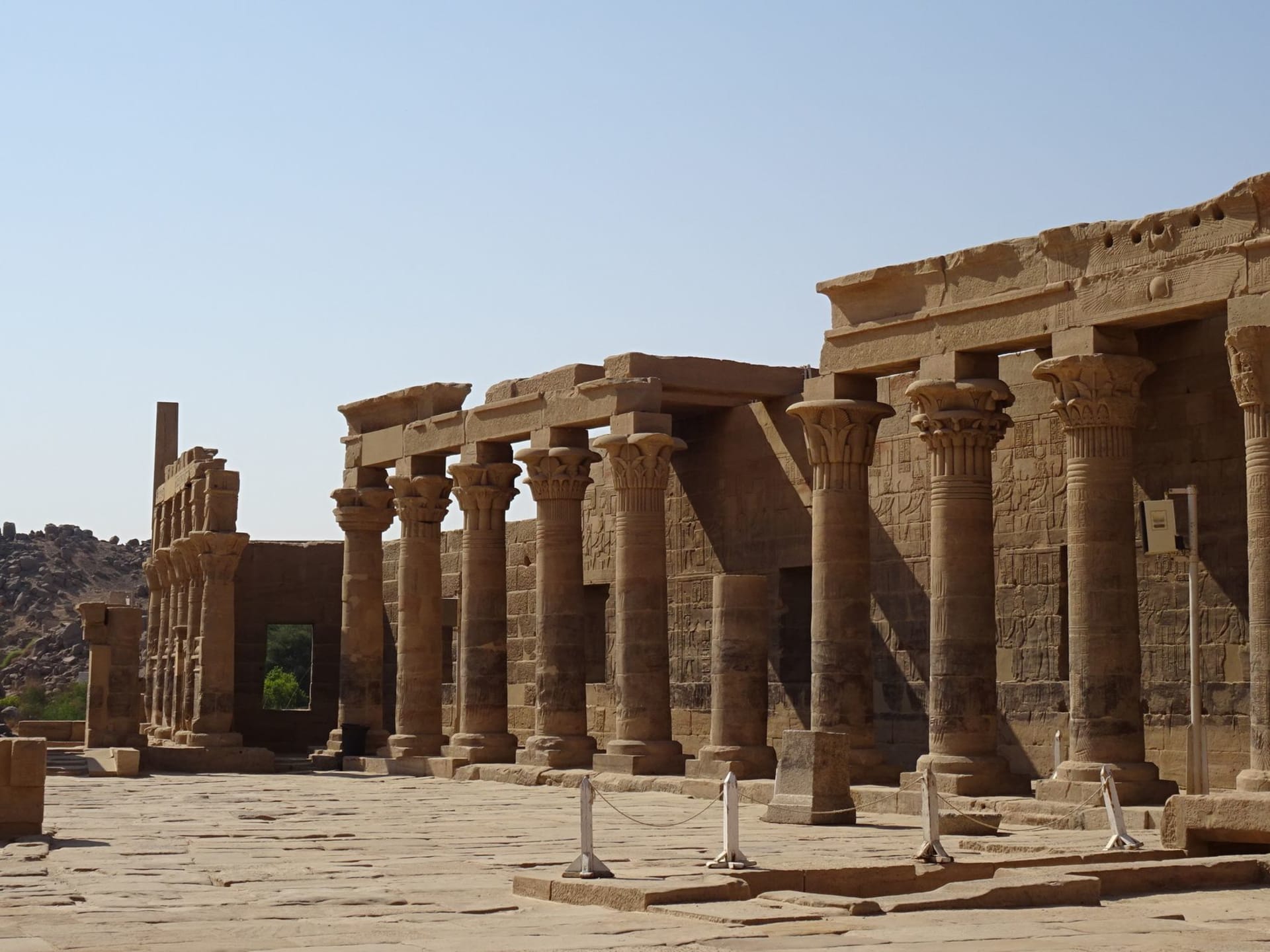
The boats leave from a dock south of the High Dam, a small fleet of motorboats jockeying for position in the narrow channel between granite islands. My captain gunned the engine and we shot out into the reservoir, and for a moment there was nothing to see — grey water, granite outcrops, a sky the colour of old pewter in the early evening light. Then Agilkia Island came around a bend and the temple appeared: a colonnade running along the waterline, pylons rising behind it, a single palm framing the whole composition in a way that felt staged and was not. I understood, in that moment, why the Egyptians built their temples precisely where they did.

The temple of Philae was originally on a different island — Philae itself, now permanently flooded by the waters of the Aswan Low Dam completed in 1902. For most of the twentieth century, Philae spent eight months of each year partially submerged, the water rising to the cornice of the lower columns before dropping again with the season. The UNESCO operation that moved it in the 1970s remains one of the great feats of archaeological logistics: the temples and smaller structures dismantled stone by stone, each piece numbered and recorded, and reassembled on Agilkia Island above the water line. The island was reshaped by blasting to approximate the original topography. The result is uncanny — a temple that was built elsewhere, moved to survive, and now feels as if it grew from its new island naturally.
The cult at Philae was dedicated to Isis — the last surviving ancient temple to receive active religious use, still functioning as a place of worship well into the Christian era. The Roman emperors Augustus and Tiberius added their cartouches to the walls. The last dated hieroglyphic inscription anywhere in the world was carved at Philae in 394 AD, after which the old writing system died within a generation. The walls hold that extinction in them quietly — the final sighs of a visual language that had lasted three thousand years.

I stayed past closing time — the guard was kind about it, or distracted, and I gave him a cigarette and he gave me another hour — and watched the light go from gold to rose to grey across the water. At full dark the Sound and Light show begins, and even if the narration is a little theatrical, the colours projected across the colonnade at night are worth staying for once.
When to go: The boat trip is at its best in the late afternoon when the light on the water is extraordinary. Come between November and February. The site closes during Sound and Light performances on some evenings; check schedules at the dam jetty before you go.