Africa
Nile Valley
"The river is still moving. Everything else here has been still for four thousand years."
The felucca had been drifting south for three hours when the temple appeared. No signpost, no entrance gate, just a cluster of stone columns rising from the east bank in the late afternoon gold, close enough that I could make out the carved figures still standing in their ancient procession along the wall. The captain didn’t slow down. For him it was scenery. For me it was the moment the Nile Valley stopped being a concept from a history textbook and became a place I was actually floating through — a corridor of human time so long and so dense that monuments appear by the river the way billboards appear on a highway.
The Nile Valley between Luxor and Aswan is the richest stretch of archaeological real estate on the planet. Karnak at dawn, before the tour groups arrive with their headsets and their fifteen-minute stops, is cavernous and overwhelming in the proper sense — you feel small in it, reduced to the correct scale. The hypostyle hall has a hundred and thirty-four columns, each one wider than a grown man can wrap his arms around, and standing among them while the first light comes sideways through the gaps produces something close to vertigo. Across the river, the Valley of the Kings is built into the limestone cliffs in a way that took me a beat to understand: tombs dug vertically downward, the art covering the underground walls as vividly as anything above ground — vivid blues and ochres and the crisp black outlines of hieroglyphs that look freshly painted. The desert heat that kills tourists also desiccates and preserves. Nothing rots here.
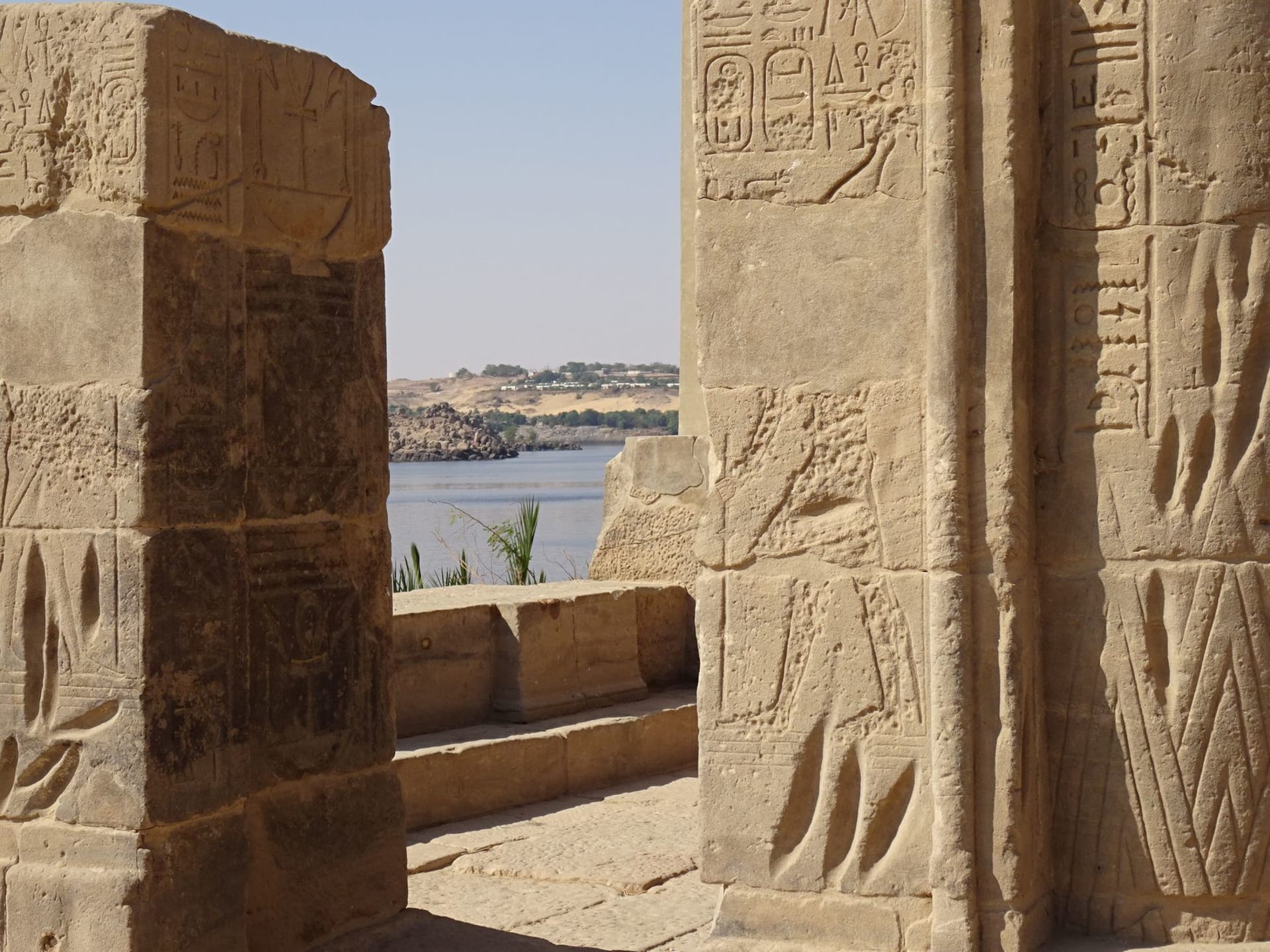
Aswan operates at a different frequency. The city is softer, more Nubian in character — painted houses in pink and turquoise, perfume markets replacing papyrus shops, granite boulders breaking the river’s surface in ways that slow the current to something almost languid. The island temple of Philae, moved stone by stone when the High Dam flooded its original site, sits on Agilkia Island like a footnote to the engineering of the ancients that is itself a feat of modern engineering. I arrived by motorboat at dusk and stayed past dark, long after the other visitors had gone, watching the lights come on across the water with a small glass of karkadé — hibiscus tea, cold, served everywhere here and tasting of nothing you could buy back home.
When to go: October through March is the only rational window for the Upper Nile — summer temperatures in Aswan regularly pass 45 degrees Celsius and the heat is not metaphorical. December and January are peak season with cooler nights and the clearest skies; if you can go in late October or early November you get the same light with significantly thinner crowds.
What most guides get wrong: They treat the Nile as transport between monuments when it is the destination itself. Every five-day Egypt package I have ever seen is a checklist of sites connected by air-conditioned buses. The actual experience lives on the water — a two or three-day felucca sail between Aswan and Edfu, camping on the riverbank, waking up to silence and herons. That is the Nile Valley. The temples are the punctuation; the river is the sentence.