Esna
"The temple is not in the town. The town grew up around the temple until it swallowed it whole."
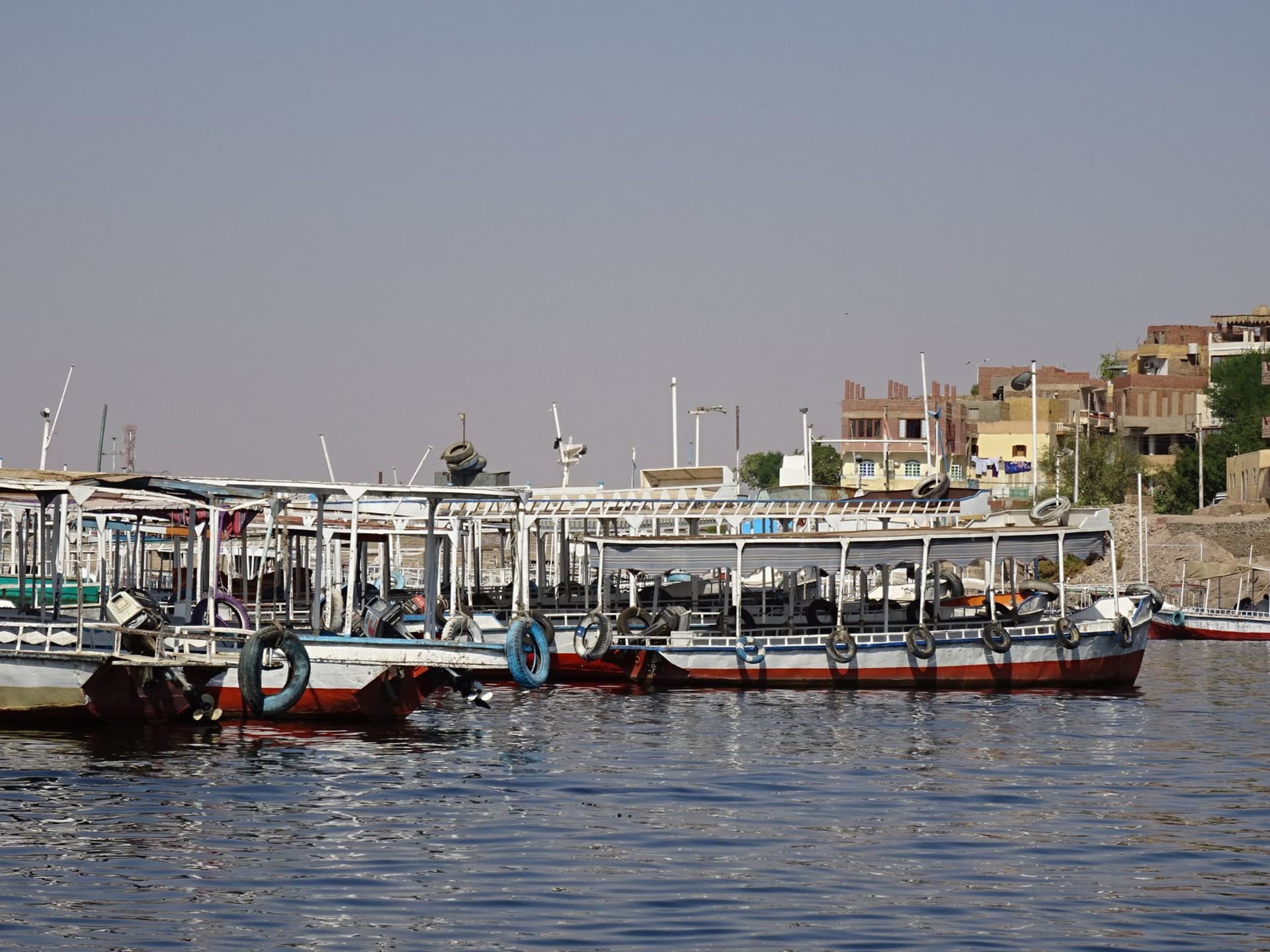
Esna is where the Nile cruise ships slow for the lock. Every boat on this stretch of river must pass through it — a single lock chamber in the centre of town that can only process one vessel at a time, creating queues that sometimes stretch for hours and that turn the Corniche into a parade of idle tourists watching each other from their decks. I arrived by service taxi from Luxor instead, from the landward side, and discovered that this is a real town — a mid-Nile market city of a hundred and thirty thousand people that happens to have a lock and a temple, in that order of daily importance.

The Temple of Khnum is what brings the cruise ships. It sits in an excavation pit at the centre of the old town, ten metres below street level, surrounded on all sides by buildings that grew up after the sand covered it and that now lean over it with a proprietorial intimacy. The excavated portion is the hypostyle hall only — the rest of the temple remains beneath the city, beneath shops and houses and alleyways, and will remain so for the foreseeable future. What is visible is a Ptolemaic and Roman addition built over an older structure, and its ceiling is the most elaborately decorated I encountered anywhere in the Nile Valley: astronomical calendars, festival lists, zodiacs, images of Khnum at his potter’s wheel fashioning the bodies of kings from clay. The columns have retained colour that the exposed temples further north have lost to the open air — deep greens and blues, preserved by burial, now dazzling under the artificial lights strung between the column shafts.
The descent into the excavation pit is abrupt: stone steps leading down from the surrounding street directly into a different world. At the bottom, the noise of the market above — motorcycle engines, vendors calling prices, the general hum of a functioning town — becomes muffled and distant. The air is cooler. The smell changes to something older.

The market that fills the streets above the temple sells the things that the town needs rather than the things tourists want: live chickens, galabiyyas, fresh bread, vegetables from the surrounding farmland. I bought a mango from a cart near the temple entrance and ate it standing up, the juice running to my elbow, watching a family argue cheerfully with a fruit seller about price. The temple entrance was thirty metres away and completely ignored by everyone around me.
When to go: Esna works best as a half-day stop between Luxor and Edfu — either on a felucca trip or as a day excursion from Luxor by service taxi. The temple opens at six; arriving early puts you ahead of the cruise ship traffic that fills the lock by mid-morning. The market is most active before noon.