Abydos
"Every Egyptian who ever lived wanted to be buried here, or at least to have their name written on these walls."
Abydos requires effort. It is not on the Nile cruise circuit in any meaningful way — a detour of some ninety kilometres from the river, northwest into the desert edge, accessible by service taxi from Luxor if you are patient with the logistics or by private car if you are not. I went by service taxi, which involved waiting forty minutes in Luxor’s main taxi square until enough passengers arrived for the driver to consider the trip worthwhile, and then driving into a landscape that felt increasingly old in ways difficult to articulate — flat farmland giving way to desert edge, the cliffs getting closer, the sky getting wider.

Abydos was the burial place of Egypt’s earliest kings — the first dynasty pharaohs lie in mastabas here, four thousand years old — and it became the legendary burial place of Osiris, god of the dead. That made it the most sacred site in Egypt for the entirety of Egyptian civilization: a place where every pharaoh wanted to leave a mark, and where every private person of means wanted to be buried or at least to have a memorial stele. The city of the dead at Abydos stretches for miles beneath the desert. The visible site is a fraction of what remains underground.
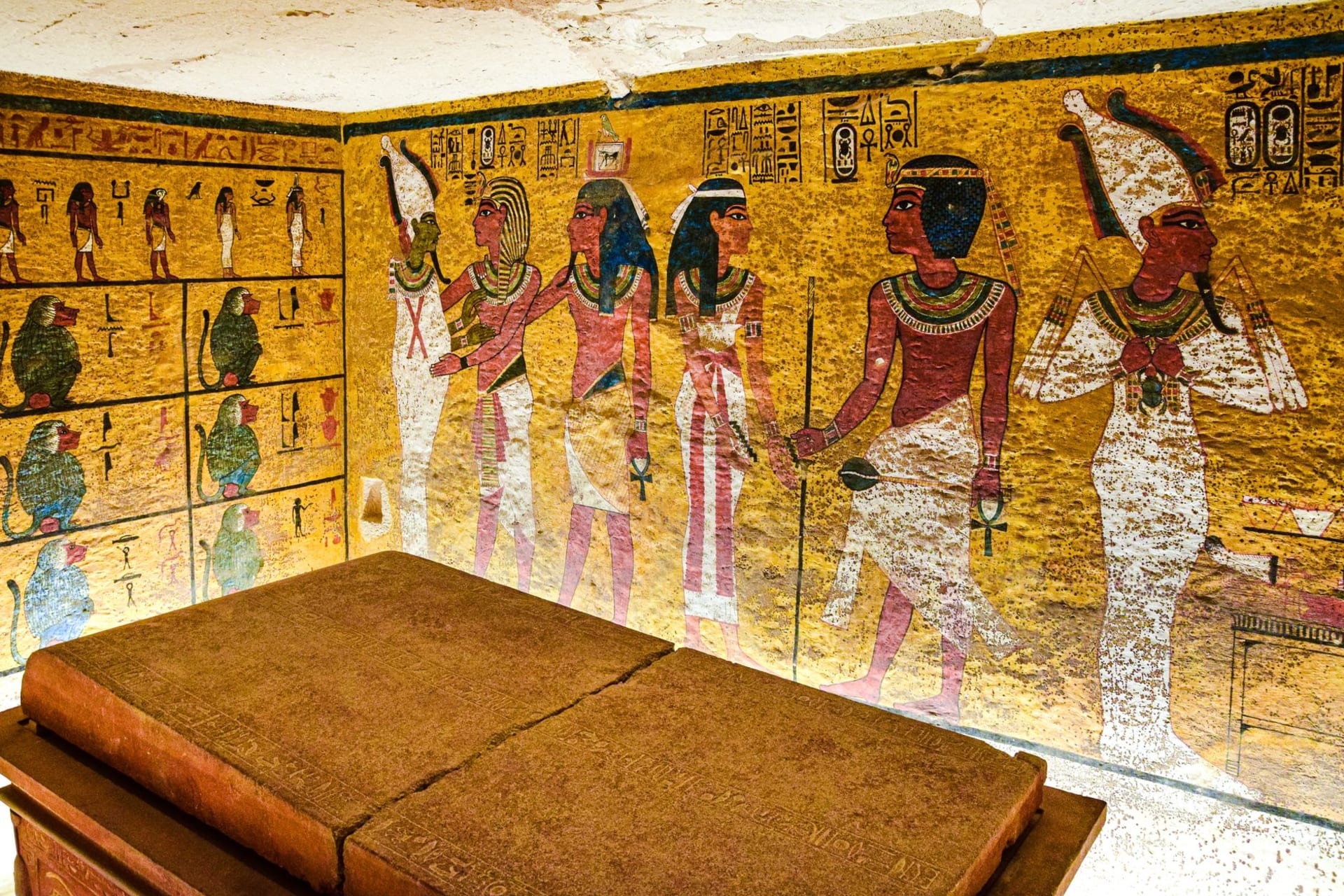
What survives most beautifully is the Temple of Seti I, built in the thirteenth century BC and containing some of the finest wall painting in Egypt. Seti was a meticulous patron — his artists worked slowly and carefully, and the colour and line quality in the hypostyle halls are, to my eye, superior to anything in Luxor. Blues of an impossible depth. A gallery of the sacred barques of seven gods, each image so precisely rendered that the details of the rigging are legible across three thousand years. And almost no one here — a guide explaining things to a couple of German travellers, a caretaker sweeping the same section of floor repeatedly. That absence of crowd changes everything about how a site receives you.

The Osireion, behind the main temple and only partially excavated, is stranger still — a subterranean structure of massive granite blocks, half-flooded with groundwater, oriented toward the desert, designed to replicate the primordial mound of creation. It looks like nothing else in Egypt: brutal, enormous, and inexplicably wet in a landscape that has never seen rain.
When to go: Any time between October and March, and ideally on a weekday when even the modest visitor numbers drop further. The site has minimal shade; come before eleven in the morning. The shared service taxi from Luxor is the cheapest option — the split fare is usually less than three dollars each way.