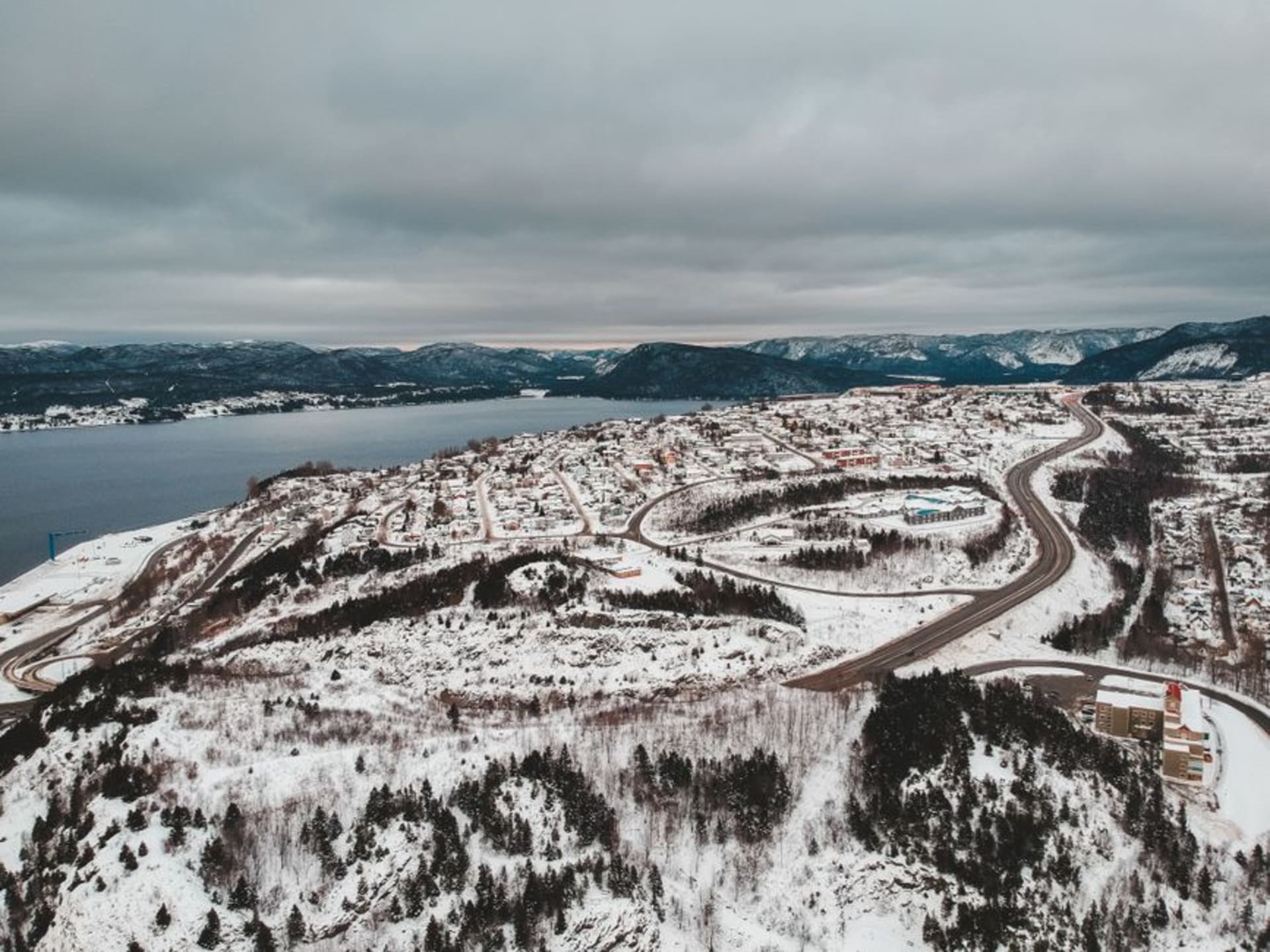
Corner Brook
"Corner Brook smells like paper and salt, and somehow that combination works."
A mill town wrapped around the Bay of Islands, where paper history, ski slopes, and the road to Gros Morne all meet.
We rolled into Corner Brook on a grey afternoon, and the first thing that hit us wasn’t the view — it was the smell. That faint, sulphurous tang of the pulp mill drifting over the whole city. Lia wrinkled her nose, but I found it strangely comforting, like the town was being honest with you about what it is. Corner Brook is Newfoundland’s second-largest city, and it exists almost entirely because of that mill, built in 1925 and once one of the largest newsprint operations on the planet. You can’t really understand this place without understanding paper.
We checked into a small guesthouse on a street that climbed steeply toward the water, and that evening we walked down to look at the Bay of Islands properly. The light was doing something soft and pewter-coloured over the water, and I kept thinking about James Cook charting this exact coastline in the 1760s, decades before he ever set eyes on Tahiti or Hawaii. There’s something humbling about standing where a career started, long before it became legendary. Lia pointed out a fishing boat working its way between two of the islands, and we just stood there for a while, not saying much.

The next morning we ducked into the Corner Brook Museum and Archives, housed in the old 1926 post office — a solid, dignified brick building that’s outlived several versions of the city around it. I remember standing in front of a display about the mill’s early workforce and feeling the scale of it: an entire city summoned into being by a paper company. Later, we drove up to Marble Mountain, which even in the off-season looked impressive, its runs cut into the hillside like pale scars. We didn’t ski — wrong month for that — but I made a mental note out loud, and Lia just laughed and said “obviously we’re coming back in winter.”

What I keep coming back to about Corner Brook is that it never tries to be quaint. It’s a working city that happens to sit in a spectacular place, and it’s also the last real town before Gros Morne swallows you into wilderness. We grabbed coffee and supplies there before heading north, and I was grateful for the practicality of it — no pretense, just a good base camp with a mill humming in the background.
When to go: Come between December and March if you want Marble Mountain’s slopes at their best, or June through September if Gros Morne is the real destination and Corner Brook is your launch point.