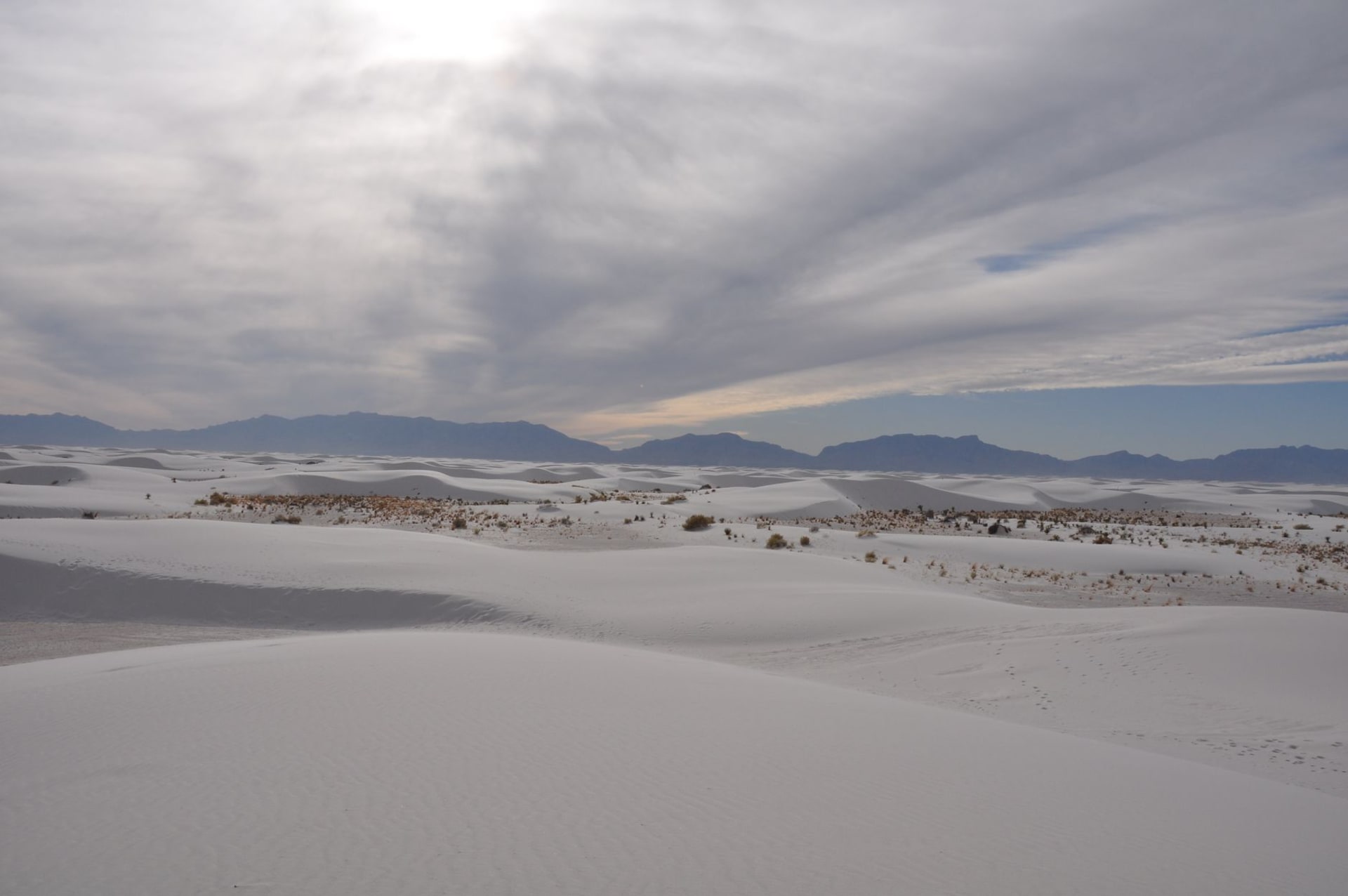
White Sands
"The dunes turned pink in fifteen minutes and I forgot I was anywhere I'd been before."
Nothing prepares you for the whiteness. I’d seen photographs — everyone has — but photographs do not carry the reflective intensity of midday sun on gypsum. I squinted even behind dark sunglasses. The dunes are made not of quartz sand but of selenite crystals dissolved from the surrounding mountains and deposited by an ancient lake, and the difference in color is total: these are bone-white, old-paper-white, the white of things bleached past all color. The road into the park cuts through a corridor of dunes that creep across it constantly, and the rangers have to plow it clear after windstorms. The dunes are moving. Everything here is in slow, patient motion.
I arrived in the late afternoon in October, which the ranger at the entrance station confirmed was correct timing without my asking. By four o’clock the tour buses were gone and the light was shifting from flat white to something more golden. I walked in from the Interdunes Boardwalk and then just kept going, off-trail into the dune field, which is permitted and somehow surprising for a national park. Within five minutes of walking the parking lot disappeared. There was no sound except wind. The air smelled of nothing — or of something I don’t have a word for, a mineral blankness.

The temperature drop that happens at sunset here is one of the more dramatic atmospheric shifts I’ve experienced. At five in the afternoon it was comfortable in a t-shirt. By six, with the sun touching the San Andres Mountains to the west, I was wishing for a jacket. The dunes turned pink first, then a pale mauve, then finally a cool blue-grey in the last light. I watched this sitting at the top of a dune I’d climbed mostly just to climb it, and I thought about the fact that this landscape is bisected by the White Sands Missile Range — that Trinity Site, where the first atomic bomb was tested in 1945, is forty-five kilometers north — and that the American desert has this habit of harboring both the ancient and the apocalyptic with equal indifference.
I ate green chile posole from a roadside stand outside Alamogordo on the drive back to Las Cruces. The woman running it ladled it from a pot into a styrofoam cup with a flour tortilla on the side. It was one of the best meals of the trip — the hominy swollen and tender, the pork in long shreds, the green chile carrying real heat that built slowly through the bowl. I stood by the car in the cooling desert dark and finished every drop.

The park has a back-country camping program — three designated sites in the dune field, no water, no facilities, just gypsum sand under your sleeping pad and the most light-pollution-free sky in the southern part of the state. I did not do this on my first visit but it is the thing I most want to return for. People who have done it describe waking at three in the morning to a sky so dense with stars that the dunes are faintly lit just by their collected light. I believe them.
When to go: October through April, avoiding peak summer heat when midday temperatures exceed 40°C and the dunes radiate heat from below as well as above. Sunset visits are reliably magical year-round. The full-moon nights in summer have a reputation — the park stays open late on those evenings and the dunes glow silver under moonlight — but bring water and start early.