
Twenty-seven white dishes on rails across a silent high desert basin, listening to galaxies too far to see.
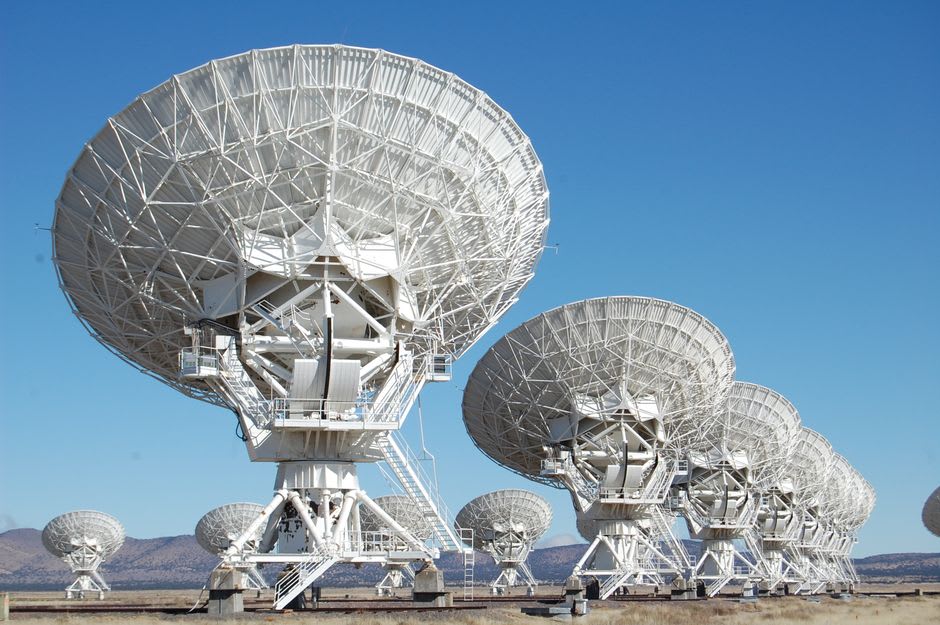
We drove west out of Socorro on a road so straight that Lia fell asleep before I’d even finished my coffee, and I almost woke her up twice just to say “look how empty this is.” The Plains of San Agustin do that to you — an ancient lakebed so flat and so wide that you can watch weather happen thirty kilometers away while you’re standing in sunshine. Then, without much warning, they appear: white dishes, each one a full 25 meters across, scattered across the basin like something dropped from orbit. I’d seen photos for years. Nothing prepared me for how they made the whole landscape feel like it was tilted toward the sky.
We parked at the visitor center and did the self-guided walking tour, which took us right up underneath one of the antennas — close enough to hear it creak faintly as it tracked. A ranger there told us the 27 dishes are arranged in a Y shape and can actually be moved along rail tracks, spread out to sharpen the array’s resolution or pulled in tight when a different kind of image is needed. Lia, who studied physics before she didn’t, spent a good ten minutes explaining interferometry to me while I nodded and mostly just stared upward.

What got me, honestly, wasn’t the science — it was the stillness. The National Radio Astronomy Observatory finished building this place in 1980, and since then it has helped astronomers study black holes and gravitational lensing, mapping galaxies and star nurseries in radio light nobody’s eyes could ever see. Standing there at over 2,100 meters, wind pushing against my jacket, I kept thinking about how much of the universe is loud in ways we’re simply not built to hear, and how someone had to build twenty-seven of these things in the middle of nowhere just to listen properly.
I’ll admit it too: part of why I wanted to come was Contact. I watched that movie as a teenager in Lyon, long before I imagined I’d ever stand under the real dishes, and walking the gravel path with Lia I kept catching myself humming its score. We ate cold empanadas from a cooler in the parking lot afterward, watching one antenna slowly rotate against the sunset, and it didn’t feel silly at all — it felt like exactly the right way to end the afternoon.
When to go: The walking tour is open year-round, but I’d time it for spring or fall — the high desert basin turns brutal in summer and bitter in winter, and you’ll want to linger, not hurry.