
Taos
"Taos sits at 7,000 feet and carries itself like it knows something the rest of the world hasn't figured out yet."
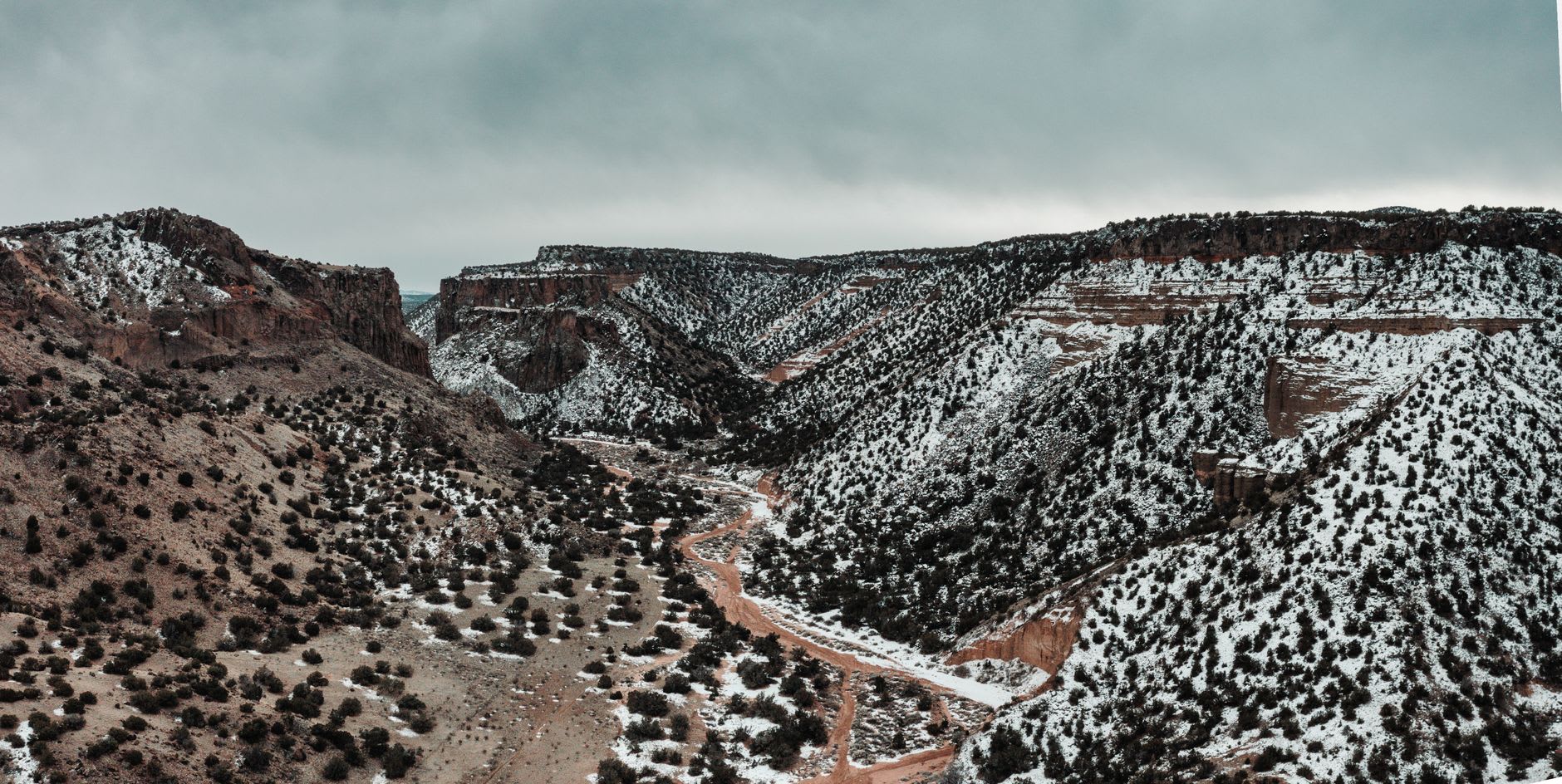
The drive to Taos from the south is its own preparation. You follow the Rio Grande Gorge north through high desert, and then you cross the bridge — the Taos Gorge Bridge — and the ground simply vanishes beneath you, a 180-meter drop to the brown ribbon of river below with almost no warning. I gripped the steering wheel a little harder, pulled to the overlook, and stood at the railing for longer than I’d planned. Then Taos proper materializes as you keep driving: low adobe buildings, a water tower, mountains behind everything. It is a small town that has absorbed an extraordinary amount of projection — artists, mystics, ski bums, retirees from somewhere more expensive — and remains fundamentally itself despite all of it.
The Taos art colony dates to 1898 when two painters broke down here on a wagon trip and just stayed. Something about the light, they said, and they were right. The Taos Society of Artists that formed after drew names like Ernest Blumenschein and Bert Phillips, then later DH Lawrence wrote here, and then the counterculture arrived in the sixties, and the tradition of people showing up to Taos and losing track of their original plans continues. The Harwood Museum of Art on Ledoux Street is where I spent a quiet morning, moving through rooms of Taos Society paintings and feeling the quality of attention those early artists brought to this landscape — the way they painted the light on the mountains as something categorical and permanent.
The Plaza itself is modest — smaller than Santa Fe’s, quieter, more worn. On the Sunday I arrived there was a farmer selling dried red chile ristras from the back of a pickup, a couple of galleries open early, and a restaurant doing green chile breakfast burritos through a small window. I ate one on a bench in the sun and watched an older man walk his dog in a slow circle, unbothered. This is Taos at its most honest: not the curated version, not the ski resort version, just a mountain town where people have figured out that the pace of the place is the point.
The mountains north of town offer a completely different register. Taos Ski Valley is forty-five minutes up the canyon and gets serious snow — some of the steepest in-bounds terrain in the United States, and a culture that still has the rough edges of a working mountain community. I went in late October, before snow, just to walk the trails above the valley floor. The aspens were in full color, shivering yellow in a cold wind, and the silence between gusts was absolute. I ate green chile stew at the lodge afterward and it was exactly right.

What Taos does that few small American towns manage is hold its contradictions without collapsing them. There are serious Pueblo communities nearby living as they have for centuries. There are tech workers who moved here for the fiber internet and the hiking. There are fourth-generation New Mexican families who have watched the town change around them with varying degrees of tolerance. There are galleries selling six-figure paintings beside shops selling handmade moccasins. The friction between these things is not uncomfortable — it generates a particular kind of aliveness that feels rare.
When to go: Late September through mid-October for the aspen color and harvest season. February through March for skiing with reliable snow and fewer crowds than Colorado resorts. Avoid the week of the Taos Art Festival in July if you want elbow room — though the festival itself is worth the crowd.