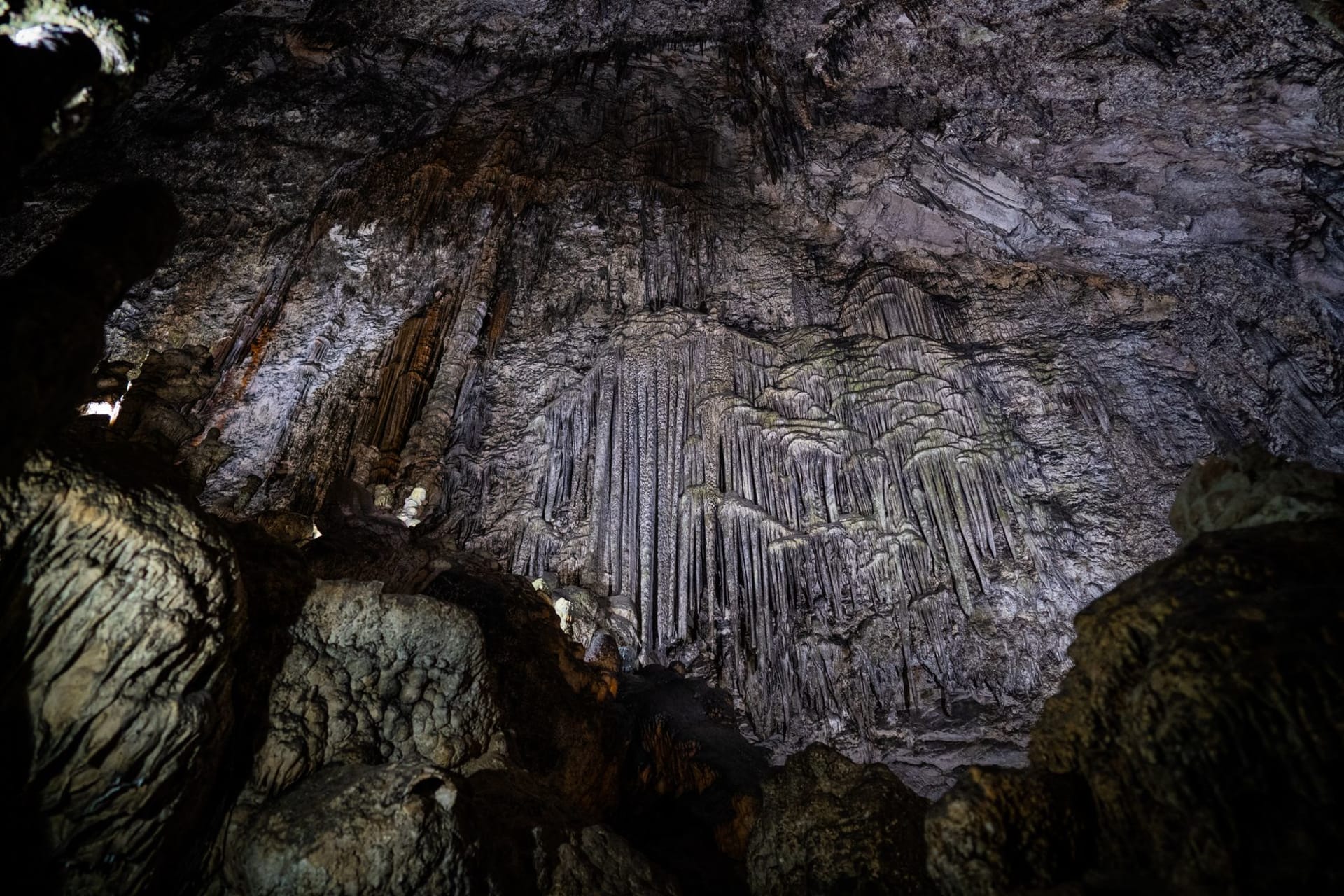
Carlsbad Caverns
"The bat flight at dusk is one of the most genuinely wild things I have seen in the American Southwest."
The southeastern corner of New Mexico is the part most visitors skip, the long highway miles between Texas and the more photographed landscapes to the north. I almost skipped it myself, and then I didn’t, and Carlsbad Caverns turned out to be one of the stranger and more affecting things I encountered in the entire state. The entrance is a natural opening in the Guadalupe Mountains at the end of a winding desert road, and you descend into it either by elevator (efficient) or by the natural entrance trail (correct). I took the trail. It spirals down 229 meters into the earth over about two kilometers, the light fading, the temperature dropping from desert heat to a constant 13°C, the scale shifting from human to geological over the course of thirty minutes of walking.
The Big Room at the bottom is 550 meters long and 230 meters wide. These are numbers that don’t mean much until you’re standing in it and trying to see the far end. The formations — stalactites dripping from the ceiling, stalagmites rising from the floor, columns where the two have met over millions of years — are lit with careful amber and blue lighting that feels respectful of the space rather than theatrical about it. I walked the perimeter trail in near-silence, in a room that had existed in total darkness for 250 million years before anyone thought to put a lightbulb in it.

But the bat flight. This is the thing I did not expect to feel the way I felt it. Every evening from late May through October, the Carlsbad Cavern colony of Mexican free-tailed bats — somewhere between 400,000 and 1 million of them — emerges from the cave entrance at dusk in a continuous spiral column that lasts for hours. There is a natural amphitheater of stone seating above the cave entrance, and visitors gather before sunset. A ranger gives a brief talk. Then silence. Then, just before dark, they begin: a clockwise vortex of bats rising from the cave mouth, widening as it ascends, the sound of their wings building from nothing to a rushing, papery roar. The column rises thirty meters into the air and heads south toward Texas and Mexico, hunting moths over the Chihuahuan Desert. It took over two hours for the full colony to leave.
I sat in the stone amphitheater the whole time. The light faded. The stars appeared. The bats kept coming. There is something in the sheer biomass of it — the understanding that this cave has been home to this colony for at least 5,000 years, that this nightly exodus has happened continuously since before any European set foot in the Americas — that recalibrates your sense of what the word “ancient” means.

The town of Carlsbad, forty-five minutes away, is an oil-and-gas town with motels and fast food and the particular flat pragmatism of extractive industry settlements. It is not charming, but it has good green chile if you know where to ask, and it puts you in position for an early start at the park before the tour buses arrive from El Paso and Albuquerque. I ate breakfast at a counter diner where the coffee came before I asked for it and the green chile eggs were exactly what I needed at six in the morning.
When to go: May through October for the bat flights — the colony is absent in winter. The cave itself is open year-round and is a relief in summer, holding its 13°C regardless of what is happening in the desert above. Arrive at the bat flight amphitheater at least an hour before sunset to get a seat, and check the NPS website for the estimated departure time, which changes nightly.