Acadia National Park
"Cadillac Mountain before dawn: the first light in the continental US falls on your face and you feel somehow responsible."
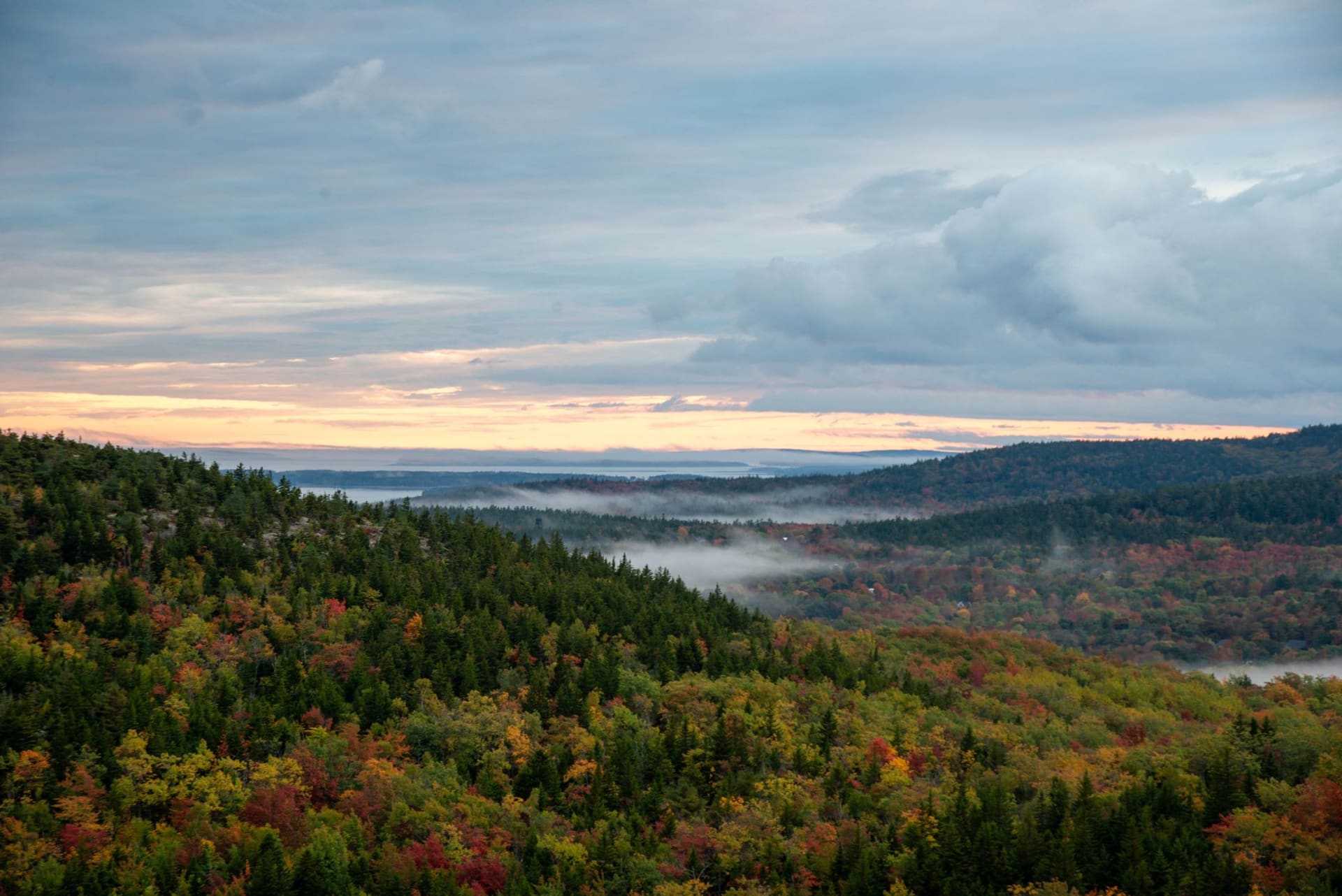
The alarm went off at three-forty-five in the morning and I genuinely considered not going. The Bar Harbor inn room was warm and the idea of driving up Cadillac Mountain in the dark with no guarantee that the clouds would cooperate seemed, in the specific logic of predawn, like an activity designed for other people. I went anyway. I drove the summit road in complete darkness, parked among maybe thirty other cars whose owners had made the same calculation, and stood at the summit railing in a cold that was somewhere between unpleasant and clarifying. Then the sky began to change in the east, over the water, and within twenty minutes the first light in the continental United States was falling on Frenchman Bay — all those dark islands and the cold Atlantic between them — and then on my face, and I stood there in the embarrassing grip of something that felt like gratitude.
Acadia is the only national park in New England, and it sits on Mount Desert Island off the Maine coast in a way that seems deliberately improbable: granite mountains rising directly from the sea, their faces pink and gray and wet with sea spray, the forest between them dense and dark. The park covers most of the island and includes the surrounding waters, and John D. Rockefeller Jr. spent decades building the carriage roads — fifty-seven miles of broken-stone paths closed to motor vehicles — that let you move through the interior at a pace that matches the landscape. I walked the Jordan Pond loop early one morning when the mist was still on the water and the birches around the pond were bright yellow against the dark conifers. The surface of the pond was perfectly still. A loon called once and then went quiet.

The popovers at the Jordan Pond House are famous enough that they require a reservation for the afternoon tea service, which is a very particular kind of famous for a national park restaurant. I ate there at midday — a table on the lawn with a view of the pond and the Bubbles mountains — and the popovers came out enormous and hollow and still steaming, with strawberry jam and butter, and they were good in the specific way of things that have been made the same way in the same place for a very long time. It would be easy to be ironic about this. I chose not to be.

Bar Harbor is the gateway town and it handles the role with varying degrees of grace. In peak summer it is densely crowded and the cruise ships anchor in the harbor and the main street becomes difficult. In September it returns to something more itself — the restaurants calm down, the lobster rolls at the shacks near the pier are easier to get, and the town’s genuine charm (Victorian cottages, the village green, the views across the harbor to the Porcupine Islands) becomes apparent again. I spent two evenings on the pier watching the light go off the water and eating things I had to bib for. There are worse rhythms.
When to go: June and September are the optimal windows — full services open, manageable crowds, Cadillac Mountain sunrise reservations available. July and August are crowded beyond comfort. October is spectacular but some services close early. Winter closes the summit road but the carriage trails and coastal paths remain, and Mount Desert Island in February is an entirely different, severe, and rewarding experience.