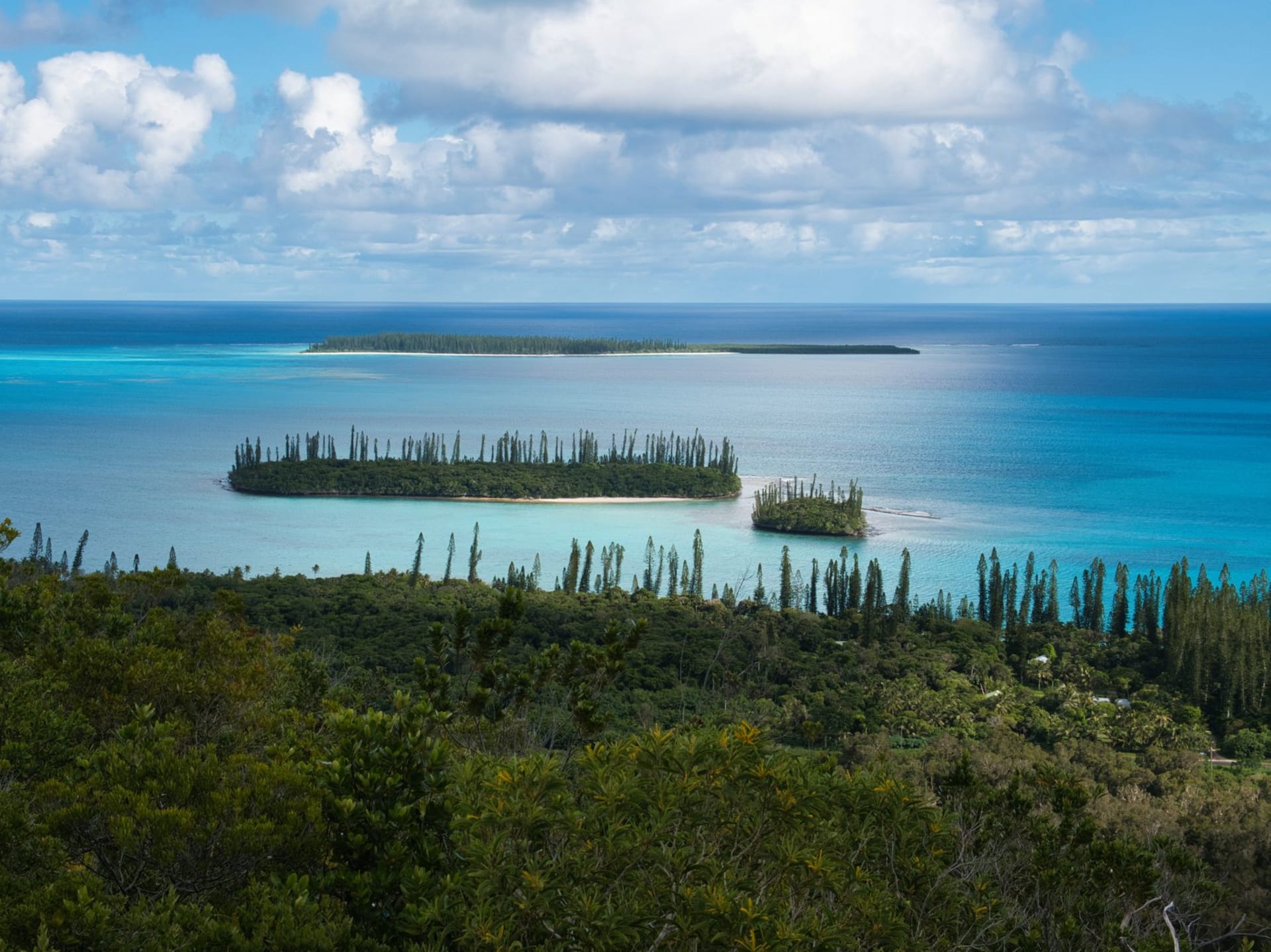
Yaté
"The Blue River earns its name in a way that makes you wonder why other rivers don't bother."
I drove south from Nouméa on a Sunday morning with no particular plan and ended up at the Yaté reservoir by early afternoon, the road having gradually shed its suburban character and replaced it with something more elemental — red laterite escarpments rising on one side, the river valley opening on the other, the vegetation thickening into something that felt genuinely primary. The Yaté region is one of the least-visited parts of Grande Terre among tourists, which means that on the day I was there, I was essentially alone with about three thousand square kilometres of landscape.
The Blue River — the Rivière Bleue in French, and the name really is that literal — gets its colour from the minerals it carries down from the nickel-rich soils of the mountains above the park. In certain light conditions, particularly in the morning and in overcast weather, the colour is extraordinary: a milky, opaque turquoise that is nothing like the clear blue of the lagoon. It is the colour of glacial rivers, except that you are in the tropics and the water is warm and the valley around it is filled with tree ferns the height of telephone poles. The cognitive dissonance is quietly wonderful.

The Provincial Park that surrounds the Blue River — Parc Provincial de la Rivière Bleue — protects a large area of the southern massif and is one of the best places in New Caledonia to encounter the cagou, the country’s national bird. The cagou is flightless, about the size of a small chicken, and utterly indifferent to human presence in a way that suggests it has not yet learned that this is historically a poor survival strategy. I saw three of them on the main trail through the park, each time at close range, each time without any apparent alarm on the bird’s part. They make a barking call — a sound that has no ornithological precedent in my experience — and they have a crest of feathers that they raise when startled, which gives them a permanently theatrical air.
The Yaté dam sits at the north end of the valley and creates the large reservoir that supplies much of Nouméa’s power. The drive along the dam road offers a different kind of view — the reservoir spreading into the hills in fingers and inlets, the surface reflecting the sky, the surrounding forest dropping directly to the water’s edge. I stopped at an unmarked pullout and sat there for half an hour watching a family of waterbirds work the shallows below the dam wall.

The indigenous community at Yaté village, on the lagoon side of the valley, manages a small boutique and cultural site where traditional crafts — baskets woven from pandanus, wood carvings, pottery — are sold at prices that reflect the labour involved rather than tourist expectations about Pacific craft markets. I bought a small basket there, compact and precise in its weave, and the woman who sold it to me demonstrated how it was made using a small offcut of pandanus leaf, her fingers moving with the particular efficiency of someone for whom the technique is entirely embodied.
When to go: April through October is the dry season and the best window for the park trails. The Blue River is at its most vivid colour in the dry months when the water runs clear and mineral-dense. Allow a full day from Nouméa — the drive is about an hour each way, and the park deserves at least four hours on the ground to be worth the journey.