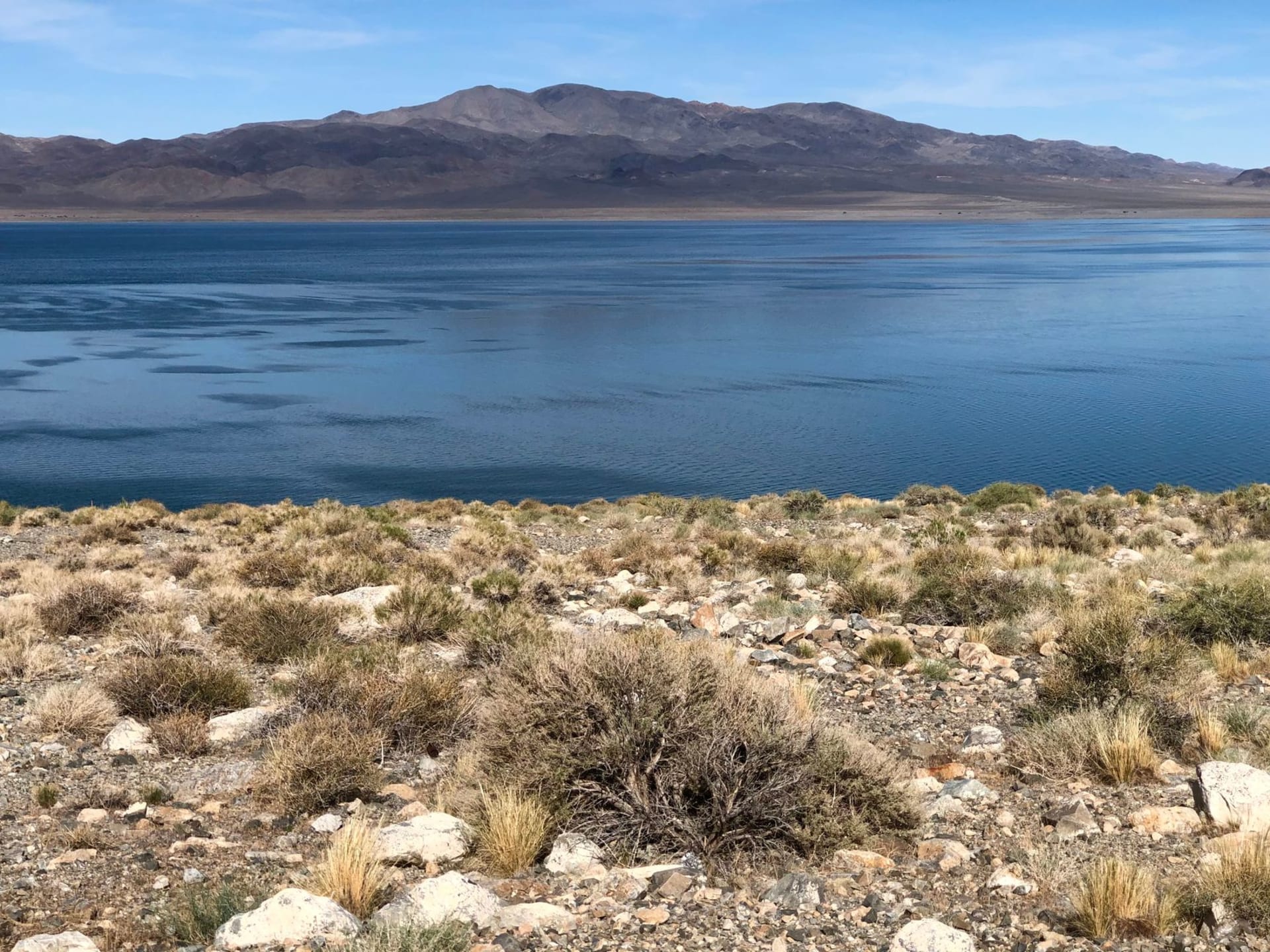
Pyramid Lake
"It is the largest body of water for hundreds of miles, and when I reached the shore there was no one there but a man fishing and the wind."
About forty minutes north of Reno the suburbs give out, the casinos fall behind, and the road drops down toward something that the desert has no business holding: a lake the size of a small sea, deep blue and entirely silent, sitting in a basin of bare brown hills. The first time you see Pyramid Lake it does not look real. It looks like a backdrop someone forgot to remove. I pulled over at the overlook and stood there for a while trying to reconcile the water with the absolute aridity of everything around it.
The lake sits entirely within the Pyramid Lake Paiute Reservation, and that fact shapes everything about visiting. There are no resorts, no jet-ski rentals, no boardwalk. You buy a permit from the tribe — for day use, for fishing, for camping — and in exchange you get one of the emptiest and strangest landscapes in the American West, looked after by the people who have lived beside it for a very long time. It is a remnant of ancient Lake Lahontan, which once covered much of this part of Nevada, and the high-water lines of that vanished lake are still visible as terraces on the surrounding hills.
The pyramid and the tufa
The lake takes its name from a tufa formation on the eastern shore, a great pale pyramid of calcium carbonate that the explorer John C. Frémont named in 1844. Tufa forms underwater, where mineral-rich springs meet the lake, building up over centuries into towers and knobs and reefs. As the lake level has dropped, more of it has emerged, so the shoreline is studded with these strange porous formations that look organic and geological at the same time — like coral, like bone, like something grown rather than deposited.

Near the formation called the Stone Mother there is a cluster of tufa that, according to Paiute tradition, is a grieving mother turned to stone with her basket of tears beside her, the tears having become the lake itself. I am wary of repeating sacred stories I only half understand, so I will leave it there, except to say that standing among those formations on a windless evening, with the water gone glassy and the light failing, the story did not feel like a metaphor. It felt like a reasonable account of the place.
Fishing, swimming, and the great silence
Pyramid Lake is famous among anglers for the Lahontan cutthroat trout, a giant native fish that was once thought extinct here and was painstakingly brought back. In winter you will see fishermen standing on stepladders in the shallows, casting into the cold, a sight so absurd that I assumed it was a local joke until someone explained the logic of getting a better casting angle over the drop-off. I did not fish. I swam, briefly, in water that was colder than the desert sun had led me to expect, and then I sat on the shore and ate a sandwich in a silence so total it had a texture.

There is almost nothing to do here in the conventional sense, which is the entire appeal. Lia and I drove the road along the western shore until the pavement ran out, stopped wherever a view demanded it, and saw perhaps three other vehicles all afternoon. For a lake this large, this close to a city, that emptiness is something close to a miracle.
When to go
Spring and autumn are most comfortable, with mild days and the desert light at its best. Summer is hot and the water warms enough for pleasant swimming, while winter is the prime fishing season for the big cutthroat trout, though it brings genuine cold and wind. Buy your day-use and fishing permits from the Pyramid Lake Paiute Tribe before you go, respect the marked areas and any closures around sacred sites, and bring everything you need — there are no services to speak of once you leave the highway.