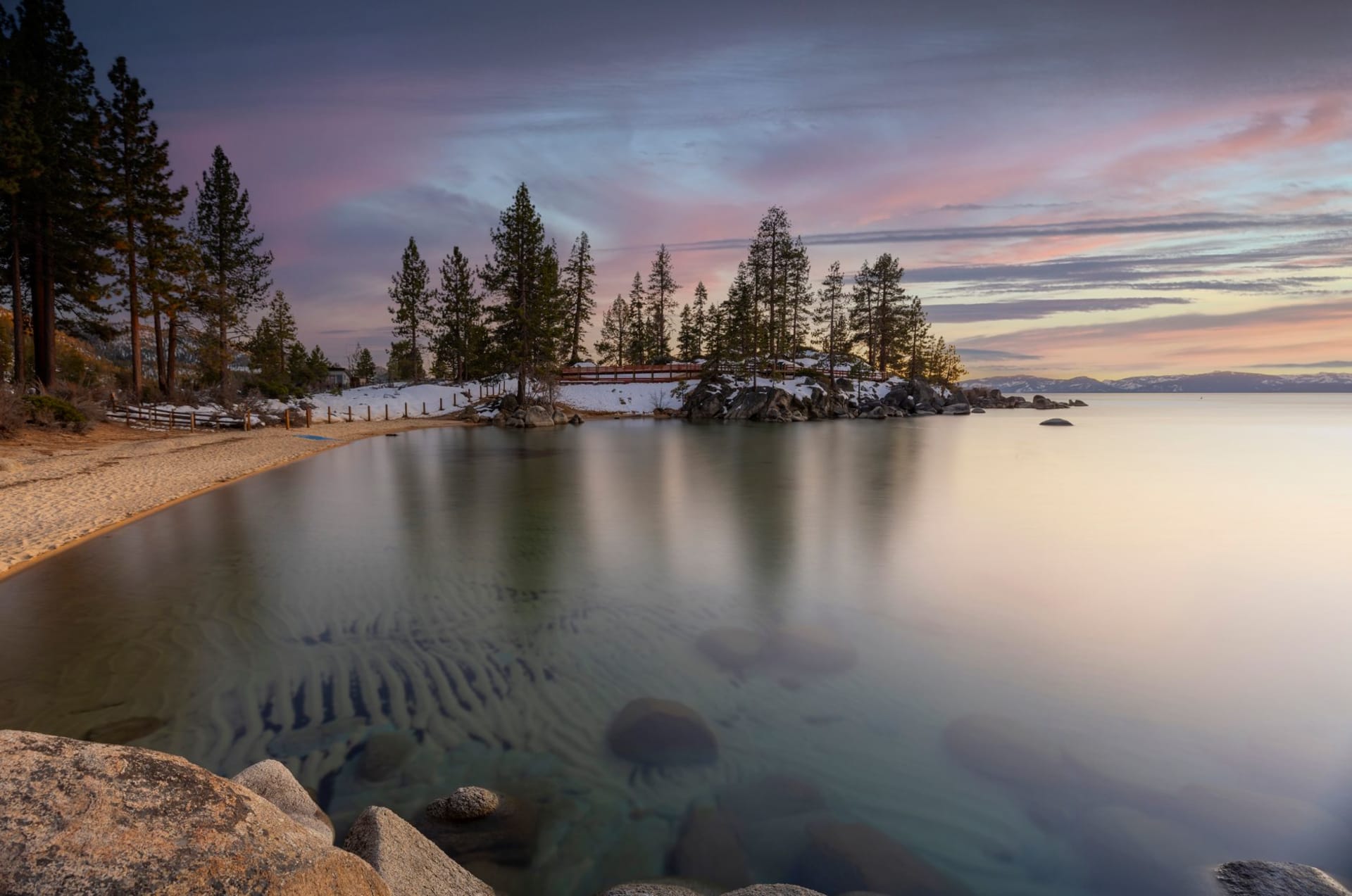
Lake Tahoe
"You crest the Sierra and there it is — a blue so saturated it looks like a painting of a lake, not an actual lake."
The first time you see Lake Tahoe from above — cresting the Sierra Nevada on the drive up from Carson City, the road lifting into pine forest and then suddenly opening onto a viewpoint where the entire lake appears at once — there is a moment of genuine disbelief. The water is not lake-blue. It is a saturated, deep cobalt that belongs in the Mediterranean or a travel poster, not sitting at 1,900 meters in the mountains of Nevada and California. I pulled over at the overlook on the Nevada side, engine off, and stood in the cold air for several minutes just looking, doing the thing where you try to believe what you’re seeing and keep having to start over.
The Nevada side of Tahoe is the quieter side. California has South Lake Tahoe with its casinos and ski resorts and summer crowds; Nevada has Incline Village and Crystal Bay and a series of public beaches and trailheads that attract about a third the traffic, with the same view. I rented a cabin in Incline Village for a long weekend and spent most of my first morning on the East Shore Trail, a hiking path that runs along the base of the cliffs above the lake’s eastern edge, the water below shifting through colors — turquoise in the shallows over the sand, blue-green over the granite, deep navy where the lake plunges to its maximum depth of nearly five hundred meters.
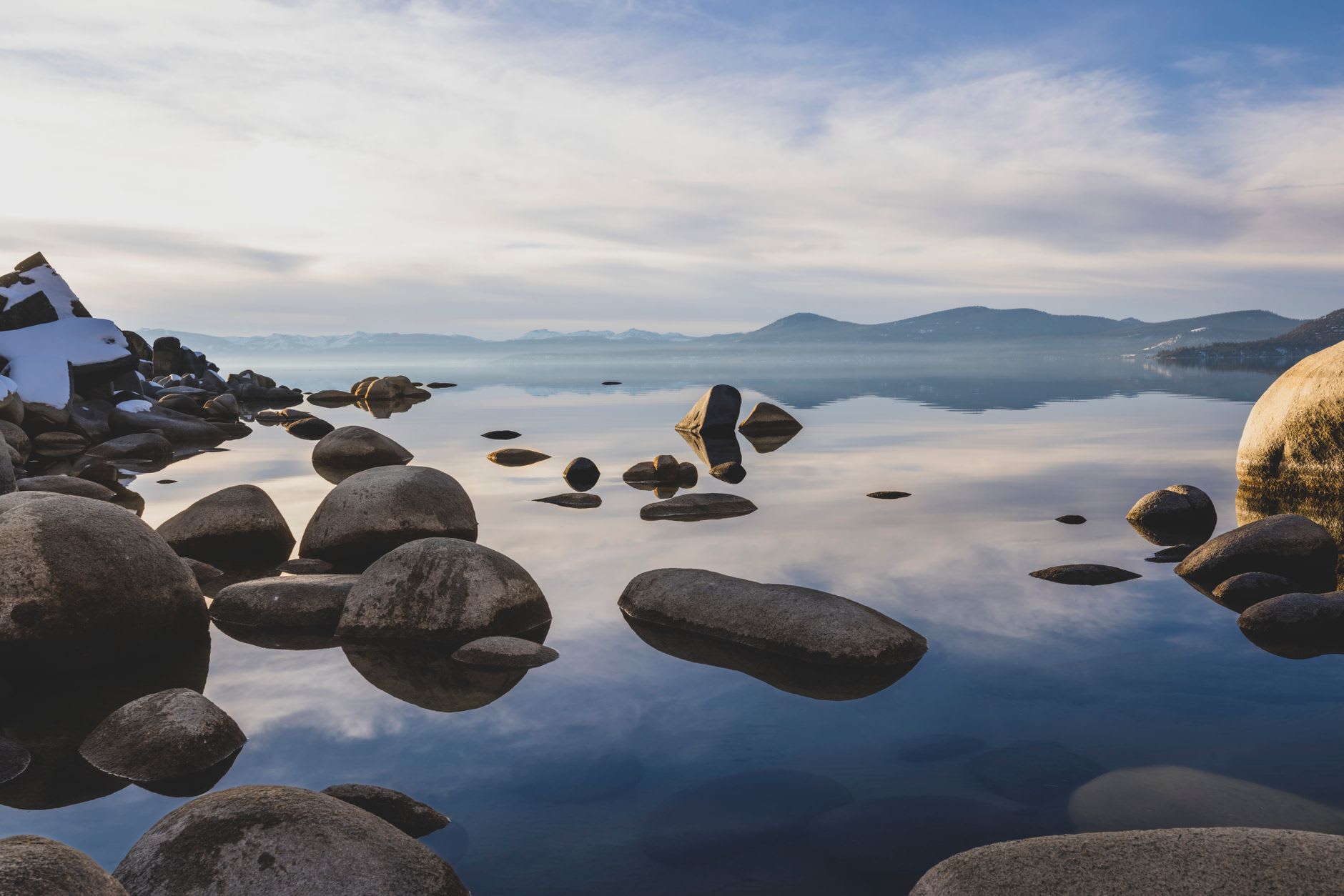
Sand Harbor State Park, on the northeast shore, has the finest beach on the Nevada side — a curve of coarse sand backed by pines, the shallows so clear that the granite boulders on the bottom are visible at ten meters depth. On summer mornings, the water is cold enough to make the entry involuntary-gasp cold, but the clarity makes swimming here feel like swimming in very cold air. The kayak rentals at Sand Harbor give you two to three hours on a lake that is perfectly still by eight in the morning and increasingly choppy by early afternoon when the Sierra winds come up, and the light off the surface at that hour is the specific white-gold of high altitude reflection.
The Nevada casinos at the south shore — Harrah’s, Harvey’s, the Montbleu — occupy a strip of development right on the state line, their parking lots technically in Nevada and their pools looking out over California. The contrast between the casino architecture and the surrounding forest is so complete as to be almost funny, but the situation has a certain honesty to it: the lake doesn’t belong to either state entirely, and the line where California ends and Nevada begins cuts through the middle of a place that feels more like a separate country. I played blackjack for two hours one night and then walked out into the mountain cold and looked up at the Milky Way through pines and both experiences felt entirely appropriate to the same place.
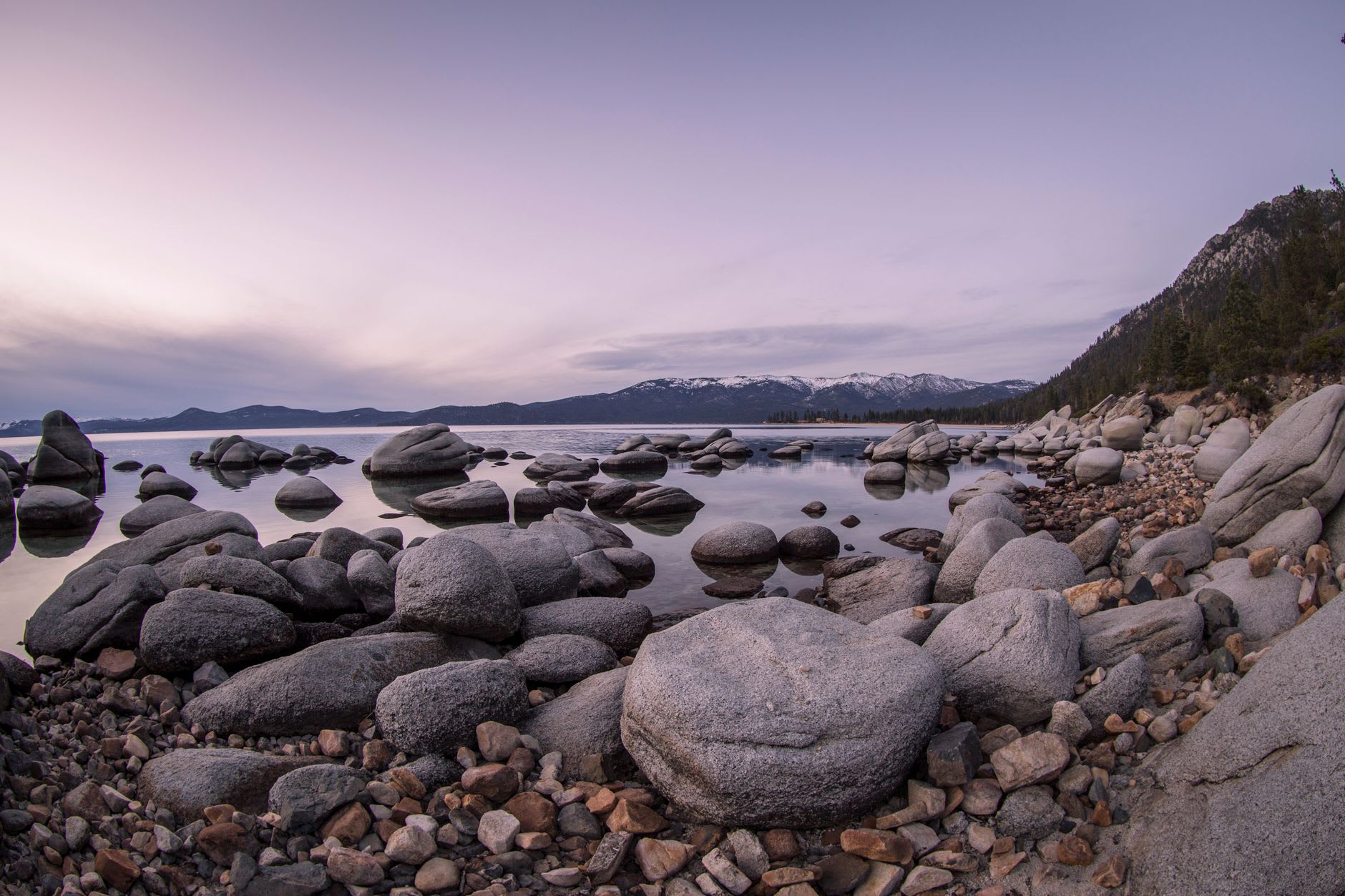
The hiking around Tahoe in late summer, after the snowmelt has cleared the high trails but before the October storms, is some of the best in the Sierra Nevada. The Tahoe Rim Trail circumnavigates the entire lake at ridge level, one hundred seventy kilometers of path through granite and pine and open meadow with the lake always visible below. Day sections of it from the Nevada side — particularly the stretch from Spooner Summit north along the ridge — give you views of both the lake and the Great Basin to the east simultaneously, the two landscapes so different in character that standing between them feels like a geographic hinge.
When to go: July and August for swimming and hiking — the lake is at its warmest (still cold, around 16-18°C at the surface) and the mountain trails are fully open. Late September and October for the Tahoe autumn, when the aspens in the canyons turn gold and the crowds vanish. December through March for skiing at Diamond Peak on the Nevada side. Spring brings snowmelt and wildflowers but some trails stay muddy through May.