Twyfelfontein
"I've stood in a lot of old places, but never one that made six thousand years feel like last week."
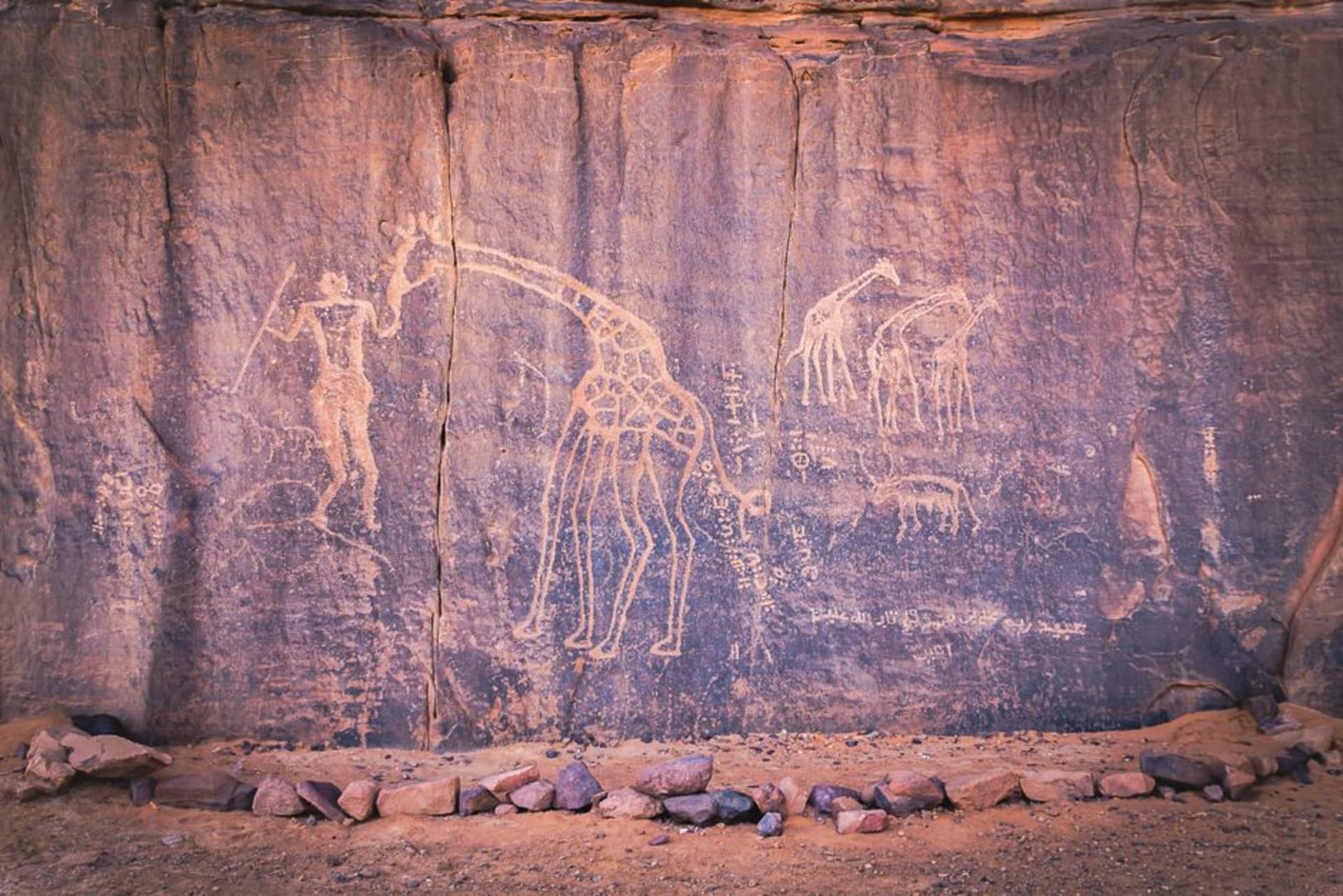
A valley of sandstone slabs in Damaraland carved with thousands of rock engravings left by San ancestors over six millennia.
We drove into Damaraland on a road that seemed to forget it was a road, gravel giving way to washboard giving way to nothing much at all, and I remember Lia gripping the door handle and laughing every time the truck bounced. Twyfelfontein — “doubtful spring,” a name a German-Namibian farmer gave the place in the 1940s because the water here never quite made up its mind whether to flow — sits low in a valley ringed by these burnt-orange hills. It doesn’t announce itself. There’s no grand gate, no visitor center trying too hard. Just heat, silence, and a guide named Josua who met us at the trailhead with a walking stick and an expression that told me he’d said his opening lines a thousand times and still meant every word of them.
What got me wasn’t the scale, though there’s plenty of that — over two thousand engravings, one of the densest concentrations of rock art anywhere on the continent. It was the specificity. Josua crouched next to a slab and traced the outline of a rhino with his finger, not touching the stone, just hovering an inch above it, and said the animal had been carved by someone who’d actually seen a rhino here, on this valley floor, when rhinos still roamed through it. Elephants, giraffes, footprints of animals and of the people who tracked them — the whole record of a hunting life pressed into sandstone by ancestors of today’s San people, going back roughly six thousand years.

There’s a particular slab Josua saved for near the end of the walk — a panel dense with geometric shapes, circles and lines that no one has fully decoded, and he just shrugged when I asked what they meant. “Nobody knows for certain,” he said, “and I like that.” I liked that too. It’s rare to stand somewhere designated a UNESCO World Heritage Site, as this became in 2007, Namibia’s first, and still feel like there’s genuine mystery left in it rather than a plaque explaining everything away. Lia spent a long time photographing the shadows the engravings threw as the sun dropped, the grooves catching light in a way that made the animals look almost like they were moving.

By the time we finished the loop my shirt was soaked through and my water bottle was embarrassingly empty for a guy who’d read the warnings twice. That’s the one thing I’d tell anyone before they come: there’s no shade out there, and the walking is on exposed rock the whole way. When to go: we went in July, deep in the dry winter, and between May and October is really the sweet spot — the heat is tolerable enough to actually look at what you’re walking past instead of just surviving the walk.