
Mokokchung
"The man who made my tea had opinions about post-colonial literature. Mokokchung is that kind of town."
Mokokchung reached me before I reached it — a journalist I met in Kohima mentioned it three times in an hour, which is how you know a place has a reputation. The Ao Naga people, whose heartland this is, have had a higher education rate than most of the rest of Nagaland for several generations, and the town reflects this in a way that is not immediately visible but becomes apparent in conversations: the guy at the tea stall recommending a book, the woman running the guesthouse who was completing a PhD by correspondence, the secondary school principal who wanted to talk about the novels of Temsula Ao, the Ao Naga writer whose work I had not read but went home and read within a week of being told to.
The town sits on a ridge at 1,325 metres and has a physical calm that belies its intellectual energy. The streets are quieter than Kohima, the traffic less aggressive, the market more orderly. The views from the ridge on clear days run down to the Tizu River valley and across to the Assam foothills, and in the evenings the light on the pines has a quality I associate with European mountain towns — a horizontal golden wash that makes everything look momentarily like a painting.
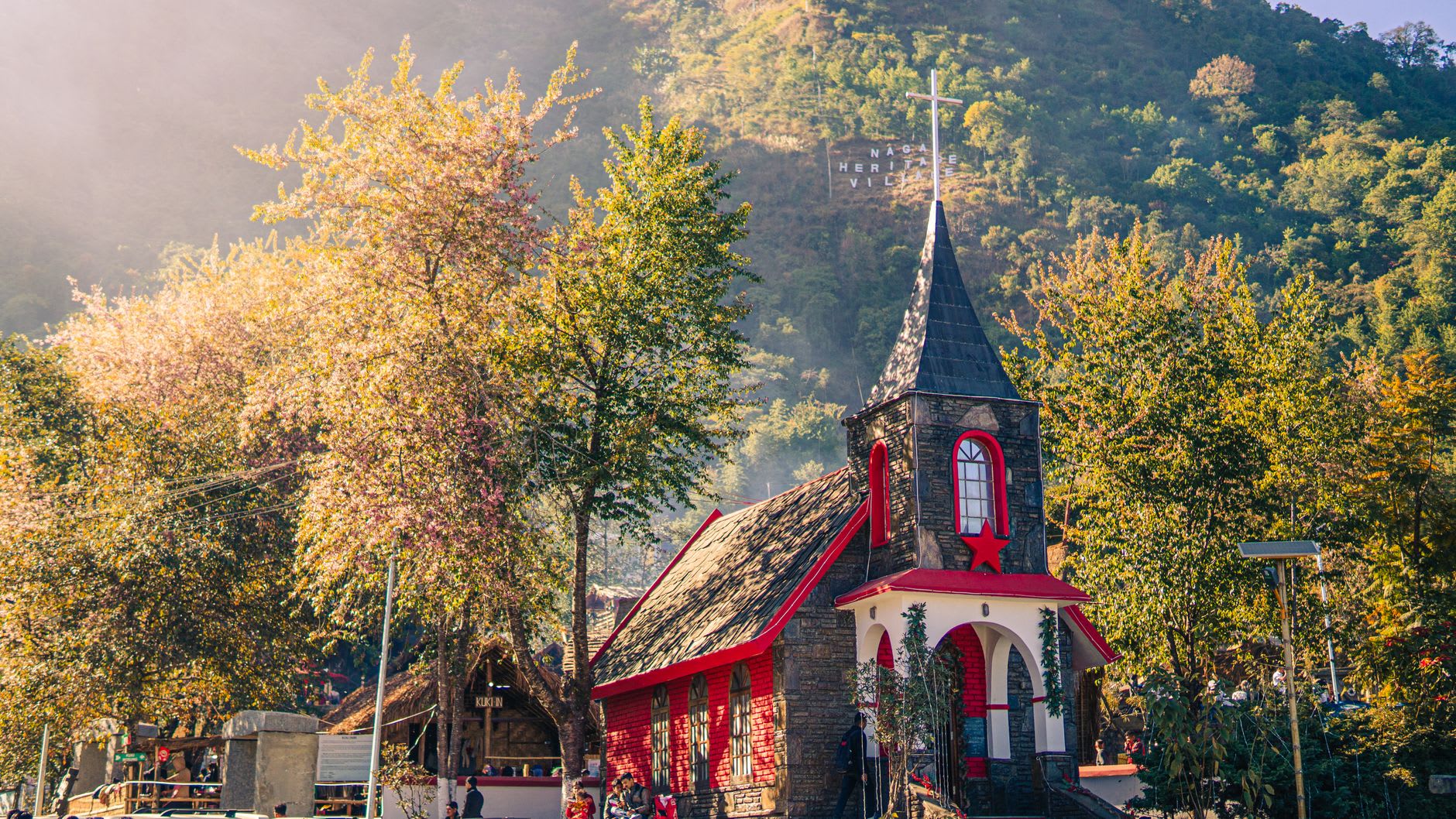
The Ao villages surrounding the town are the cultural substance of the district. Ungma, Changtongya, and Longjang are among the oldest Ao settlements and each has preserved its traditional architecture — the morung structures built from massive bamboo poles, decorated with hornbill carvings and clan insignia, the gates of the older houses still bearing the row of hornbill skulls that indicated the owner’s hunting status. Walking into Ungma felt like entering a community that had decided very deliberately what to keep and what to let go, and the balance it had struck seemed genuinely considered.
The Ao have a rich tradition of folk music built around the moatsu and tsüngremong festivals. The moatsu, held in May, involves days of community singing, dancing, and feast-making — if you time your visit you will hear the traditional Ao songs that are structured differently from any music I could compare them to, using drones and harmonics that don’t resolve the way Western ears expect them to. I heard recordings at the Mokokchung Heritage Museum and spent an embarrassing amount of time rewinding the same two minutes of a women’s collective singing around a fire.
The food in Mokokchung leans toward the Ao tradition: anishi, a pungent fermented taro leaf cake that is used like a seasoning, appears in almost everything and provides an earthy bitterness that balances the smoked meat. I ate it in a rice dish with dried fish at a woman’s house where I had been invited for lunch — an invitation that materialized through three intermediaries and felt like the natural result of asking enough questions in the right town.
When to go: May for the Moatsu festival — the most important annual gathering of the Ao people, involving music, feasting, and inter-village sports. October through December for clear weather and comfortable temperatures. Mokokchung is quieter and more accessible than other Nagaland destinations across most of the year.