Longwa Village
"The chief told me, with great calm, that his kitchen is in India and his bedroom is in Myanmar. He did not seem to consider this remarkable. I have thought about it ever since."
Getting to Longwa is its own preface to the place. It sits in the Mon district at the very northeastern edge of Nagaland, hours of jolting, landslide-prone road from anywhere, on a ridge so close to the international border that the line runs straight through the village — and, famously, straight through the house of the Angh, the hereditary Konyak chief. We arrived caked in dust after a drive that had rearranged my internal organs, into a cool, mist-wrapped settlement of long thatched houses strung along a high spine of forest, and I knew within minutes that the journey had been the correct price.
A house in two countries
The Konyak are the most storied of the Naga tribes, and Longwa is their most famous village, in part because of that border. The Angh’s longhouse — a long, dark, smoke-blackened hall hung with the skulls of hunted animals (and, in the older accounts, of men) — straddles the India-Myanmar line so precisely that the chief is said to eat in one country and sleep in the other. He is a real and serious figure; his authority extends over villages on both sides of a border he predates. We were received with a courtesy that was entirely unhurried, given black tea, and left to absorb the weight of the room at our own pace.

The Konyak were, within living memory, headhunters — the taking of heads was woven into status, ritual, and manhood until Christianity and the Indian state brought the practice to an end in the mid-twentieth century. The last generation of men who took part are now very old, and you still see them: faces and chests covered in the dark facial tattoos that marked a successful hunt, ears stretched with horns and beads, often with an old muzzle-loading gun close to hand. I will be honest that sitting with one of them, a man perhaps in his nineties, was the strangest and most genuinely humbling encounter of the whole trip. He was gentle, curious, and entirely a man of a vanished world.
The frontier and its weather
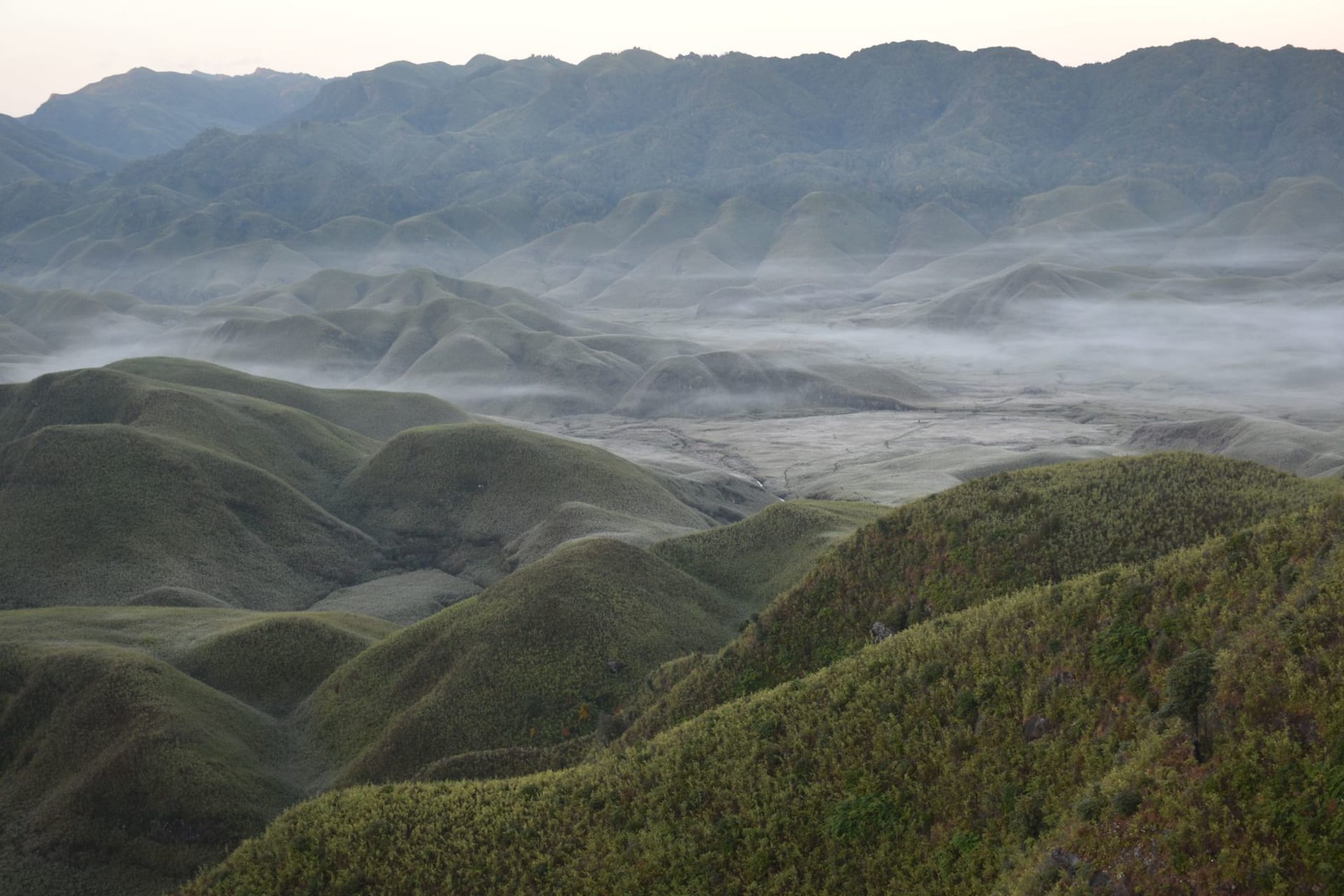
Longwa’s setting is half its power. The village runs along a ridgeline with the land falling away on both sides into folded blue ranges that disappear into Myanmar, and the mist moves through constantly, swallowing the longhouses and releasing them. The Konyak here are skilled woodcarvers and metalworkers — gunsmiths, historically — and you can watch the work being done in doorways. We ate with a family who fed us rice, foraged greens, and pork cooked with bamboo shoot and the fierce local chilli, and the conversation, conducted in fragments through a guide, kept circling back to how recently everything here had changed.

I left Longwa unsettled in the best sense. It is not a comfortable or convenient place, and it should not be visited casually or photographed thoughtlessly — these are people, not exhibits, living through the last decades of a profound and recent transformation. But it is, without exaggeration, one of the most extraordinary places I have ever been, precisely because it does not perform for you. It simply is what it is, on its ridge, in its mist, in two countries at once.
When to go
October to April is the dry, accessible season — the roads are treacherous enough even then. The Aoleang festival in early April is the great Konyak celebration and the most vivid time to visit, though the village is busiest. The monsoon, roughly May to September, makes the already difficult roads genuinely dangerous and is best avoided. Go with a respectful local guide, ask before photographing anyone, and treat the Angh’s house as the living seat of authority it remains.