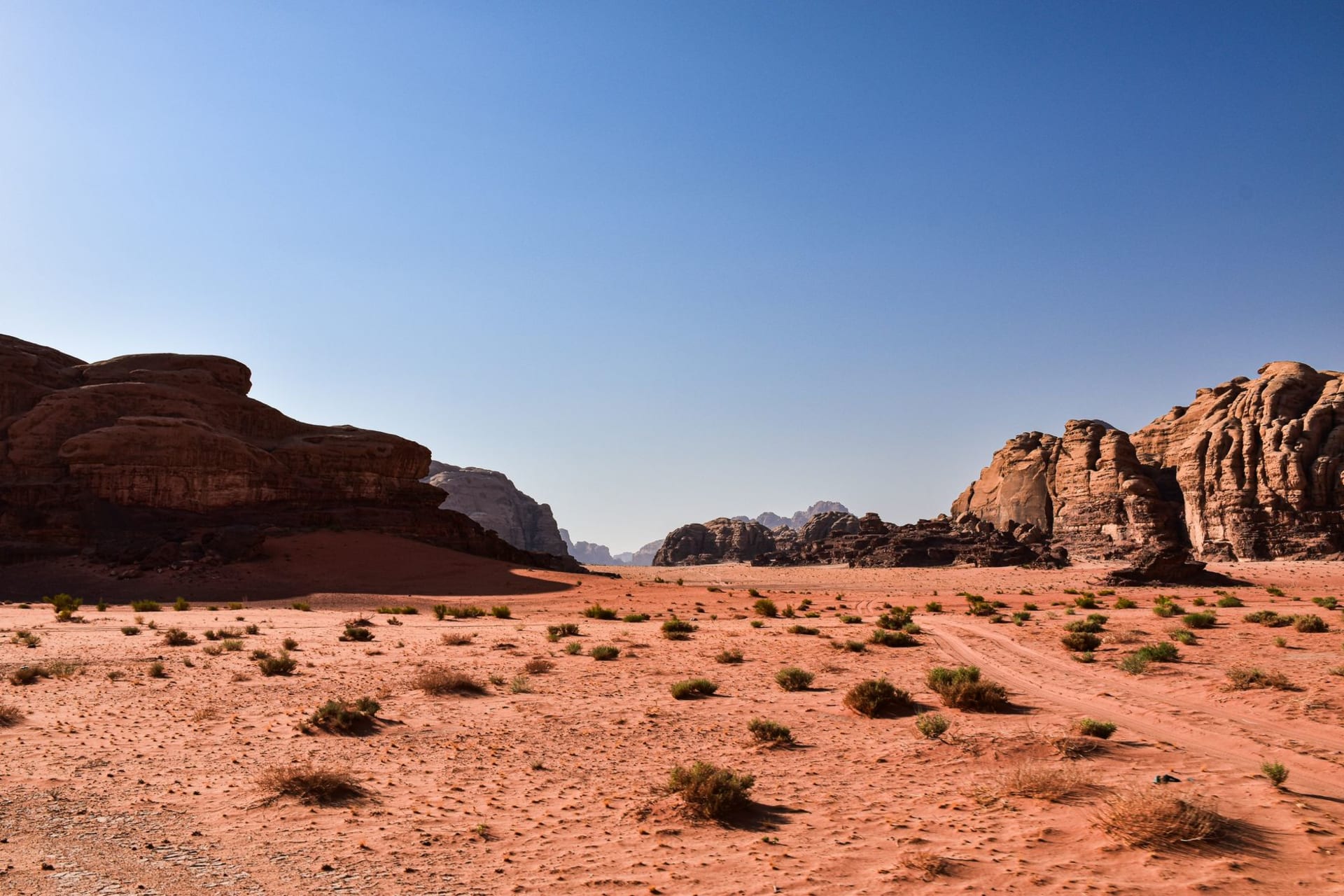
Wadi Rum
"The silence here isn't empty — it has weight, and after a while it starts pressing back."
I arrived in Wadi Rum just before noon, which everyone tells you is the wrong time, and I think they are right but I also think they are missing something. The midday desert is brutal and flat and stripped of the soft-focus romanticism that golden hour light manufactures. At noon, Wadi Rum shows you what it actually is: a system of granite and sandstone mountains rising from a floor of compressed red sand, absolutely enormous, absolutely indifferent to your presence. The sky had no clouds. The rock faces threw no shadows yet. A jeep passed in the middle distance, shrinking to a toy against the cliff walls, and it took me longer than it should have to process that I was looking at a full-sized vehicle.

The Bedouin camps are a fact of Wadi Rum life — some of them are plastic-fantastic tourist operations with air conditioning and Instagram lighting, but the ones run by Bedouin families who actually live in the valley are something else. I found one through a man I met outside the visitor center, a young guy named Khaled from the Zalabia tribe, who drove me in a battered pickup truck to a cluster of goat-hair tents in the eastern part of the reserve where his uncle runs a camp that has been in more or less the same spot for twenty years. The tea came first, as it always does — poured from a brass pot over a fire of desert scrub, sweetened to the point of theology, smelling of cardamom and smoke. The flatbread came next, cooked in the sand over embers, dotted with charcoal marks. The conversation came after that, about T.E. Lawrence (who spent time here and described the valley in Seven Pillars of Wisdom as “vast, echoing and god-like”), about the foreign film crews who keep coming, about the Nabataean inscriptions still visible in the rock faces if you know where to look.
The Nabataean connection is easy to overlook in Wadi Rum because the geology overwhelms everything else. But the scratched inscriptions in the sandstone — Thamudic and Nabataean script recording names, prayers, camels, journeys — are scattered throughout the valley. The Nabataeans used this desert as a trade corridor, a watering stop, a passage between the Hejaz and Petra. Their water cisterns are still cut into the rock. Their presence is not the headline here the way it is in Petra, but it is there in the stone, for anyone patient enough to look.

The night sky is the other reason to stay. I lay on my back on the sand outside the tent after dinner and the stars were so dense they looked structural, like something that was holding the sky up rather than something scattered across it. Khaled’s uncle, who had been sitting silent by the fire, pointed out the summer triangle and told me his father navigated by those three stars when he moved the camels between Saudi Arabia and Jordan in the days before the border was formalized. Some things in this desert have not changed since the Nabataeans moved their frankincense through here.
When to go: October through April. December and January nights drop to near-freezing — bring a proper sleeping bag. March and April offer mild days, occasional wildflowers, and the best light. Summer is possible early in the day but temperatures reach 40°C by midmorning and the desert becomes genuinely dangerous. A minimum of one night in the desert is essential — day trips from Aqaba or Petra miss most of what the valley is.