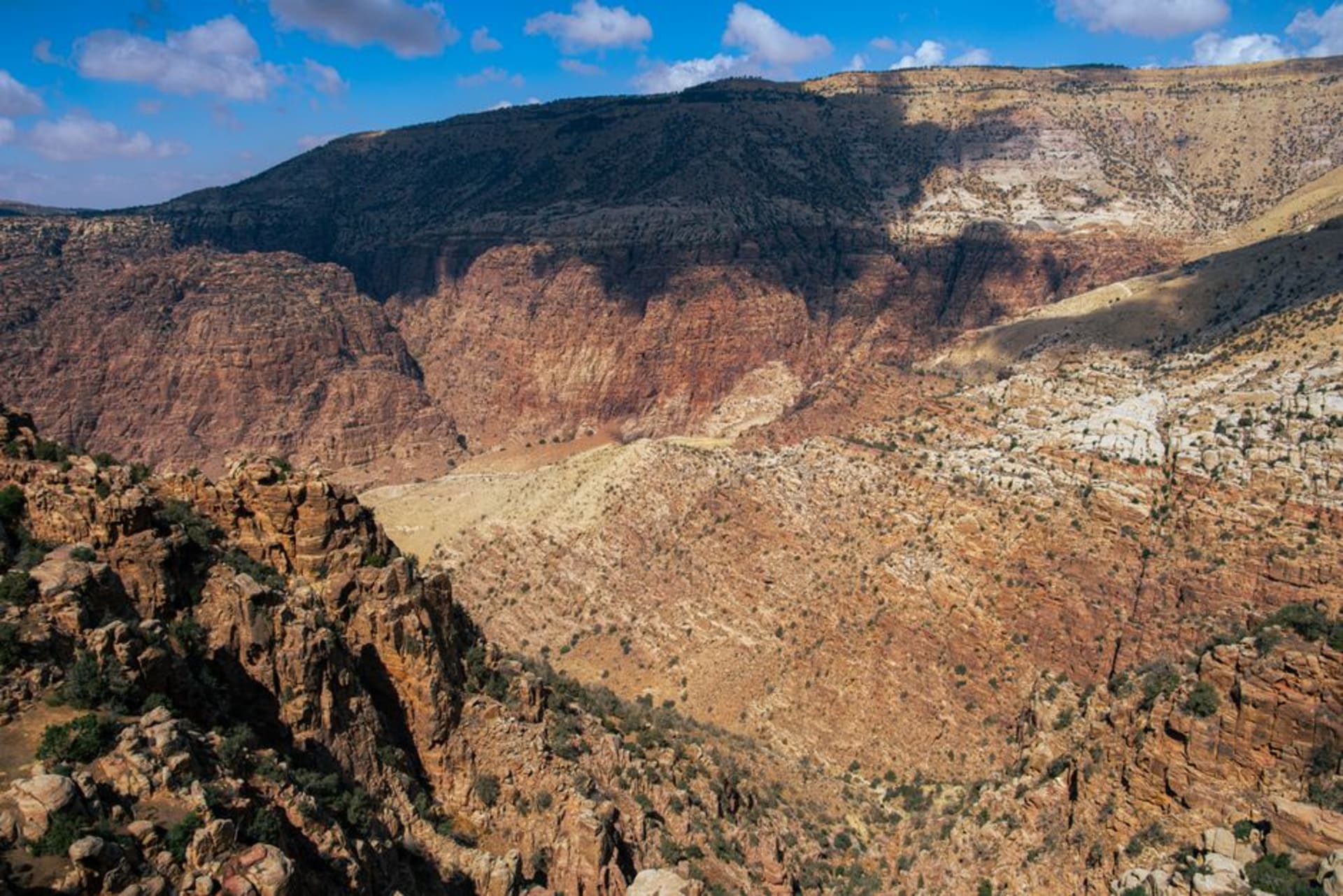
Dana Biosphere Reserve
"One village, four biogeographical zones, and a silence so complete I could hear my own blood moving."
Jordan's largest nature reserve, a canyon of stone houses and sandstone cliffs where four ecosystems collide and the silence is almost total.
I got to Dana village at golden hour, which I did not plan and which turned out to be the single best piece of luck of my whole Jordan trip. The village sits directly on the lip of a canyon that drops nearly eight hundred meters to the valley floor, four hundred-year-old stone houses built from the same tan rock they perch on, half of them restored as guesthouses and half of them still crumbling gently back into the hillside. I stood on the edge of a low wall with a glass of mint tea someone had handed me without asking, watching the canyon walls turn from tan to rose to a deep bruised purple as the sun dropped, and a Bedouin man sitting nearby said, without looking up from his own tea, “this view has not changed in a thousand years, only the roads.” I believed him.
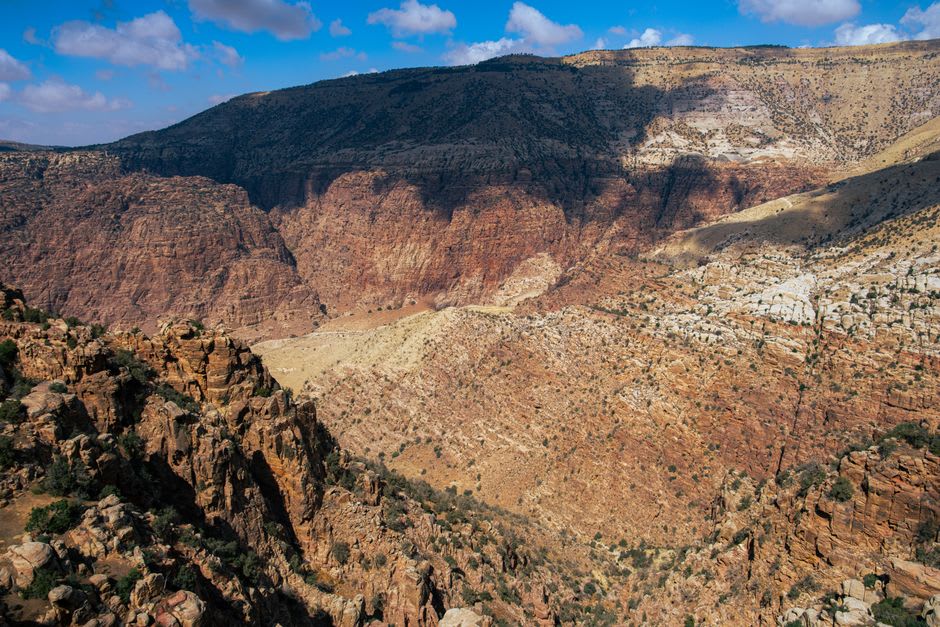
Dana is Jordan’s largest nature reserve and one of its most ecologically important, spanning four distinct biogeographical zones in a single protected area — Mediterranean highland forest at the rim, semi-arid steppe below that, and finally true desert as you descend toward Wadi Araba and the Great Rift Valley. Nubian ibex pick their way along impossible ledges on the canyon walls, and the reserve protects species found almost nowhere else in Jordan. I hiked down from the village toward Wadi Feynan the next morning, a walk of roughly six hours through changing terrain — juniper and wild pistachio giving way to bare red sandstone, then finally the copper-streaked hills near the ancient mines — and did not pass another person for the first three of them.
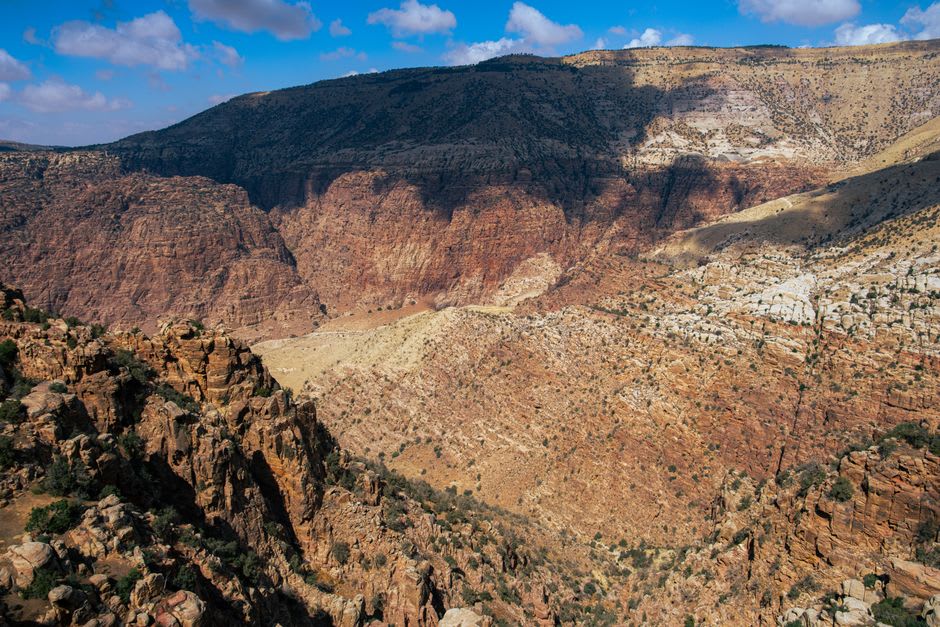
The Rummana campsite, run by the Royal Society for the Conservation of Nature, sits about forty minutes below the village and gives you tents pitched with unobstructed views into the canyon, solar showers, and a dinner of Bedouin-style rice and chicken cooked over coals that tasted better at 1,600 meters than it had any right to. I lay in the tent that night with the flap open, no artificial light for miles in any direction, and counted more stars than I have counted anywhere outside the true open desert — the Milky Way a visible smear across the whole sky, not a metaphor but an actual physical feature of the night I could point a finger at.
When to go: March to May and September to November, when daytime hiking temperatures are manageable and the reserve’s wildflowers are at their best in spring. Book the Rummana campsite or one of the village guesthouses ahead — capacity is limited by design, which is exactly why the place still feels wild.