Yangon
"Yangon is the only city I know where the most arresting thing at every hour of day is also the most gilded."
British colonial grid streets, the golden Shwedagon Pagoda flaming above everything, and excellent mohinga at dawn.
I arrived in Yangon on a night bus from Mandalay and stepped onto Anawrahta Road at five in the morning, into air that smelled of river silt and frangipani and something faintly charred that I never quite identified. The city was already awake. Vendors crouched over iron pots on the pavement. A monk in burgundy walked the center of the empty road as if it belonged to him, which in some sense it did.
The Pagoda at Every Hour
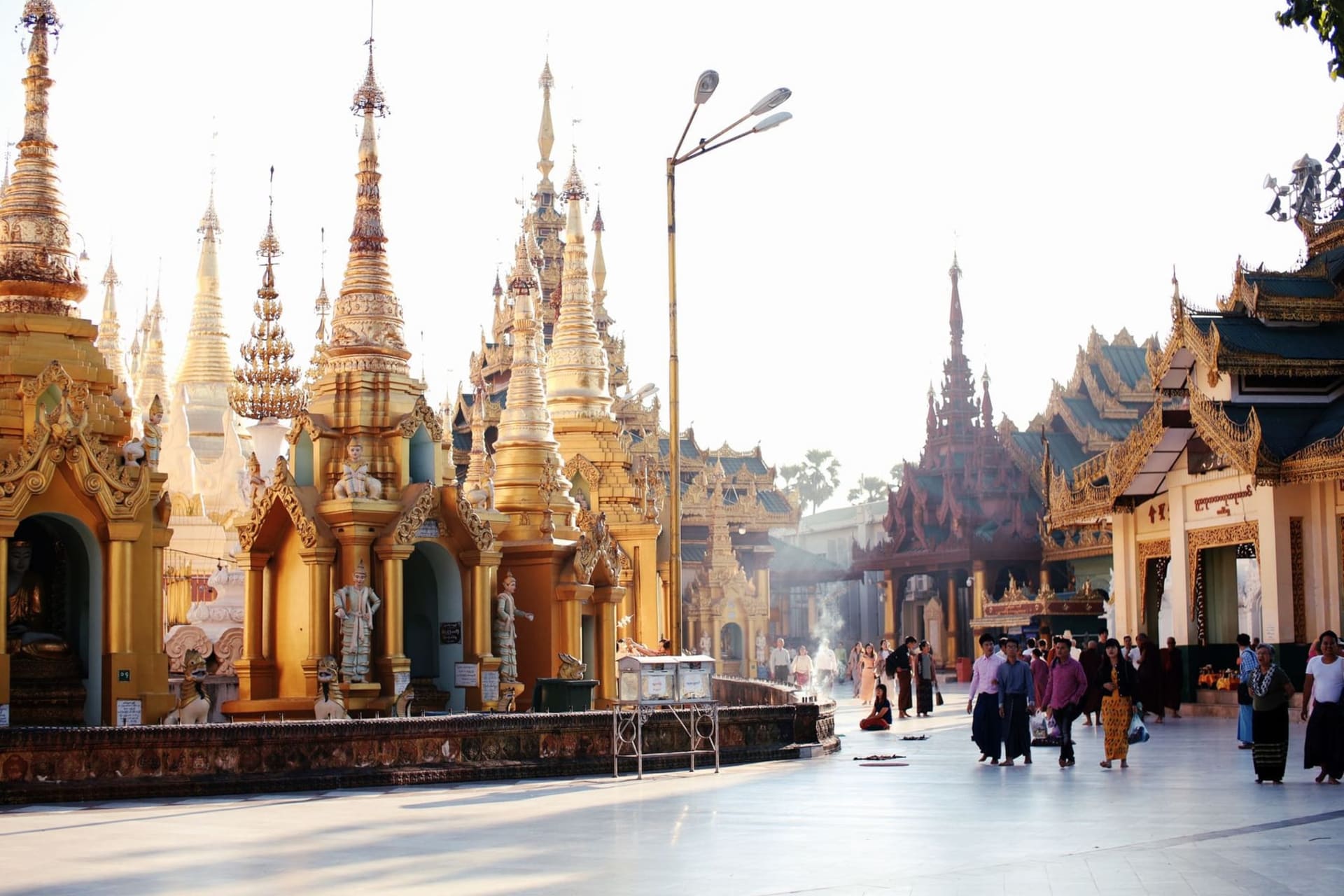
Shwedagon is not a landmark in the ordinary sense. It does not anchor one district or preside over one view. From almost anywhere in the city, if you find a gap between the decaying colonial blocks — the old Rowe & Co. building, the customs house on Strand Road, the painted facades peeling on Merchant Street — the stupa is there above the roofline, catching whatever light exists. At noon it is almost white. At four in the afternoon it turns the color of a tiger. At dusk it becomes something that has no satisfying name in French or English.
I climbed the southern staircase barefoot on the third morning, tiles warm through the soles of my feet, and walked the marble circumambulation path three full times before I realized Lia had stopped moving. She was standing at one of the small shrines facing the main zedi, eyes closed, completely still. I waited. The air smelled of jasmine offerings and candle wax and the distant diesel of Bogyoke Aung San Road.
Mohinga Before the Heat
The surprise was not Shwedagon. The surprise was the soup.
Mohinga is sold from wooden carts at the edge of Mahabandoola Garden from roughly five until the heat makes eating anything broth-based unreasonable, which in Yangon is around nine. I sat on a low plastic stool on the third morning and had a bowl of catfish broth over rice vermicelli with fritters of split-pea batter floated on top. It cost almost nothing. The broth had a depth I associated with things that had simmered overnight, which I was told was exactly right. I went back the following morning and the morning after that.
The colonial grid of the downtown — the blocks laid out by the British between the river and the Sule Pagoda, now occupied by Chinese trading companies and money changers and noodle shops — is best walked in this same early window, before the sun clears the buildings and before the motorcycles multiply on the cross-streets.
The Light That Stays
What I remembered most, leaving, was not any single image but a quality of light that seemed to cling to the city regardless of weather. Yangon is heavily overcast through much of the year, yet something warm persists — refracted off the pagoda, perhaps, or simply the particular gold of the aging teak and plaster. It makes the city look, at almost every hour, as if it is either just waking or about to be remembered.
When to go: November through February is the dry season and by far the most comfortable — temperatures stay below 35°C and the skies clear enough to see the pagoda glitter properly. Avoid May through October unless you have a particular tolerance for monsoon rain arriving sideways.