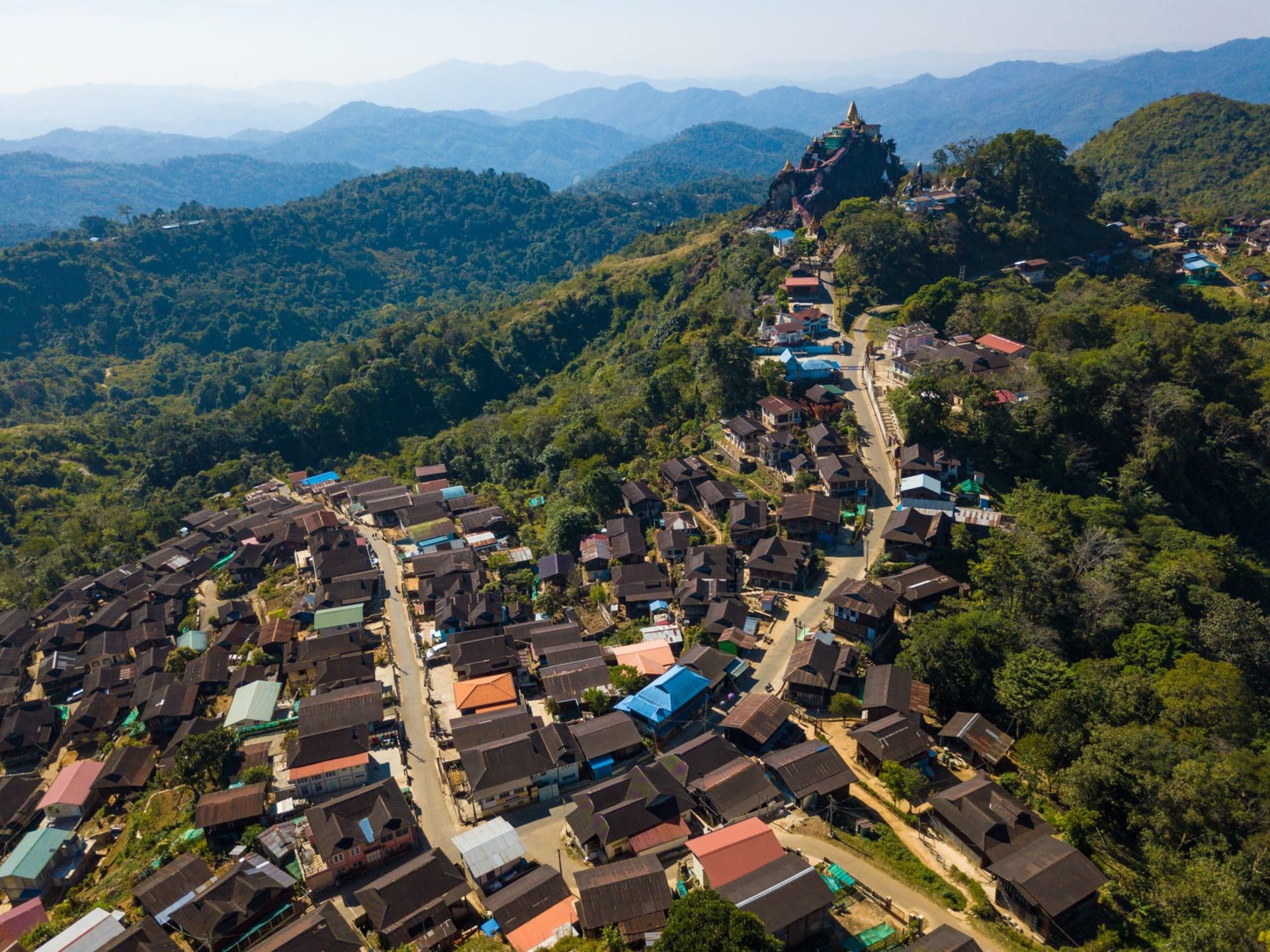
The morning market in Hsipaw runs along the river bank and wraps up by eight. Miss it and you’ve missed the day’s best hour — the one where light comes in sideways through the dust, where women in Shan jackets weigh out dried chilies on hand scales, where the smell of fermented tea leaves and woodsmoke is so specific you could navigate by it blind. I’ve started using that market as a benchmark. Most mornings don’t clear it.
The Train From Mandalay
The seven-hour train ride from Mandalay to Hsipaw is theater from the first hour. The track climbs through foothills that go from dry scrub to pine forest to something genuinely alpine, and then the Gokteik Viaduct appears without warning around a bend — a colonial-era steel trestle bridge from 1900 hanging over a gorge so deep you can’t see the bottom. The train slows to a walking pace. Everyone from outside Myanmar presses against the windows. The Burmese passengers barely glance up. You spend the next twenty minutes trying to hold the scale of it in your head, and failing.
The Unhurried Town
Hsipaw has the particular quality of a place that never quite became a destination. There are guesthouses, a handful of noodle shops, a tea house where men play chess from dawn until the heat peaks. The main street has a barbershop with a hand-painted sign, a noodle stall that opens before the market does, and a repair shop that appears to fix everything. I spent two days just walking circuits of this, sitting, watching carts unload.
Lia and I hired a guide for half a day into the surrounding hills and reached a Palaung village by noon. The road in was red dust over packed dirt, and the silence in those hills has texture — the tick of insects, a dog somewhere ahead, wind moving through bamboo you can hear but not see. The guide pointed out plants he’d eaten as a child. We were back in town by three, covered in that red dust and seriously hungry, and found exactly what we needed at the noodle stall.
Little Bagan and the River at Dusk
The cluster of crumbling stupas on a hill east of town — called “Little Bagan” by the guesthouses, though no local I spoke to used the name — has the quality of accidental beauty. Old brick going orange in the afternoon light, grass growing through the foundations, the Shan State plains stretching south behind them. No ticket booth, no guided tour option. Just pigeons, wind, and the particular freedom of somewhere that hasn’t been curated at you.
In the evenings the Dokhtawady River reflects the last of the light in long, wobbling strips. A woman set up her cart at dusk every day at the same spot on the bank, selling shan noodles with chili oil and a broth that tasted like it had been going for years. I sat there two evenings running, watched the mountains go dark in sequence, felt the specific satisfaction of being somewhere that asked nothing of me except to show up and pay attention.
When to go: November to February, when the air is clear and cool and the valley carries the particular gold of recently harvested rice fields. Avoid May through September — the roads into the hills turn to mud and the market thins. If you’re taking the train from Mandalay, book your seat days ahead; the Gokteik run fills up, and the window seats on the left side going north are worth fighting for.