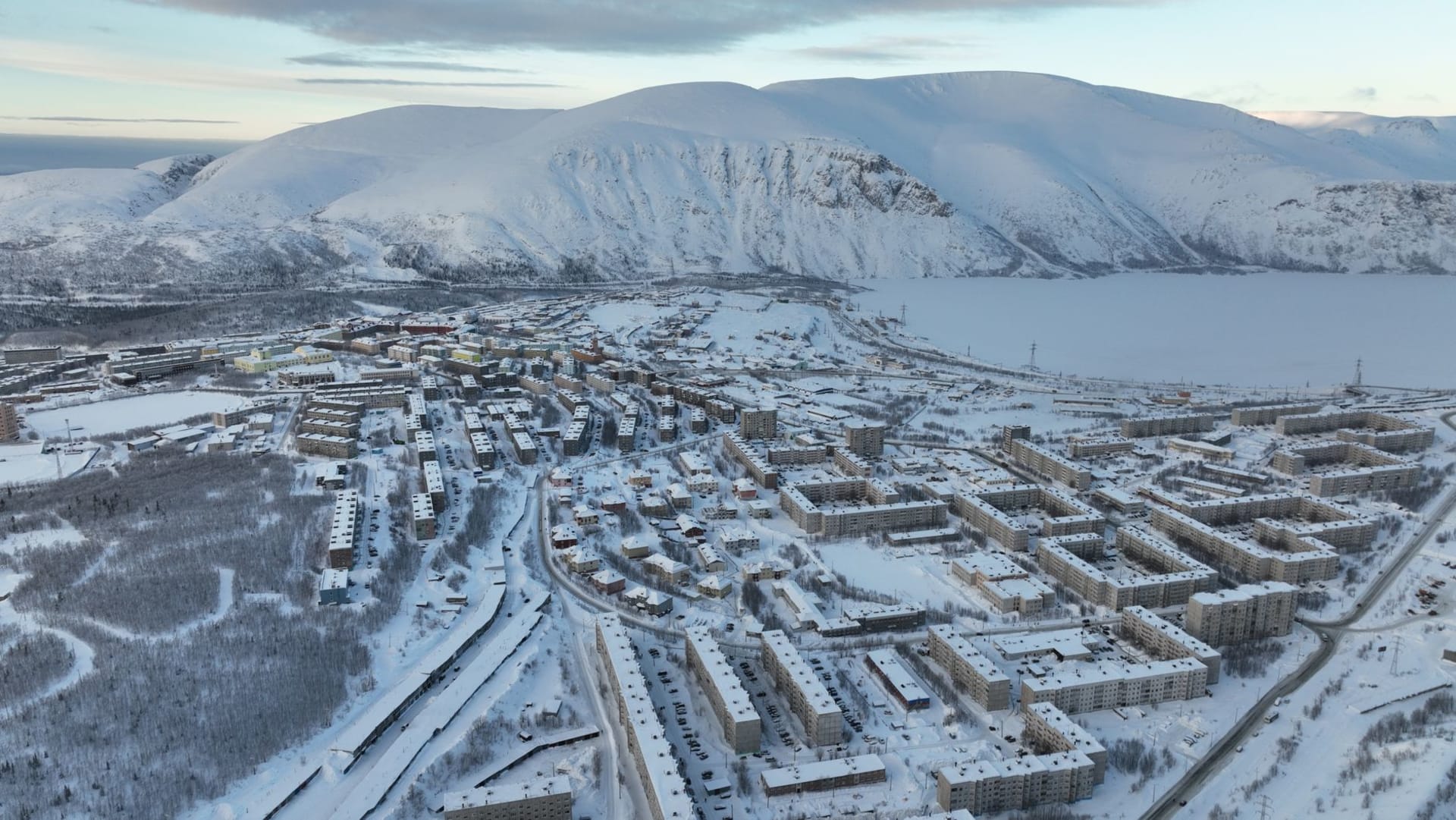
Monchegorsk
"They make nickel here and the forests died because of it and everyone just lives with that information."
I knew what was happening to the landscape before I understood why, which is the particular experience Monchegorsk offers. Driving south from Murmansk, the birch and spruce forest that lines the road becomes gradually sparser, the trees further apart, shorter, more skeletal. Then the trees stop entirely. Not because of any geographical transition — you haven’t gained altitude or changed soil type — but because the forest has been killed by sulfur dioxide emissions from the copper and nickel smelters that have been operating here since the 1930s. For several kilometres around the city, what exists is a bare landscape of bare rock and bare dead trunks and mineral-stained soil and snow, and through this landscape the chimney stacks of the Kola Mining and Metallurgical Company rise against the sky like punctuation.
It is, objectively, a site of environmental destruction. It is also one of the most visually singular places I have been in my life. The dead forest zone has a quality that I keep failing to adequately describe — it is not ugly in a straightforward way, it is strange in a way that makes your eyes work differently. The grey trunks, stripped of bark and branch by decades of acid precipitation, are polished smooth. They reflect light at angles that living wood doesn’t. In winter, with snow in the hollows of the terrain and grey sky above, the whole landscape looks like a photograph of itself.

The city itself is built on the shore of Lake Imandra, which is enormous and beautiful and partially contaminated by the same industrial runoff that killed the trees. Around the lake, away from the immediate vicinity of the smelters, the landscape recovers — gradually, hesitatingly, in the way that damaged ecosystems recover, starting with the plants that can tolerate the most and working outward from there. Ecologists have been studying this recovery for decades. Some areas replanted in the 1990s show tentative regrowth. Others remain bare. The pattern from above, I was told by someone who’d seen it in summer, looks like a map of damage.
Monchegorsk itself — a Soviet planned city of about forty-five thousand people — has the bones of the Socialist urbanism that was supposed to make Arctic industrial life not just bearable but exemplary. Wide boulevards, civic buildings with a certain ambitious proportionality, a cultural centre, a sports complex. The buildings show their age now, and the population has declined since the Soviet peak, but the city hasn’t lost the organisational logic of its planning. People walk between things in a direct, purposeful way that suggests the distances and connections were thought through. There is a good local history museum that covers both the geological treasure of the Kola ore and the human cost of extracting it, though the balance of that coverage has varied considerably across different political periods.

I talked to a metallurgical engineer in her fifties who had worked at the smelter for over twenty years and who spoke about the emissions reductions of the last decade with genuine pride — sulfur dioxide output is down dramatically from Soviet-era levels, and the recovery zones around the city are, in her view, evidence that the damage is reversible. She also spoke about the work itself with the specific enthusiasm of someone who understands a complex industrial process in its entirety, which is its own kind of expertise. The nickel in your phone very possibly passed through a facility whose chemistry she can describe in detail.
When to go: Any season, though the industrial landscape’s strangeness is most pronounced in winter when the snow clarifies the contrast between the dead zone and the recovering edges. Lake Imandra offers ice fishing in winter and kayaking in summer, both with the backdrop of the mountain range that rises on its western shore. Combine with a visit to the Laplandsky Reserve, whose administrative office is here.