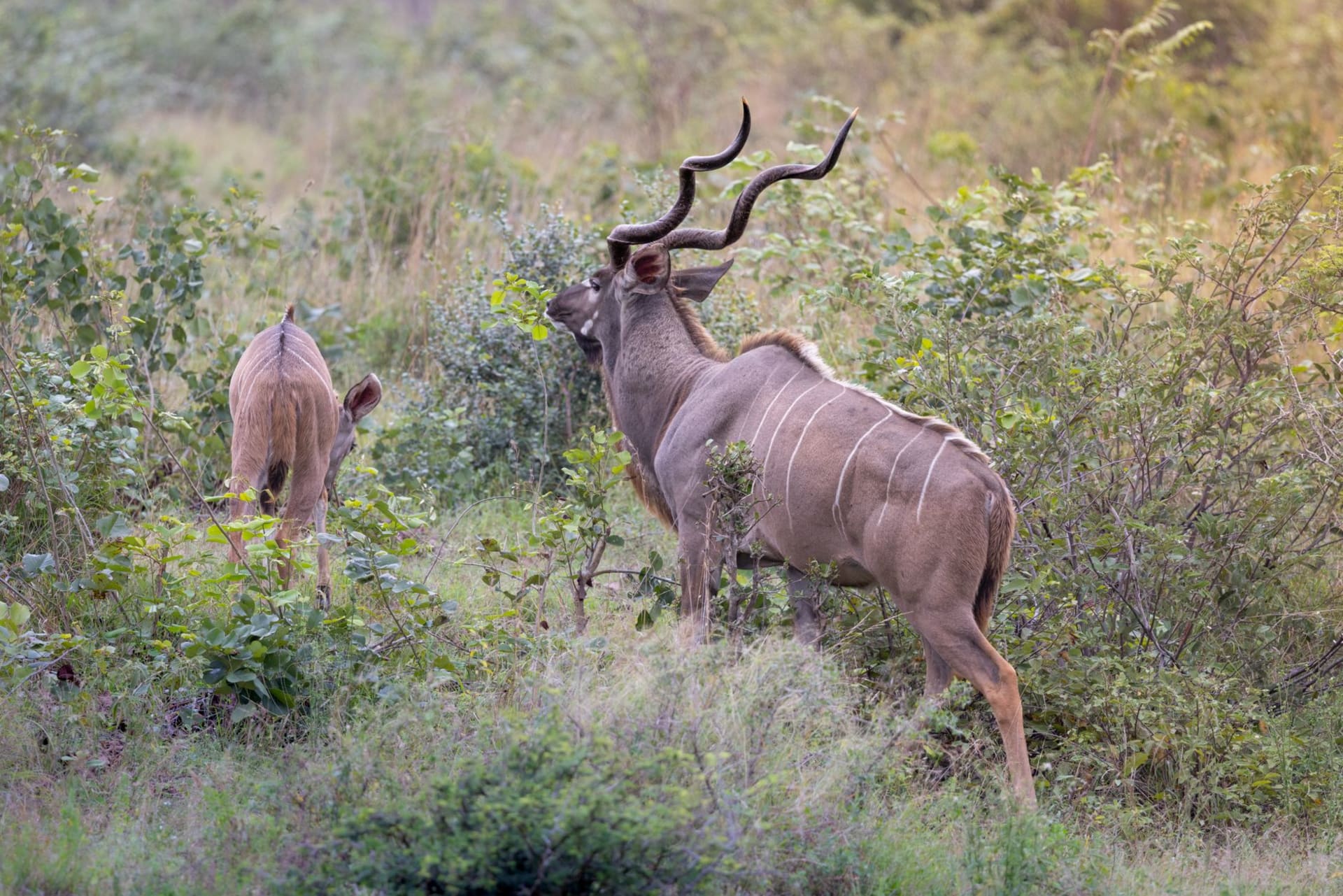
Niassa Reserve
"We drove for six hours and saw four vehicles. Three of them were ours."
The charter flight from Pemba to the Niassa Reserve takes fifty minutes, and for most of it there is nothing below except miombo woodland — that silver-green canopy of Brachystegia trees that covers most of southern and central Africa’s interior and that, viewed from altitude, has a quality that is both vast and intimate, like the surface of a sea. No roads. No towns. Occasionally a river in a dark thread through the trees, or a pan of open grassland catching the early light. When the airstrip appeared — red dirt, zebra grazing to one side, a windsock that may or may not have been functional — I had already understood something about where I was going. This is the part of Africa that doesn’t need your attention to exist.
Niassa covers forty-two thousand square kilometers in the northwest corner of Mozambique, bordered to the west by Lake Niassa — also known as Lake Malawi, depending on which side of the border you’re standing on — and to the north by the Tanzanian border. It is Africa’s largest unfenced reserve, which means the wildlife moves freely in and out of the boundaries, and the boundaries are not the point anyway. The point is the scale. After a week in the lodge, I had still not conceptually grasped the size of the place. You drive for hours and you arrive somewhere that looks like where you started, and the guide tells you that you are sixty kilometers from where you started, and you believe him, and the number still doesn’t feel real.
The wildlife here is the reason conservationists speak of Niassa in the specific tones they reserve for places that matter. The reserve holds one of Africa’s largest populations of wild dogs — the painted wolves, as some biologists now call them — and seeing a pack is not guaranteed but is not impossible. I found one on the third morning, thirteen animals sprawled under an acacia by the Lugenda River in the early heat, and the guide cut the engine and we sat in silence for twenty minutes while the dogs woke up and began the social rituals of a pack morning. There was a pup that kept falling over its own feet. The pack’s alpha female watched us with the calm of something that has never been hunted.
The elephant herds in Niassa are not the habituated animals of heavily visited parks. They have not spent decades learning that vehicles are harmless, and they show it. When we encountered a herd crossing a dry riverbed on the fourth day, the matriarch turned toward us immediately and stood there with her ears spread, assessing, for a long time before deciding we were acceptable and moving the family on. There is something in that encounter — the animal that has not decided in advance what you are — that carries a weight I hadn’t expected. Lake Niassa appears at the reserve’s western edge as an inland sea, its water so clear and its beach so empty that I swam in it for an hour without seeing another person and felt briefly like I had arrived somewhere the map hadn’t quite decided on yet.
When to go: July through October exclusively — the reserve is inaccessible by road in the wet season, and the dirt airstrips close in heavy rain. This requires planning: lodge bookings months in advance, charter flights from Pemba or Lichinga, and realistic expectations about the remoteness. But July in Niassa is one of the genuinely remaining experiences of African wilderness on a scale that most of the continent has already lost.