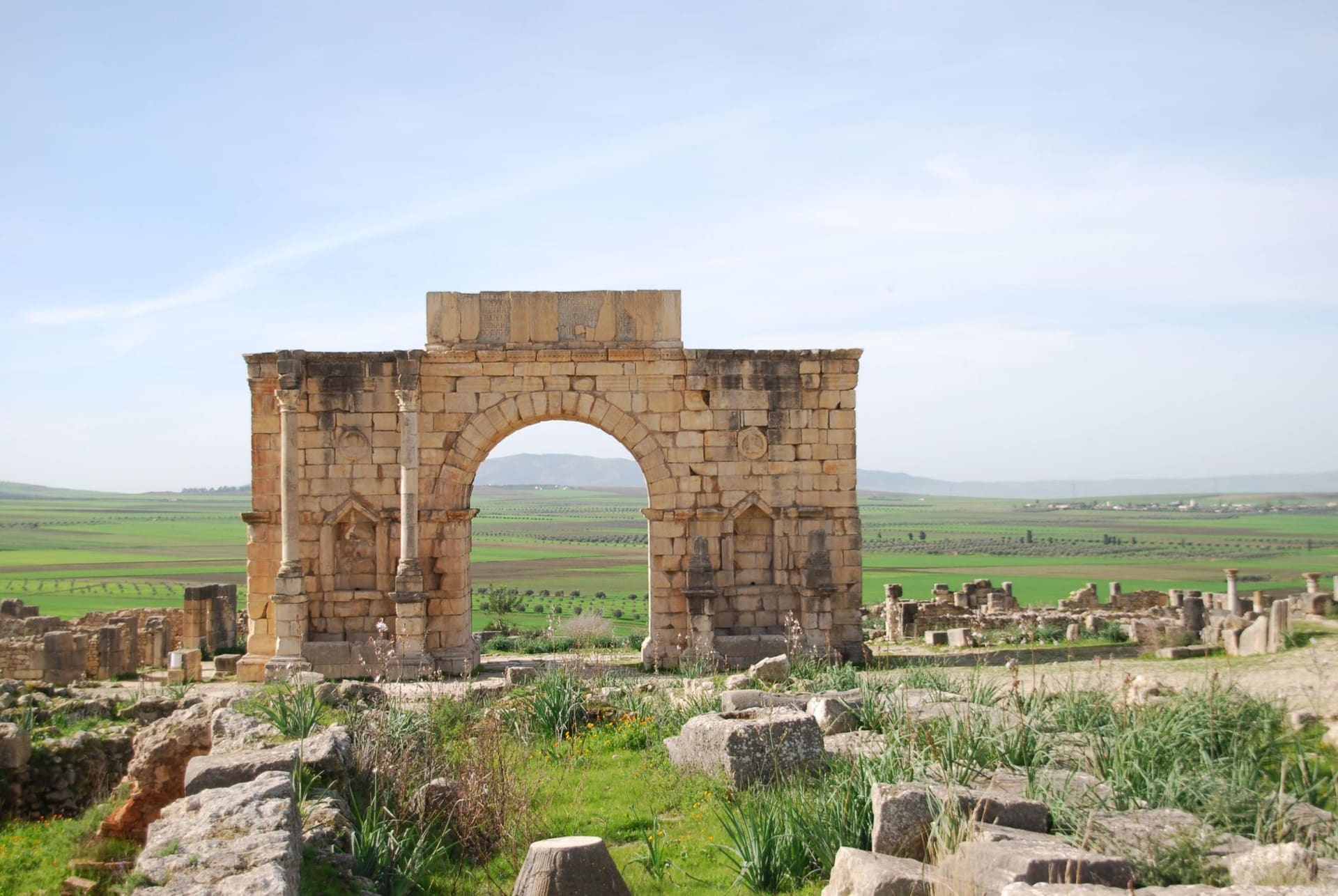
Volubilis
"I came expecting a few sad columns and found an entire Roman city lying open like a book nobody had bothered to close."
Volubilis was the one stop on our Moroccan loop that I’d quietly assumed would underwhelm. I’d seen Roman ruins before — Lia and I have made something of a habit of them around the Mediterranean — and I figured a provincial outpost on the empire’s far southwestern edge would be a handful of stumps and an interpretive sign. I was wrong, which I’ll admit happens more often than my self-image prefers. Volubilis is the real thing: a substantial Roman city, abandoned and weathered but astonishingly legible, spread across a green hillside about half an hour’s drive from Meknes.
We arrived mid-morning, and the first thing I noticed was the storks. They’ve colonized the tops of the columns and the triumphal arch, building enormous untidy nests and clattering their bills at each other, completely indifferent to the ancient masonry holding them up. There’s something fitting about it — empires fall, storks carry on.
Walking the dead city
What makes Volubilis remarkable isn’t the height of its monuments but the completeness of its layout. You walk down what was clearly a main street, past the foundations of houses, into the forum, under the arch of Caracalla, along the line of the old olive-press workshops — this was an oil town, and the stone presses are still here, the channels where the oil ran still carved into the floors. You can read the city’s economy in its ruins, which is the kind of thing I find far more moving than any restored cathedral.

But it’s the mosaics that stopped me. They’ve been left in situ — in the floors of the grand houses where they were laid, open to the weather, no glass, no rope at a distance. You stand at the edge of a room that hasn’t had a roof in fifteen hundred years and look down at Bacchus, or Orpheus charming the animals, or geometric patterns rendered in tiny tiles with a precision that feels almost insolent given how long they’ve survived. Lia crouched over one for ages, and a guard wandered over not to hurry her but to point out a detail she’d missed — a dolphin worked into the border.
The light and the silence
We’d come from the sensory overload of Fes, and Volubilis was the opposite: space, wind, birdsong, the smell of wild fennel that grows everywhere among the stones. In spring the hillside is green and dotted with poppies, and the contrast of red flowers against pale Roman limestone is the kind of thing that makes you stop talking.

There’s almost no shade, which matters enormously here. We made the mistake of lingering until the sun got high, and by noon the open site had turned into a frying pan. The site is large, the ground uneven, and the heat is the kind that sneaks up on you while you’re admiring a floor.
When to go: Spring — March and April — is ideal, when the hills are green and the wildflowers are out and the temperature is still kind. Arrive at opening or come in the late afternoon for the best light on the stone and to dodge the midday heat. Avoid high summer midday entirely; there is no shelter and the site is utterly exposed. Bring water, a hat, and good shoes for the uneven paving.