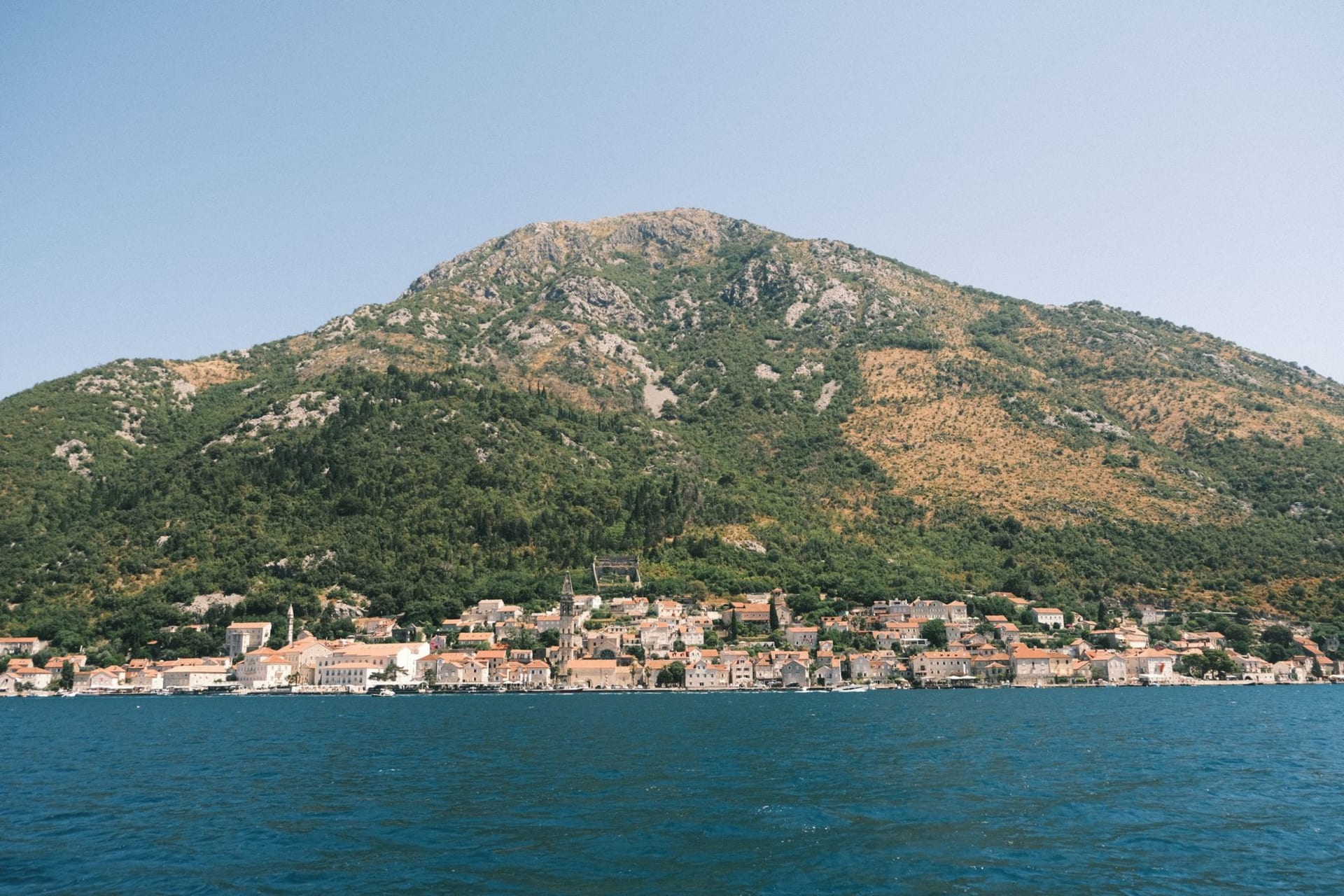
Perast
"There are villages that have made peace with being small. Perast made peace with being perfect."
The taxi driver from Kotor told me Perast had maybe four hundred residents and seventeen churches, and I assumed some of this was exaggeration. By the time I’d walked the single main street end to end twice, I wasn’t sure the church count was high enough. They’re everywhere — baroque facades wedged between palazzo walls, bell towers rising above rooftops, tiny chapels tucked into courtyards you’d only notice if you tried every door. Perast was a maritime power in the seventeenth and eighteenth centuries, and its townspeople built with the ambition of people who’d seen Venice and weren’t particularly intimidated by it. Then the sea trade shifted and the money left, and the churches stayed.

The bay here is extraordinary. I say this having seen a fair amount of coastline, and the water at Perast is in a category of its own — shallow, glass-still in the morning, so clear that the pebbles on the bottom seem lit from below. Two small islands sit a few hundred meters offshore: Saint George, a monastery on a dark cypress-covered rock that you can look at but not visit, and Our Lady of the Rocks, a church that was literally constructed by accumulating stones thrown from passing boats every year for generations. The tradition continues. A fisherman rowed me out there for a few euros, and I sat inside the church for longer than I’d planned, watching the light shift through small windows onto paintings offered by sailors who’d survived storms at sea.
The waterfront promenade runs the length of the village, and the café tables are the closest I’ve found to the Italian concept of the passeggiata — nothing to do except sit and watch the bay change color. I ordered a coffee at two in the afternoon and was still there at five. The woman who brought it came back twice to ask if I wanted anything else, then stopped asking and seemed to accept that I was simply going to be there for a while. I think Perast does this to people.

There is one restaurant near the main square that does things properly — the mussels come from the bay itself, steamed in local wine with garlic and oil, and the bread is for soaking up what’s left at the bottom of the bowl. It’s the kind of meal that feels like an argument for simplicity.
When to go: Perast in May or early June is close to perfect. The crowds are modest, the water temperature is approaching swimmable, and the afternoon light on the stone facades lasts long enough. September is equally good. In July and August, tour groups arrive from the cruise ships in Kotor and the main promenade becomes congested between eleven and four — arrive before ten or after five.