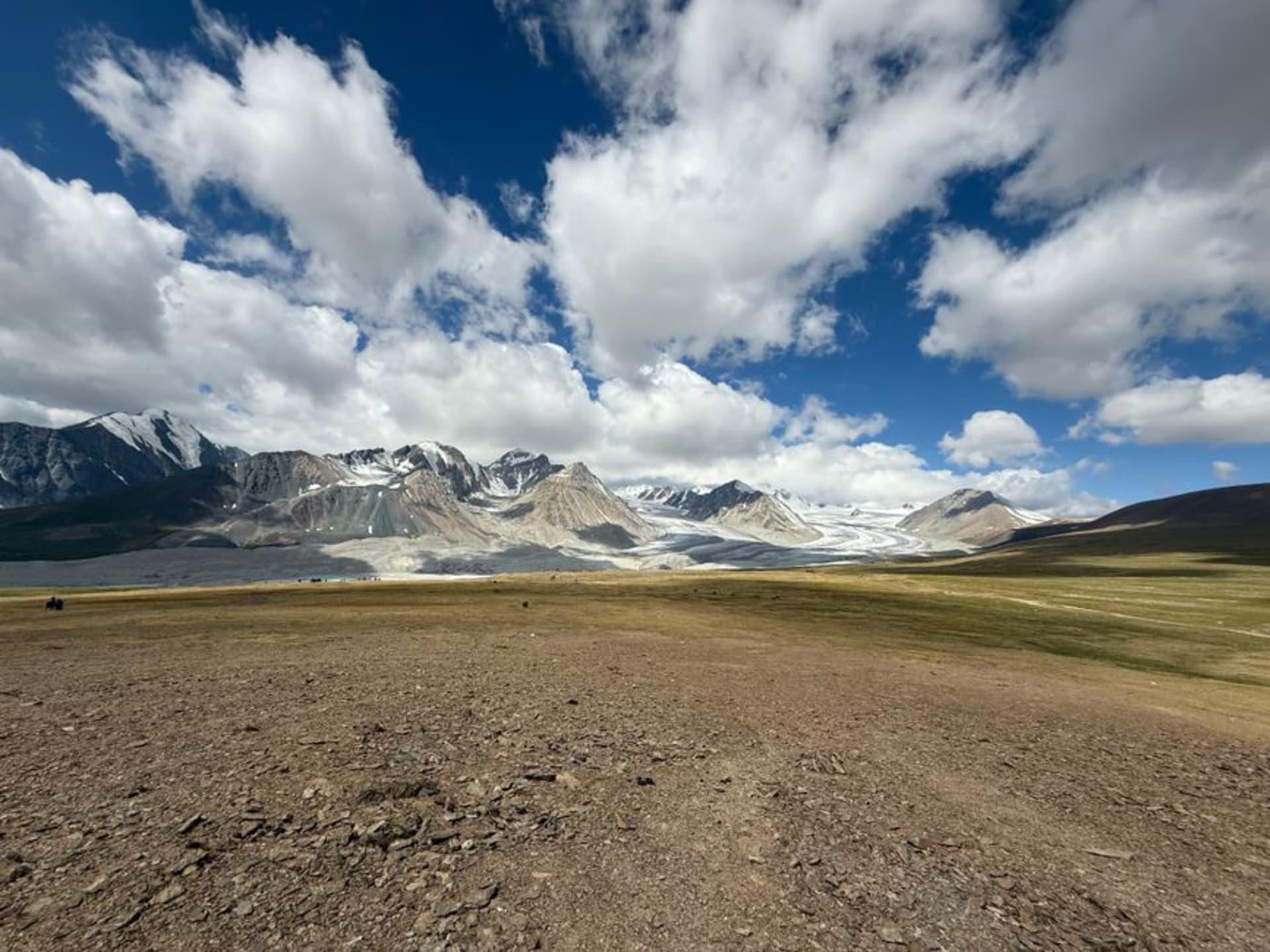
Altai Tavan Bogd National Park
"I was further from Ulaanbaatar than most Mongolians will ever travel in their lives, and closer to Kazakhstan than to anywhere I'd call familiar."
Five glaciated peaks at the far western edge of Mongolia, where Kazakh eagle hunters still ride the ridgelines and three countries meet at a single snowbound point.
Getting to Tavan Bogd requires committing to the idea that Mongolia is bigger than you think it is, even after you’ve already adjusted your expectations upward once. The park sits at the absolute western tip of the country, in Bayan-Ölgii province, close enough to both Russia and China and Kazakhstan that the tripoint where Mongolia, Russia, and China meet lies within a day’s ride of the park boundary, and the local population is overwhelmingly ethnic Kazakh rather than Khalkh Mongolian — a different language, a different script until recently, a different set of customs stacked onto the same relationship with horses and eagles that defines this whole stretch of the Altai.
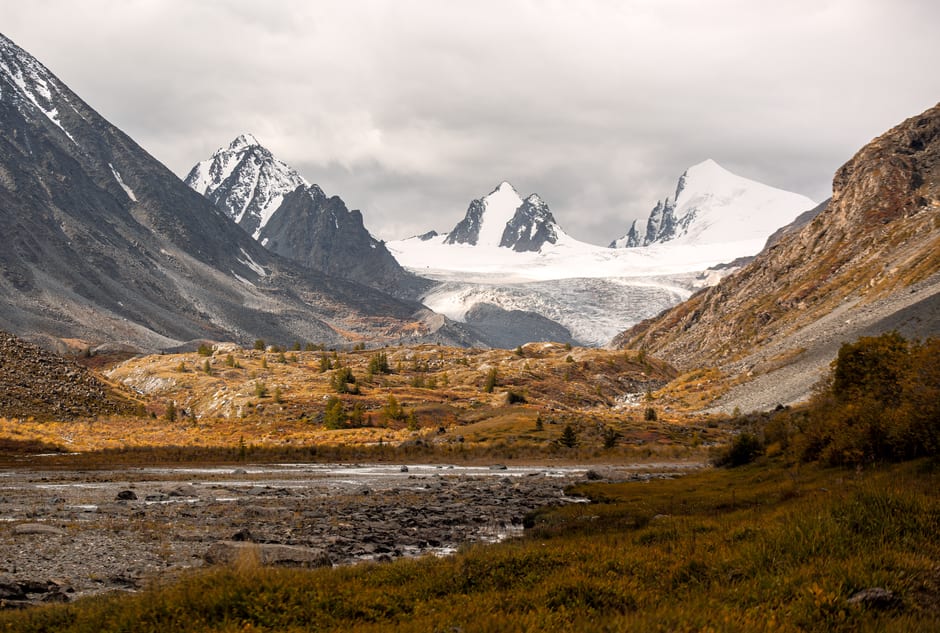
The park’s namesake is Tavan Bogd Uul, “Five Saints Mountain,” a massif of five peaks the tallest of which, Khüiten, tops out above 4,300 meters and carries Mongolia’s largest glacier system down its northern face. I did not attempt the peaks — that requires a mountaineering permit, real technical gear, and considerably more ambition than I brought — but the trek to base camp through the Tsagaan Gol valley is achievable for anyone reasonably fit, four or five days on horseback or on foot alongside a string of pack animals, camping each night in a valley a little more dramatic than the one before.
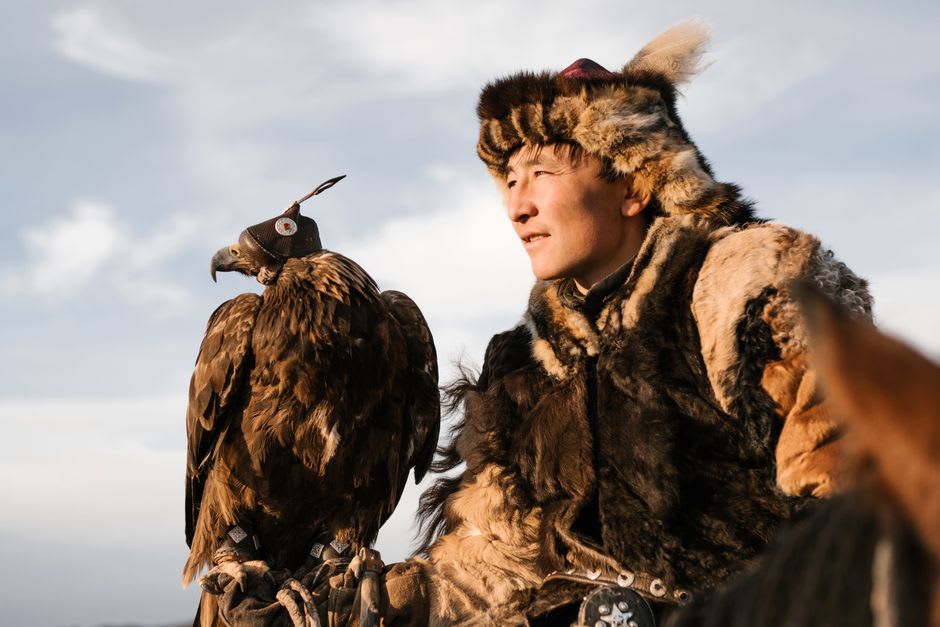
The eagle hunting tradition here is not staged for visitors, though visitors are increasingly permitted to watch it — I spent a morning with a hunter named Dalaikhan, whose golden eagle, a female he’d raised from a chick taken from a cliff nest years earlier, rode hooded on his forearm through a two-hour ride up a ridge before he released her toward a fox pelt dragged by an assistant on a length of rope, a training exercise rather than a hunt, but the speed and violence of the dive were entirely real. He told me, through a translator, that he would release the eagle back to the wild after seven or eight years, as tradition required, so she could raise young of her own before she grew too old to breed. “She is not mine,” he said. “I am only keeping her for a while.”
The glacial valleys beneath the peaks hold ancient deer stones and rock carvings — some of the oldest Bronze Age petroglyphs in Central Asia, images of ibex and deer and hunting scenes pecked into rock faces thousands of years before anyone wrote anything down about this place. Walking among them with the glaciers visible above and the silence of the high valley pressing in, the depth of time here felt less abstract than usual.
Getting here means flying to Ölgii and then driving hours further on tracks that occasionally disappear into gravel wash, and the whole undertaking has a logistics-heavy, slightly expedition-like character that most of Mongolia, for all its remoteness, doesn’t quite match. That’s exactly why I’d go back.
When to go: July and August are the only realistic window for trekking, when the high passes are clear of snow and the rivers are fordable rather than raging. The annual Golden Eagle Festival in nearby Ölgii, usually early October, is worth timing a visit around if eagle hunting is the draw.