Asia
Mongolia
"I drove six hours without seeing a road sign. That was the point."
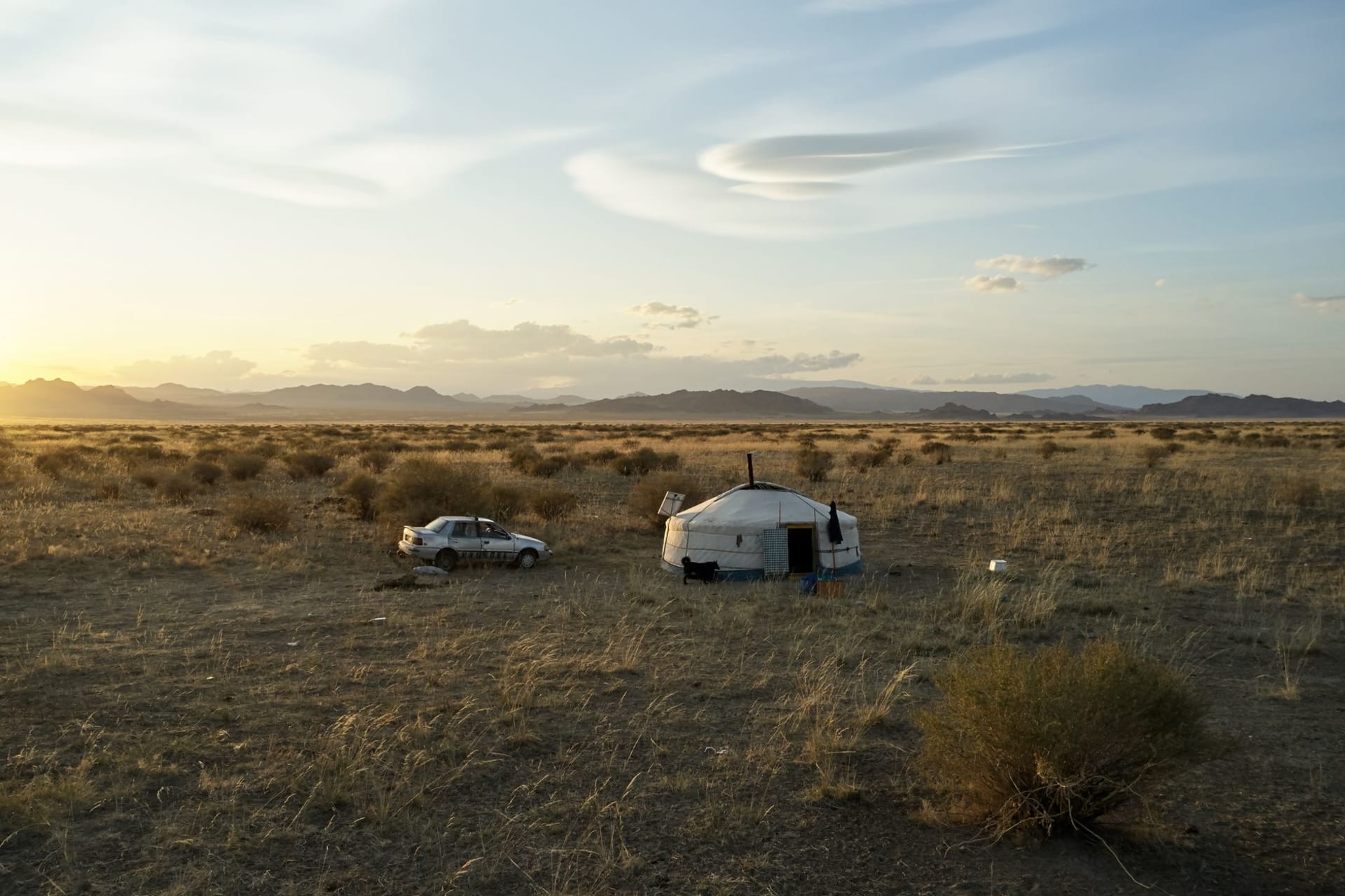
I arrived in Ulaanbaatar convinced I understood what emptiness looked like. I grew up near the Landes, I’d crossed the Sonoran Desert, I’d driven through the Bolivian altiplano at altitude. None of that prepared me for stepping out of a Russian van two days south of the capital and realizing the horizon was simply — gone. Not hidden. Not interrupted. Just absent, as if the earth had decided not to end.
Mongolia operates on a scale that rewires something in the brain. The Gobi is not the sandy dune field most people picture; it’s gravel plains, saxaul forests, and volcanic rock formations interrupted by the occasional camel train. The Khövsgöl in the north is a freshwater lake so cold and clear you can see fifteen meters down while sitting in a wooden boat. Between them, the central steppe rolls in every direction without a fence, without a road, without a cell tower — just grass, wind, and the occasional silhouette of a ger. I ate dinner that first night with a family I’d met an hour earlier, sitting cross-legged on a felt mat while the grandmother poured airag from a leather flask and the youngest child climbed onto my shoulder to see what I was writing. Nobody had invited me in a formal sense. The door was open, I was there, it was dinnertime. That is how it works.
The food took adjustment. Mongolian cuisine is built on meat and fat because the climate and the nomadic life demand it — boiled mutton, tsuivan noodles cooked in broth, khuushuur fried dumplings eaten with both hands over a fire. I came to love the directness of it. No garnish, no reduction, no concept of a sauce. You eat what the land produces. In Ulaanbaatar, the scene is different: Korean barbecue joints, surprisingly good espresso in Soviet-era buildings converted by art students, a central market where the dried dairy products — aaruul, byaslag — look alien until you try them and realize they taste like a very serious version of cheese.
When to go: June through August for the steppe in full green, and for Naadam (mid-July), the national festival of wrestling, archery, and horse racing. September is sharper, colder at night, and dramatically empty. Avoid November through March unless you are specifically prepared for -30°C and know what you are doing.
What most guides get wrong: They treat Mongolia as a destination for extreme adventurers and sell it on logistics: the visas, the Russian vans, the lack of roads. All of that is real, but it misses the point. Mongolia is not hard travel — it is different travel. The absence of infrastructure is not an obstacle, it is the experience itself. The moment you stop trying to manage the itinerary and let the landscape — and the families you meet along the way — decide what the day looks like, everything opens up. That is not a tip. It is the only way this place makes sense.