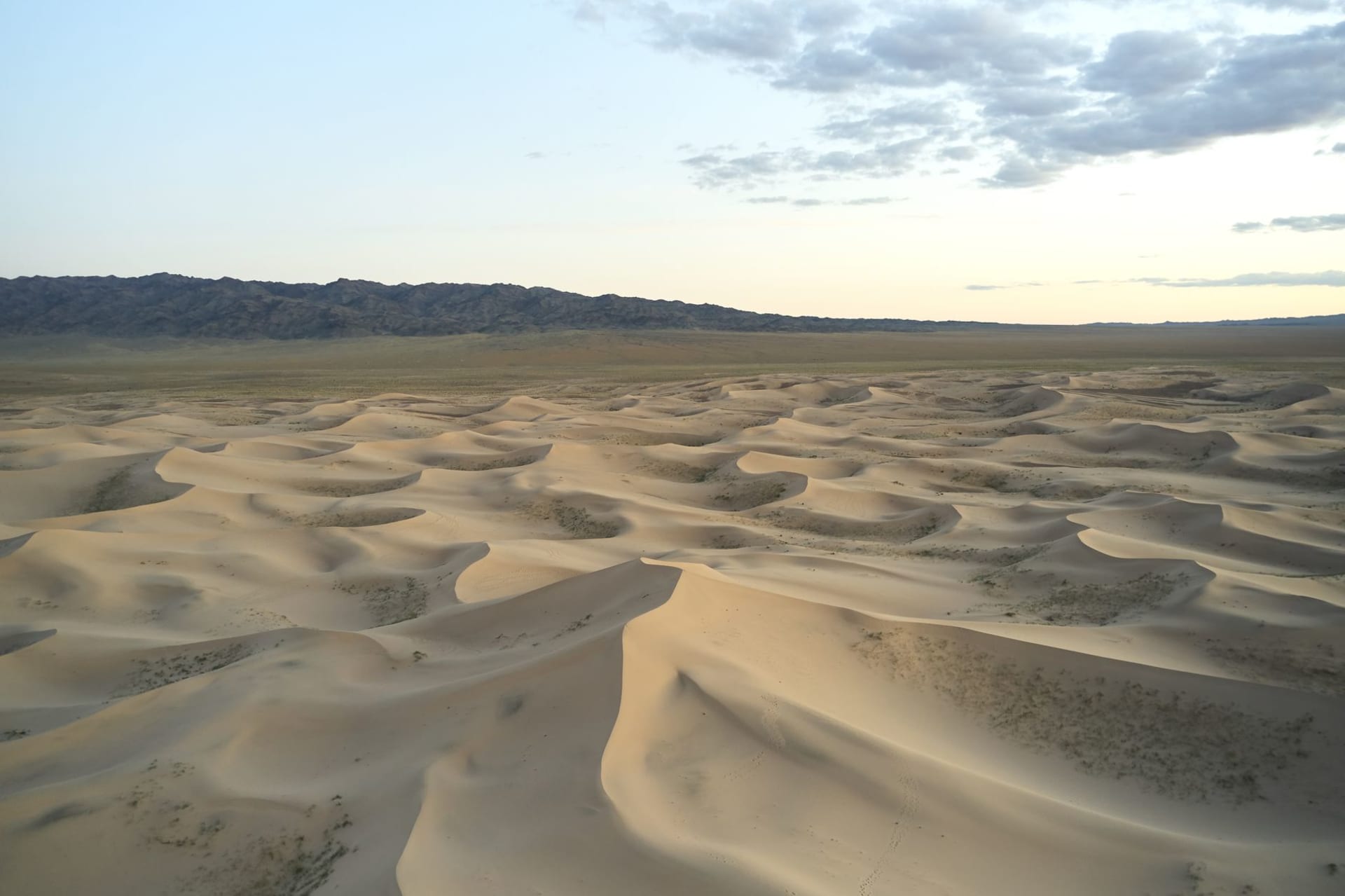
Khongoryn Els
"Climbing a dune is a humiliation engineered by physics: for every two steps up, the sand gives you one back, and it does so with what feels like personal contempt."
In the Gobi Gurvansaikhan, the great national park that covers a slab of southern Mongolia the size of a small country, there is a range of sand dunes so large it has its own weather and its own mountains. The Khongoryn Els — the locals call them Duut Mankhan, the singing dunes — stretch for roughly a hundred kilometres along the foot of the Sevrei mountains, and the tallest of them rise around three hundred metres, a sheer golden wall standing improbably against the flat gravel plain. We had been driving across the Gobi for two days, through a landscape so consistently empty that the dunes, when they finally appeared on the horizon, looked like a mistake.
The climb, and the noise
You cannot, it turns out, simply walk up a three-hundred-metre dune. I tried. The sand gives way under each step in a way that converts forward effort into a kind of sliding penance, and the ridgeline that looked twenty minutes away from the bottom took the better part of an hour of graceless scrambling, hands and feet, lungs burning in the dry air. Lia, who had wisely paced herself, arrived at the crest looking composed while I arrived looking like a man who had lost a fight with a beach. And then we sat down, and the wind picked up, and the dune began to sing.

The sound is real and strange and difficult to describe — a low, droning, resonant hum, somewhere between a distant propeller plane and an enormous cello, produced when the dry surface sand shears and cascades down the steep face in sheets. It rose and fell as the gusts came and went. I have read the physics of it since and the physics does not diminish it at all. Sitting on the crest with the whole Gobi spread out below — the gravel plain, the green ribbon of an oasis valley, the camels moving across it like punctuation — listening to several hundred metres of sand resonate beneath us, was one of those moments where I stopped narrating the trip in my head and simply shut up.
Camels, an oasis, and the long descent
The dunes sit above a surprising sliver of green: a spring-fed oasis valley where Bactrian camels graze and the nomadic families who herd them have lived for generations, several of whom run the ger camps where you stay. We rode camels the following morning along the base of the dunes — an experience I’d describe as majestic from a distance and alarming from on top — with a herder named Bataa who clearly found our nervousness very funny and was too polite to say so directly.

The descent off the high dune, I should say, redeems the brutal climb entirely. You simply run, or bound, or roll, and the slope that fought you for an hour delivers you to the bottom in about three exhilarating minutes, the sand singing under your heels the whole way. I did it twice. I would have done it more if my dignity and my shoes had held out longer. The Gobi is a place that asks a lot and gives strangely, and Khongoryn Els is the clearest example of the bargain I found.
When to go
Late May to early September is the accessible window, with June and September offering the most bearable temperatures — Gobi summers are brutally hot at midday and surprisingly cold at night, so come prepared for both in the same twenty-four hours. Climb the dunes in late afternoon for the best light, the coolest sand, and the longest shadows raking across the ridgelines. Reaching the dunes means a long overland drive; build it into a wider Gobi loop rather than a rushed dash.