Musée Océanographique
"Cousteau worked here for three decades. You can still feel why he didn't want to leave."
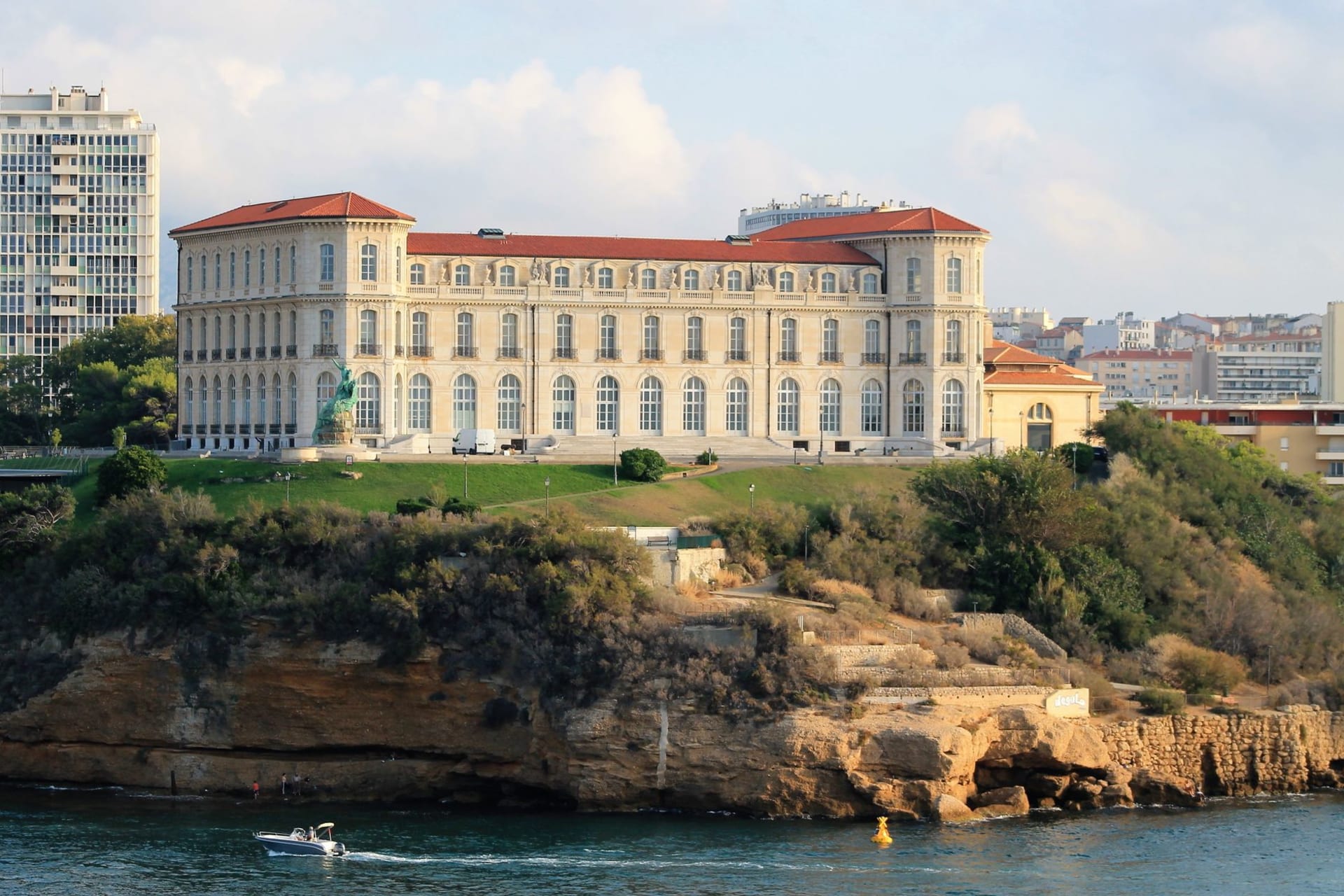
The Musée Océanographique is built into the cliff at the southern tip of Le Rocher, cantilevered over the sea at a height that makes the first view of it from the gardens below genuinely arresting. Prince Albert I founded it in 1910, bringing back specimens from his own oceanographic expeditions — he was, by all accounts, a prince more interested in the deep ocean than in casino revenues, which is the kind of historical personality that makes Monaco more interesting than its reputation suggests. Jacques Cousteau ran the museum from 1957 to 1988, thirty-one years during which the institution became a global symbol of marine exploration and conservation. You feel his presence still, in the slightly missionary quality of the exhibitions, in the sense that the building has a point of view.

The aquarium is the heart of the building and one of the finest in Europe. It occupies the basement, carved into the rock, and is divided into a Mediterranean section and a tropical section. The Mediterranean tanks are the ones I find more interesting: they show you what lives in the water directly beneath Monaco, which you have been looking at since you arrived — scorpion fish, sea horses, grouper, octopus moving through the blue-green light with that alien intelligence. The lagoon tank in the tropical section is a full reef system, two floors high, and watching it from the gallery level above is one of those experiences that quiets the mind in a way that is difficult to explain and very easy to experience. I stood there for a long time.

Upstairs, the museum proper is a grand nineteenth-century salon of natural history — whale skeletons hanging from vaulted ceilings, Prince Albert’s original ship instruments in glass cases, historical charts of currents and migration routes that look both scientific and beautiful. The terrace off the top floor faces south and east, and the view from it is vertiginous in the best way: the sea directly below, the French Riviera receding eastward toward Italy, Monaco’s harbor visible back to the west. I had a coffee there from the small café and felt enormously well-located. The building costs something to enter — not Monaco Casino prices, but real museum prices — and it is entirely worth it.
When to go: Midweek in shoulder season, when the crowds thin and the aquarium allows a calmer passage. The museum opens at ten and the early morning in the aquarium, before group tours arrive around eleven, is genuinely peaceful. Timed entry helps in summer but even so, the Mediterranean tanks and the basement galleries are always less crowded than the tropical lagoon. Allow two to three hours minimum if you want to give the whale room and the upper museum their due.