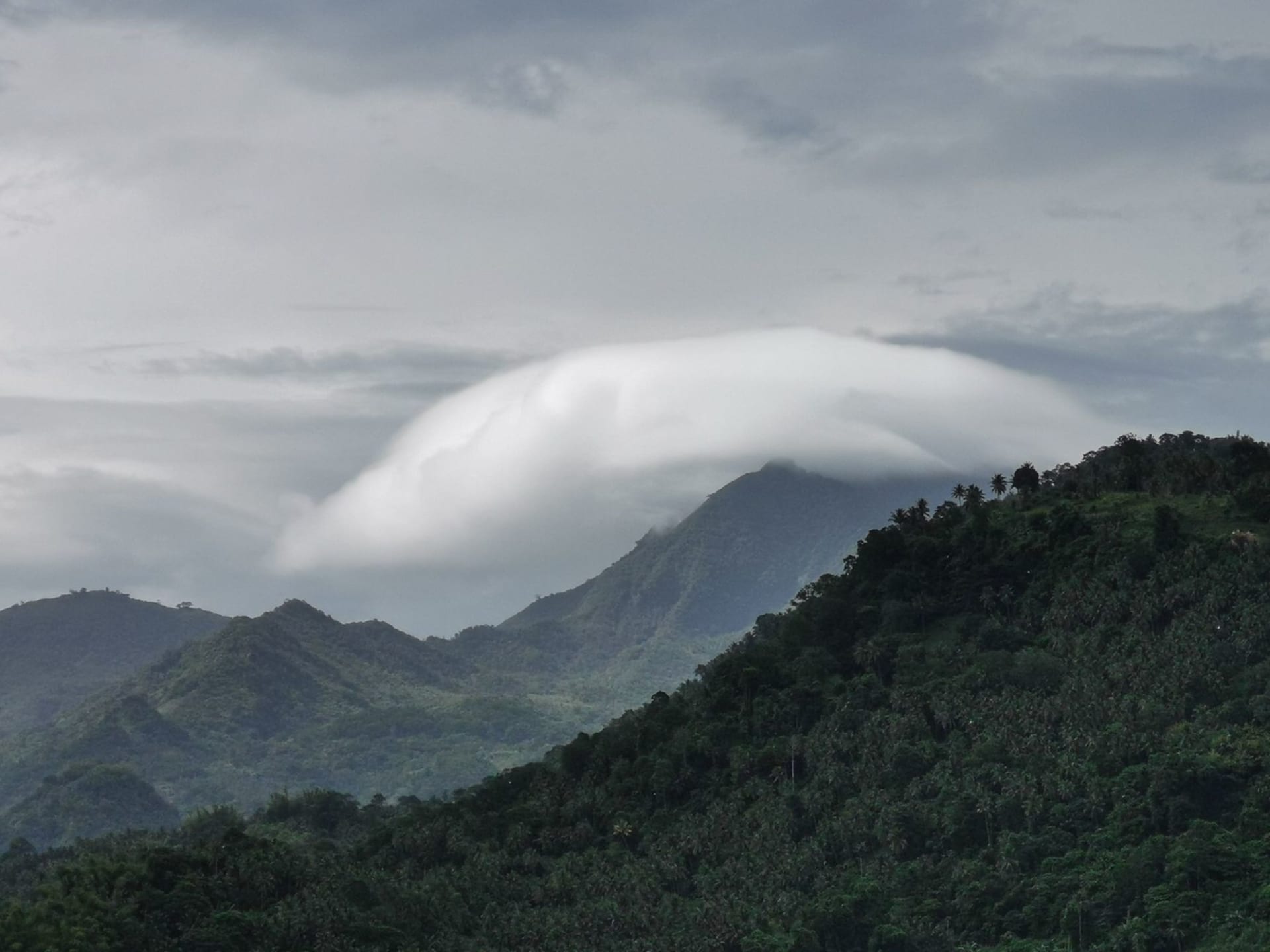
Sokehs Ridge
"The Germans built a road up here to bring down the men they'd executed. I walked it in the opposite direction."
Sokehs Rock appears from the water before anything else does. Coming in by ferry from the main port area of Kolonia, the basalt ridge rises on the northwest end of Pohnpei like a wall someone forgot to finish — sheer faces of dark volcanic rock, hundreds of meters high, draped in vegetation that somehow clings to near-vertical surfaces. From the town side, it dominates the skyline. From the lagoon, it is the first thing that orients you. When I found the trailhead — down a residential street, unmarked, the path beginning between two houses — and started climbing, I was thinking about the view. I came down thinking about something else.

The Sokehs Rebellion of 1910 is not much discussed outside Micronesia. The Germans administered Pohnpei at the time as part of German Micronesia, and in 1910 they began forcing Pohnpeian men to work without compensation building the road that switchbacks up Sokehs Ridge. The men of Sokehs island refused. When German officials came to enforce the labor order, the Sokehs killed the district administrator and several others and retreated to the ridge, where they were pursued through the jungle for weeks. German warships arrived. The rebellion was crushed. Seventeen men were publicly executed and their bodies were displayed at the base of the ridge as a warning. The community was exiled from Pohnpei entirely. What remains on the ridge today are the German fortifications — concrete walls and gun placements half-consumed by jungle — along with views of the lagoon that the men who built the road never got to appreciate in peace.
The hike itself is steep, hot, and short — maybe forty-five minutes to the ridge from the trailhead, with a punishing final pitch that requires hands on rocks. The reward is one of the finest views in Micronesia. The entire lagoon spreads below, the outer reef a pale line where the Pacific changes color, the mangrove-fringed islets of Sokehs dotting the water between the ridge and the open sea. On a clear morning, before the daily clouds build over the interior, the visibility extends to the horizon. I sat in the shade of a mango tree that had taken root in a gap in a crumbling German wall and ate a breadfruit dumpling I’d bought from the market that morning, still warm from its banana-leaf wrapping.

The descent passes closer to the cliff edge and gives a different angle on the rock face — close enough to see the texture of the basalt, the ferns growing from cracks, the swifts that nest in the overhang and dart out into the lagoon air below in arcs that seem to require a disregard for gravity. By the time I reached the bottom, sweated through, the afternoon rain was beginning its approach from the south. I made it to a covered market stall and drank a coconut and watched the rain move across the water.
When to go: Morning starts are essential — cloud cover builds over the Sokehs interior by mid-morning on most days. The path is slippery after rain, which is most of the time; trail shoes or rubber-soled footwear are non-negotiable. Go on a clear day, December through April if possible.