Maní
"Diego de Landa burned the books here. The convent is still standing. The poc chuc is extraordinary. I'm not sure what to make of that."
The town of Maní is 90 kilometers southeast of Mérida, in the low limestone hills of the Puuc region. You reach it through a series of small Yucatán towns where the highway narrows and the houses get lower and the signs start including Maya-language annotations. The day I drove there, the Puuc hills were hazy with dry-season dust, and Maní announced itself quietly: a church, a plaza, a few streets. Nothing that prepares you for what happened here.
On July 12, 1562, Fray Diego de Landa — the Franciscan bishop of the Yucatán — conducted an auto-da-fé in this town. He had discovered that Maya people he had been converting to Christianity were still practicing their traditional religion, and his response was imprisonment, torture, and the burning of every object of traditional religion he could gather. He burned 5,000 idols, 13 altars, hundreds of ritual objects, and 27 folded bark-paper books — Maya codices, the accumulated written knowledge of an entire civilization. He later expressed regret for the scale of the proceedings. The codices were gone.
Only four Maya codices survive in the world today. The Dresden Codex is in Germany. The Madrid Codex is in Spain. The Paris Codex is in France. A fragment is in Graz, Austria. Nothing remains in Mexico.
La Asunción de María and What Remains
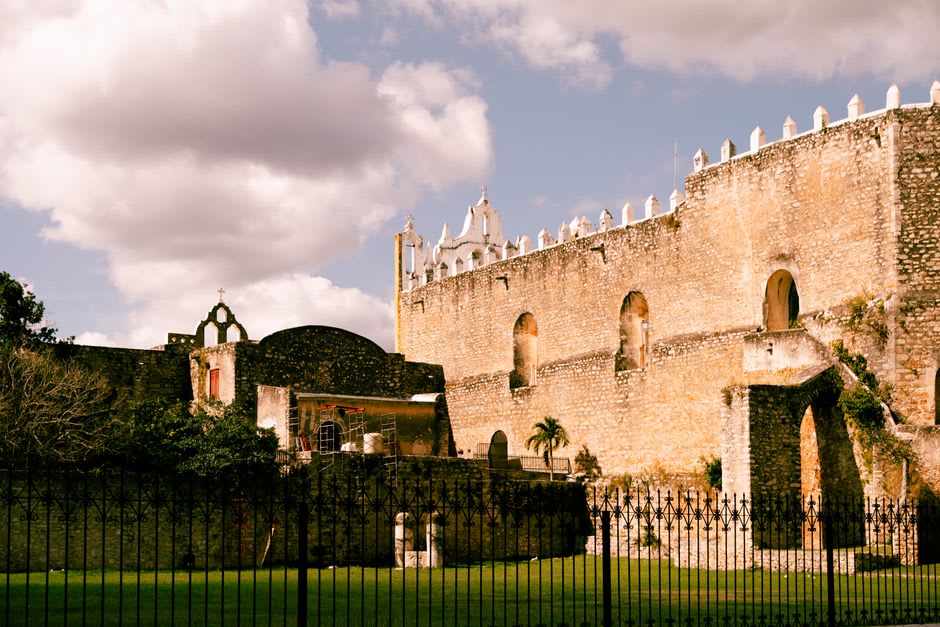
The church and ex-convent of La Asunción de María was built in 1549 — older than the burning, which happened in its shadow. It’s a Franciscan structure in the blunt colonial mode the early missionaries built throughout the Yucatán: thick walls, a single nave, an open atrium that would have been used for outdoor mass before the indigenous population was deemed ready to enter the church itself. The stone is limestone, the regional material, and the whole complex is the color of old bone in the midday heat.
I walked around the atrium slowly. A school group from Mérida was there, the children mostly ignoring the church and chasing each other around the fountain while a teacher explained something about the convent to a small cluster of attentive ones. The weight of what happened here is not architectural — the building doesn’t show you what it witnessed — but standing there knowing it made the stones feel different. Heavier, and also more ordinary, which is its own kind of disturbing.
The church interior is spare and cool. There’s a wooden retablo, some colonial-era paintings, the particular quality of silence that old churches in hot climates accumulate. I stayed longer than I’d planned.
The Poc Chuc
And then there is the food, which creates its own strange situation.
Maní is known throughout the Yucatán for poc chuc, the dish of pork marinated in sour orange and cooked over wood coals. I had eaten poc chuc in Mérida several times before driving here, and I had thought I understood it. I did not understand it.
The poc chuc at the restaurant on Maní’s main plaza — a large, open family comedor that has apparently been operating for generations — is made with pork sliced thin, pounded, soaked overnight in naranja agria (the specific Yucatecan sour orange, not available in France, that I have failed repeatedly to replicate with combinations of orange and lime juice), and grilled over wood rather than gas. The char is different. The sour orange penetrates differently. There’s a black bean paste on the side and pickled red onions and habanero salsa and warm tortillas from a woman pressing them in the back corner.
It is a direct and remarkable piece of cooking, and I ate it in a plaza a hundred meters from where the books burned, and I could not fully resolve what to make of that. Mexico contains contradictions that don’t resolve on your timeline, and Maní is a concentrated version of that lesson.

Maní is an easy day trip from Mérida or from the Puuc archaeological sites — Uxmal, Kabah, Sayil are all within an hour. Go for the church and stay for lunch. The comedor on the plaza usually runs out of poc chuc by two in the afternoon, so don’t arrive late.