Ek Balam
"Standing at the top looking over unbroken canopy with eight other people around me, I kept asking myself why everyone goes to Chichén when this exists."
I left Valladolid just after seven, early enough that the colectivo north had two empty seats and the driver was still finishing his coffee. The road runs flat through milpa fields, past topes that exist for no visible reason, and deposits you at a site entrance calibrated for maybe a hundred visitors on a busy morning. Chichén Itzá, forty-five minutes south, processes that many before breakfast. Walking through the gate the first time I had a peculiar sensation — the complete absence of infrastructure designed to manage crowds — and I wasn’t sure whether to feel grateful or suspicious.
The Frieze at the Summit
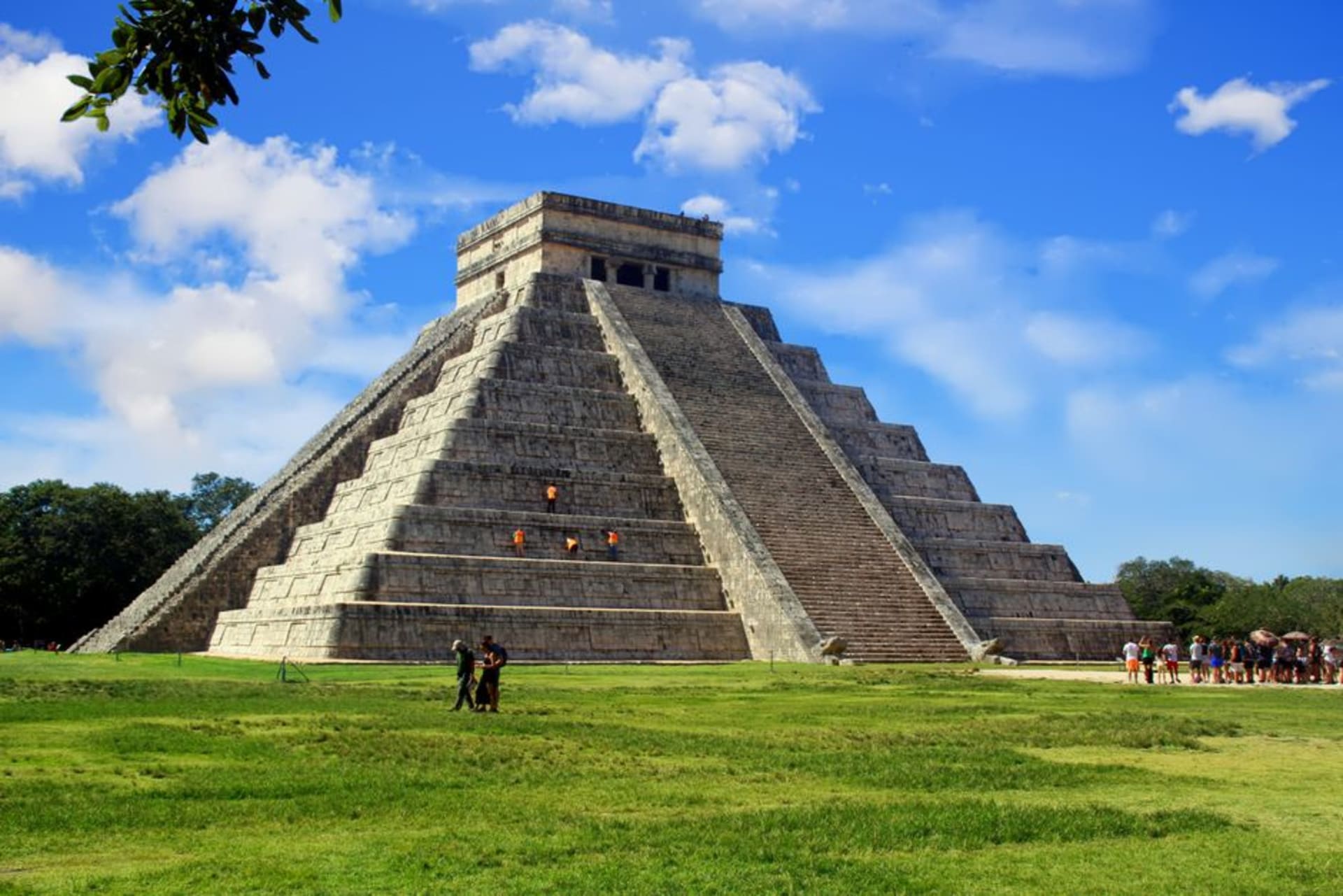
Thirty-two meters is not the tallest pyramid in the Yucatán, but it is currently the tallest one you can still climb, which changes how you relate to it from the first step. The stone is steep enough on the upper section that I used both hands, and it is original — no center rope, no concrete rail — just limestone worn smooth in the middle and sharp at the corners. Two-thirds of the way up, the royal tomb entrance stops you before you have fully processed what you are looking at.
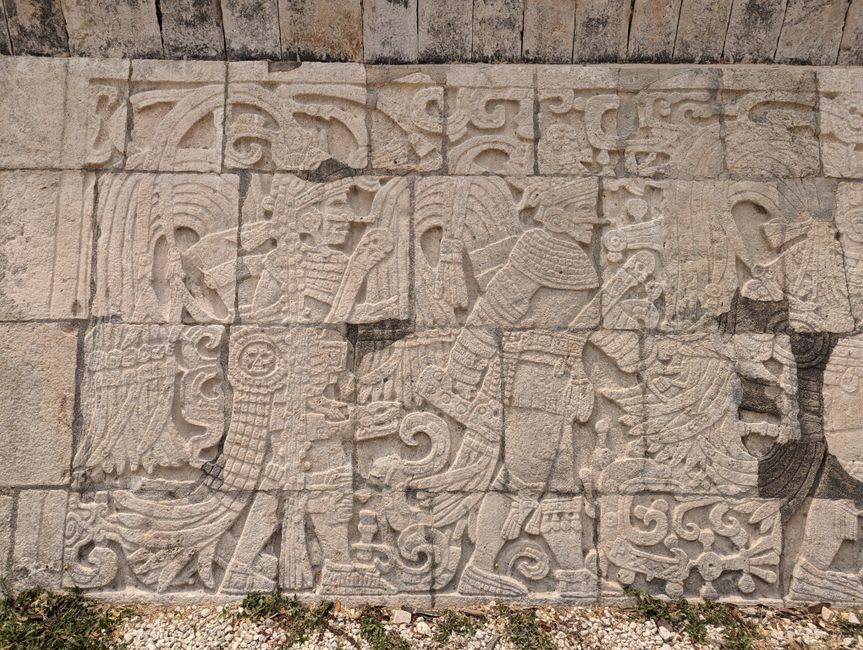
The winged figures flanking the jaguar mouth are intact. Twelve hundred years old and readable at arm’s length — individual feathers, individual teeth, an identifiable expression on each guardian’s face. A protective roof went up in the nineties; without it none of this would have survived the weather. At the summit, unbroken jungle in every direction, no hotel corridor visible on the horizon, maybe eight other people standing there with me on a Thursday morning. A plaque confirms this is the best-preserved Maya stucco façade in existence. I did not need the plaque to believe it.
Cenote Xcanche and the Village Below
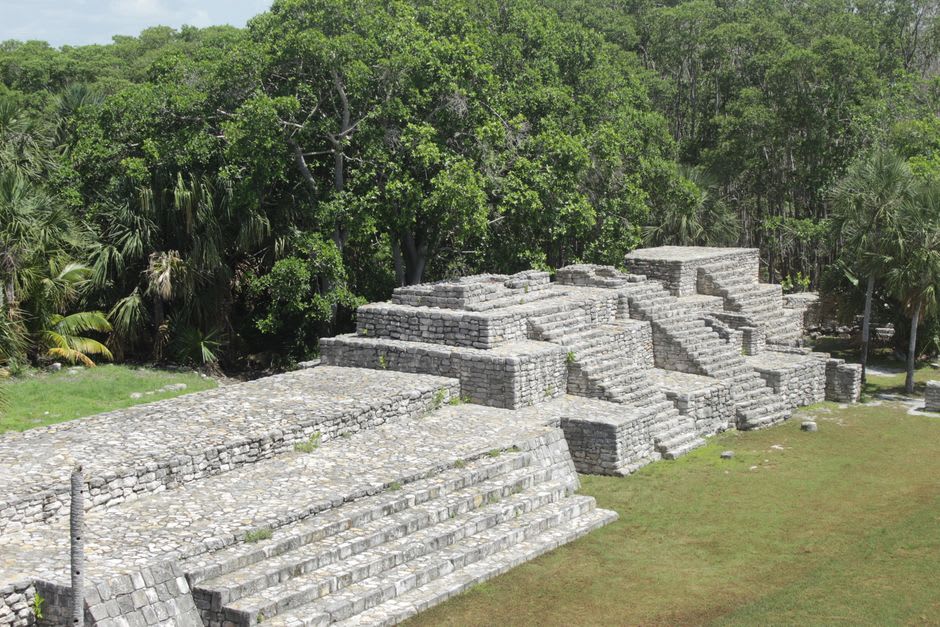
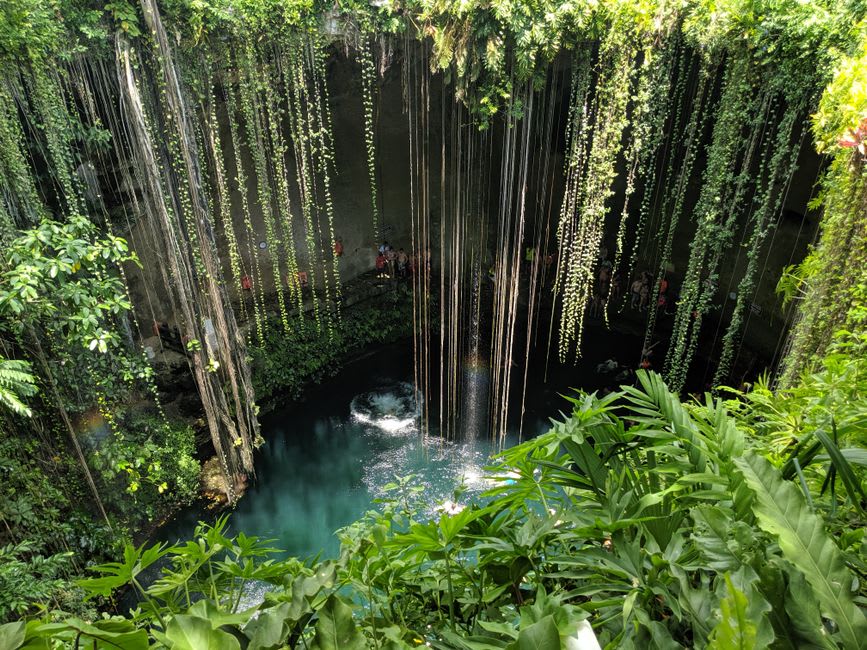
The site itself takes two hours if you read every panel — the Oval Palace, the Twin Pyramids, the sacbé that crosses the central clearing. None of it has been reconstructed into a glossy approximation; what restoration work exists is minimal and clearly labeled. Afterward, the village at the entrance road rents bicycles for sixty pesos, and Cenote Xcanche is a twelve-minute ride through the milpa on a flat dirt track. It is a wide circular cave, about fifteen meters down by rope ladder, cold and very clear. A platform above lets you swing in on a rope. I swam for forty minutes and saw three other people.
Back at the parking area, a woman sells marquesitas most mornings — the Yucatecan crepe rolled with Edam cheese and honey that people here eat at any hour of the day. The Edam is not optional and it is correct. It is worth sitting on the curb with one before you get back in the colectivo.
The Argument for Arriving at Seven
The low eastern light hits the frieze at an angle that makes the stucco figures throw actual shadows, which is when they are most legible. The other reason is temperature — the exposed limestone steps at seven in the morning in July are manageable; at eleven they are not. Tour groups from Valladolid arrive between nine and eleven, not in Chichén numbers but enough to change the quality of the summit. Come first and you have thirty minutes at the top, possibly an hour, with the canopy to yourself.
There is no restaurant inside the site. Bring water and something to eat. Valladolid is the right base — thirty minutes south, a real city with good longaniza at the market on Calle 32 and one of the most handsome main squares in the Yucatán.
Getting There
Colectivos leave from the corner of Calle 44 and Calle 39 in Valladolid, near the OXXO — not from the main terminal. They run roughly every forty minutes from around six in the morning and cost about forty pesos each way. The ride is thirty to forty minutes. A taxi from Valladolid runs two hundred fifty to three hundred pesos each way and is worth negotiating if you want to hire the driver for the morning and include the cenote.