Chichén Itzá
"At 7:45am, before the first tour buses, El Castillo stands in a silence it hasn't earned and probably doesn't need. It's extraordinary anyway."
I want to begin with what I think is the most useful thing I can say about Chichén Itzá, which is this: the crowds do not diminish the archaeology. I made the mistake, before going, of reading too many accounts that foregrounded the tourist experience — the vendors, the buses, the sheer density of people at peak hours — as if the crowds were the primary fact of the site and the Maya ruins were a kind of backdrop to them. This is exactly backwards. The crowds are real, and I’ll address them, but El Castillo is one of the most precisely engineered structures I’ve ever stood in front of, and it is this regardless of who else is standing there.
The correct approach to Chichén Itzá is entirely logistical. Solve the logistics and the site gives you what it has, which is very considerable.
7:30am and What It Offers
The site opens at 8am. If you arrive at 7:30 — which means arriving at the entrance by 7:30 rather than at your hotel alarm at 7:30 — you will be in the first group through the gate. The first group through the gate at Chichén Itzá has approximately thirty minutes of a different experience than anyone who arrives at 9am will have.
I was not fully awake when we walked through the entrance. The access road from the parking area to the main structures takes about five minutes to walk, and I was on my second coffee of the morning, which I’d poured into a thermos at the hotel specifically for this purpose. Lia, who is significantly more functional before 9am than I am, was already moving quickly ahead of me on the path.
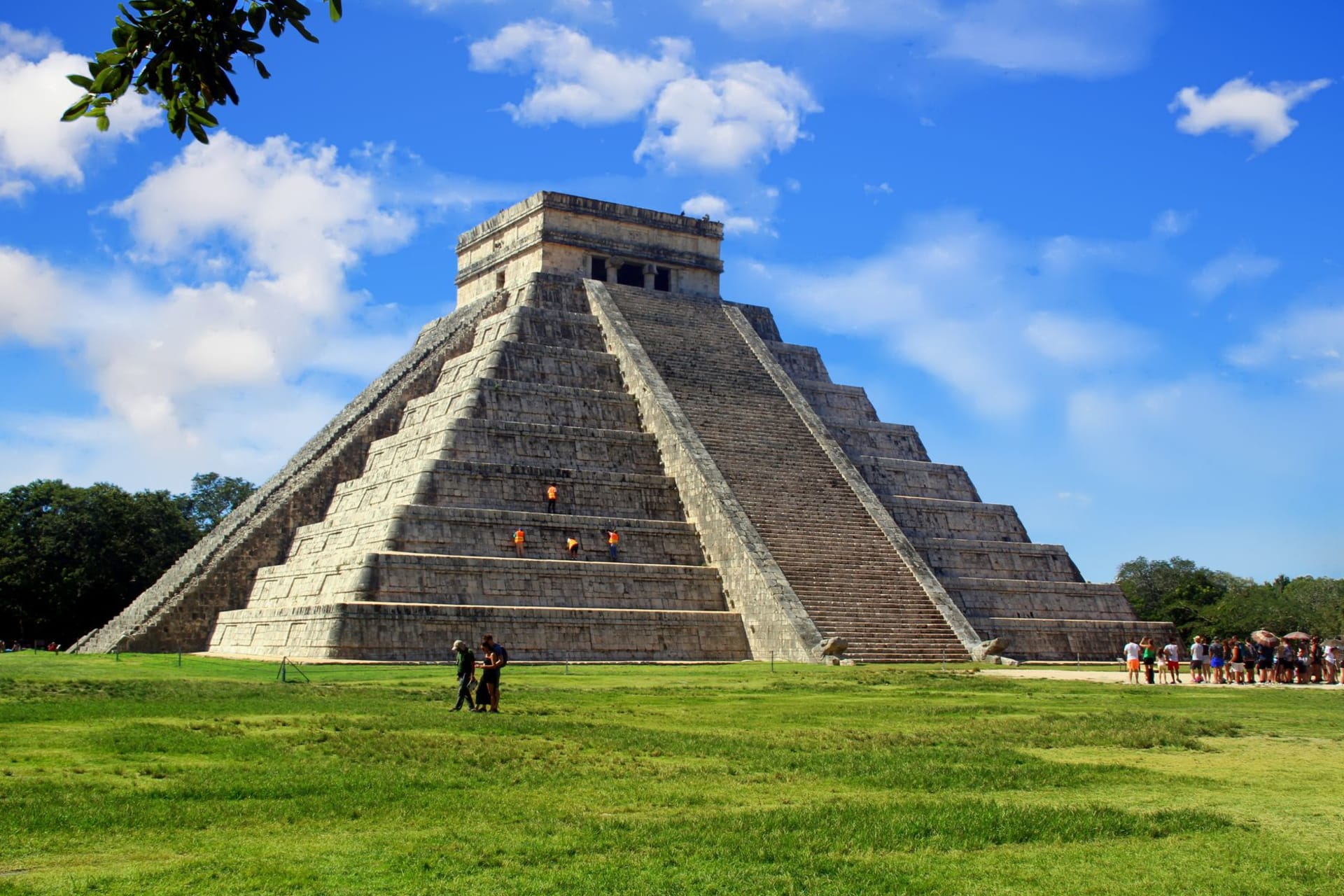
El Castillo appears before you’re expecting it. The trees line the path and then open, and there it is — the pyramid, 30 meters high, ninety-one steps on each of four sides plus the platform step at the top equaling 365, oriented to the cardinal directions with a precision that took me a moment to register as intentional and then continued to register. The morning light was coming from the east, which lit the north staircase and put the other faces in shadow, and there were perhaps fifteen people in the entire clearing.
I stood there for what I think was five minutes without moving.
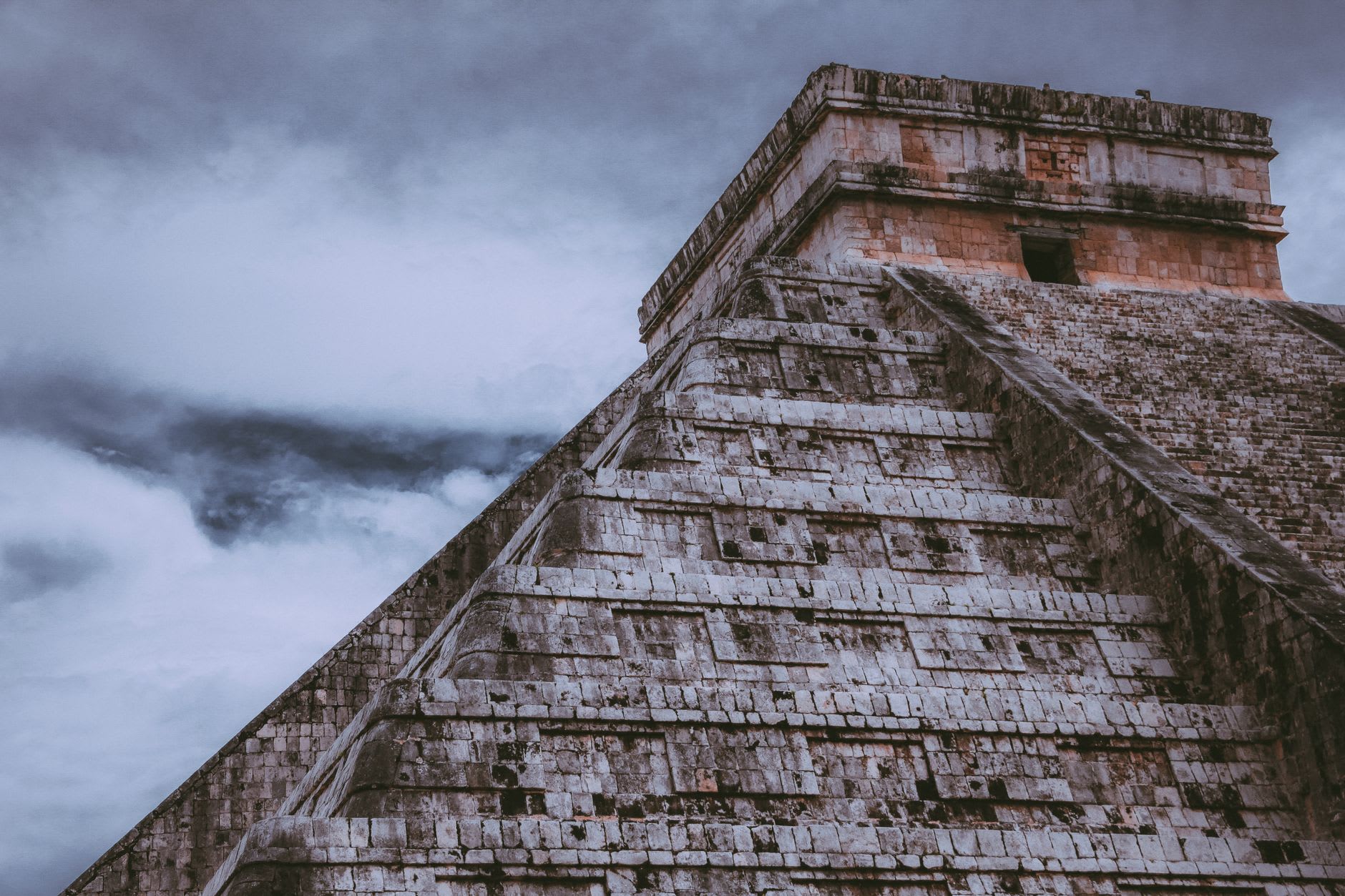
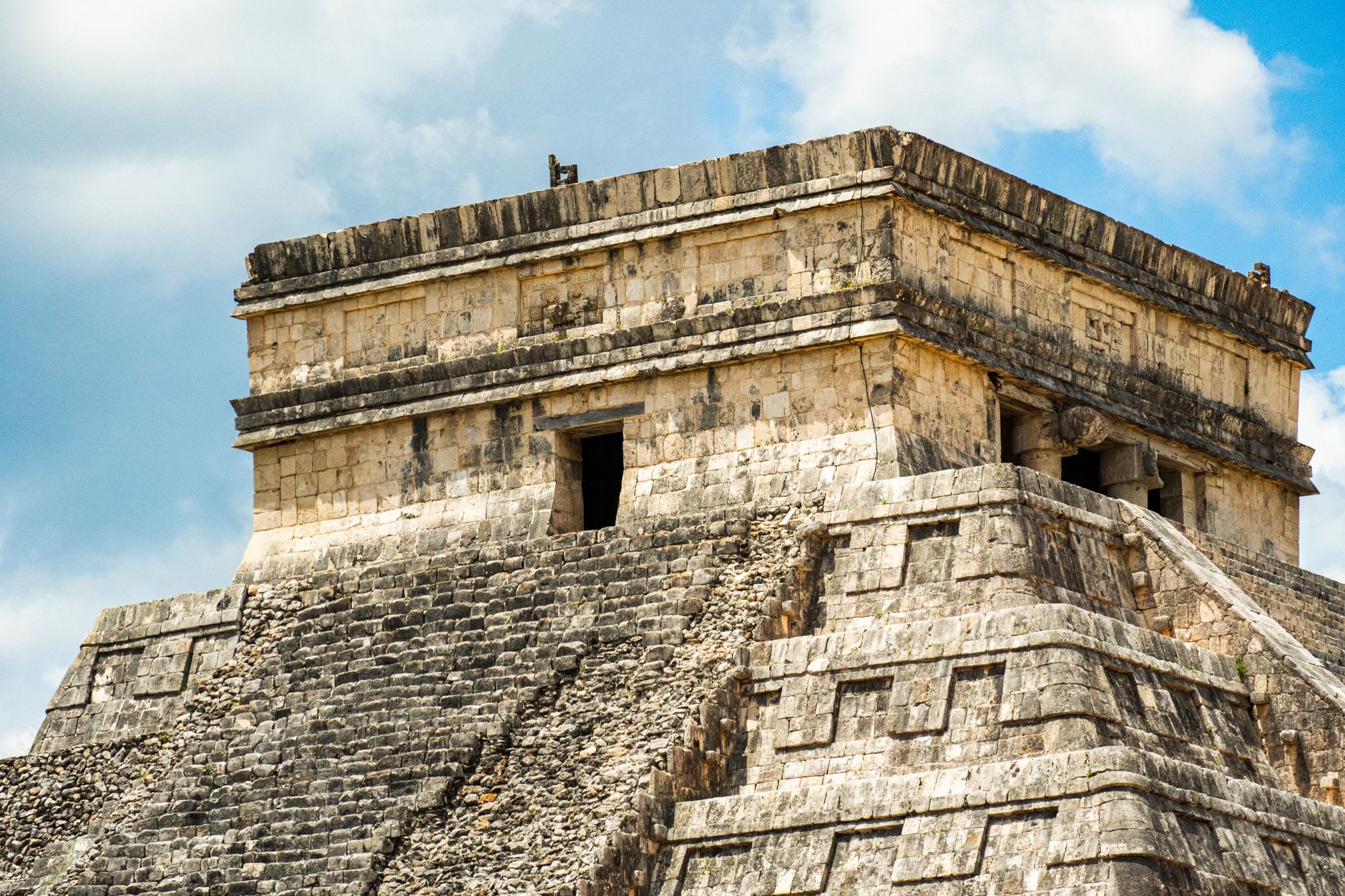
El Castillo works at this scale because it’s designed to be seen from ground level as something that compresses the sky. You feel the geometry from below, not from above — the angles of the staircase balustrades, the way the nine terraces produce a shadow play that changes through the day. The structure is not ornate in the way that, say, Uxmal or Palenque are ornate. It is purely geometric. The ornament is the mathematics.
The Observatory, the Ball Court, and the Equinox I Watched on Video First
El Caracol is the round building at the south end of the site, and it is the one that makes me most aware of my own ignorance of what I’m looking at. Circular buildings are rare in Maya architecture — most Maya construction is rectilinear, based on a logic of stacked horizontal planes. El Caracol spirals. Its windows align with the azimuth positions of Venus at key points in its 584-day cycle. The Maya calendar, which is significantly more complex than the Gregorian one, required this level of astronomical observation to maintain, and El Caracol is the instrument that did it. I walked around it slowly and thought about what it means to build a telescope a thousand years before the word telescope existed.
The Great Ball Court is the largest ball court in Mesoamerica — 168 meters long, with stone rings set 8 meters high on the vertical walls. The acoustics are famous and real: a clap at one end produces a clear echo at the other. A guide near us demonstrated this for his group and the echo bounced back so cleanly that people laughed in surprise. The carvings along the lower walls show the ballgame ritual in detail, including the decapitation scene whose interpretation is still debated — whether it represents the losing captain or the winning one being sacrificed, and what the sacrifice meant in the context of the ritual. These are not questions with settled answers.
The equinox: twice a year — spring and autumn — the setting sun creates a shadow on the north staircase balustrade of El Castillo that appears as a undulating serpent descending from the pyramid’s peak to the serpent head at the base. I had watched this on video several times before visiting. Watching it on video is genuinely impressive. I wanted to see it in person.
We went at the spring equinox. There were perhaps 8,000 people in the site. This is not an exaggeration — the crowd for the equinox event is massive, organized, and arrives from across the Yucatán and beyond. Families, archaeologists, tourists, people who have come specifically for this reason. The crowd formed in front of the pyramid hours before the effect began.
What I hadn’t anticipated was that the crowd itself became something extraordinary. Eight thousand people watching a shadow move down a stone staircase in absolute near-silence, the collective attention so focused that you could feel it physically, people craning forward as the serpent body lengthened segment by segment in the declining light. Someone near me was holding a child up to see. An older man was openly crying. The crowd watching the precision of something built a thousand years ago to capture this specific moment was as moving as the moment itself.
I was not expecting to be moved by the audience. I was anyway.
The Cenotes and the Decompression
By 10am the site is full. By 10am you’ve been there two and a half hours if you followed the early-entry advice, and you’ve seen El Castillo, El Caracol, the Great Ball Court, the Temple of the Warriors, the Group of a Thousand Columns, the Sacred Cenote at the site’s northern end (which you can walk to but not swim in — it was used for ritual offerings, and the underwater archaeology ongoing there has found extraordinary things). By 10am you are also hot, slightly footsore, and aware that the tour bus population has tripled in the time you’ve been walking.
This is the moment to leave and go swimming.
Cenote Ik Kil is 3 kilometers from Chichén Itzá and is the most famous of the nearby cenotes — large, circular, open-topped, with vines hanging from the rim and a platform for jumping into the 40-meter deep water. It can be crowded. Cenote Samulá, about 35 kilometers toward Valladolid, is quieter and feels more enclosed, with a low ceiling and roots hanging into the water and a population of blind fish visible near the bottom in clear visibility.
We went to Samulá. The water was cold in the way cenote water is always cold — an underground constant of around 24 degrees that feels extreme after an hour in 35-degree heat above ground. I swam for forty minutes and said very little and felt the morning recalibrate into something processable.
Getting There and Practical Notes
Chichén Itzá is located approximately 120 kilometers east of Mérida and 40 kilometers west of Valladolid. It’s more accessible from Valladolid — 40 minutes by car or colectivo — and Valladolid is a better base for the site than Mérida if you want to do the early-entry strategy, because you’re starting a shorter distance away.
ADO buses run from both Mérida and Cancún to Chichén Itzá directly. If you’re on a tour from Cancún, you will likely arrive mid-morning with the main bus wave. If this is your situation, the best mitigation is to go directly to the structures at the south end of the site first (El Caracol, the Observatory area) rather than heading to El Castillo immediately — the crowds tend to concentrate at the pyramid early.
The entrance fee is split: there’s a federal fee and a state fee, paid separately but at the same gate. Combined, the total is reasonable for what you’re getting. Guided tours from the entrance are available at multiple price points. The free guides near the entrance are sometimes excellent and sometimes not — asking to see credentials and clarifying whether they’re licensed by INAH (the federal archaeological institute) is worthwhile.
Dress for heat, bring more water than you think you need, wear shoes you can walk in for two to three hours on uneven ground. Bring a hat with significant brim coverage — the site is largely open and the Yucatán sun is serious at any hour. Don’t buy anything from the vendors at the entrance; the prices improve significantly inside and improve further still in Valladolid. And arrive at 7:30.