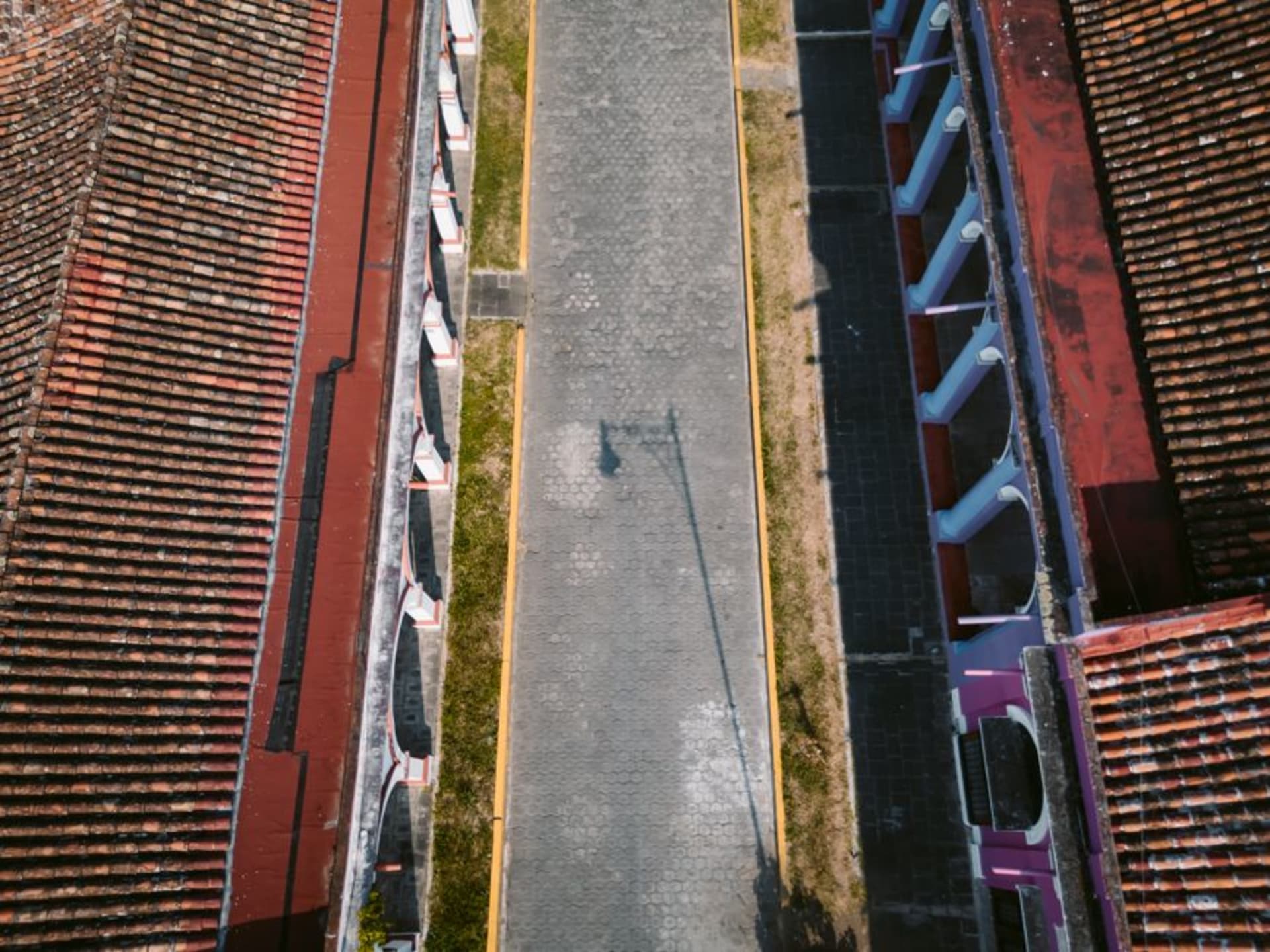
Santiago Tuxtla
"Not many towns share their main square with a colossal Olmec head, and Santiago Tuxtla wears this fact lightly."
I came from San Andrés Tuxtla on a colectivo that deposited me at the edge of the plaza without ceremony, which is how I prefer to arrive anywhere. It took me a moment to register what I was looking at. The Olmec head sits in the center of the zócalo on a low platform, massive and placid, and the people of Santiago Tuxtla were going about their morning — buying churros, checking phones, letting children run circles around benches — as though a three-thousand-year-old basalt face overlooking the church were the most normal arrangement in the world. In a sense, for them, it is.
A Very Famous Neighbor
The Cobata head — named for the hacienda where it was found in 1970 — is the largest Olmec colossal head discovered to date, standing around 3.4 meters tall and weighing somewhere near forty tons. The numbers are one thing; being next to it is another. It has closed eyes, which is unusual among the colossal heads, and this gives it the quality of someone deep in thought, or perhaps just tired of being looked at after three millennia. The flatness of the nose, the fullness of the lips, the sheer physical confidence of the carving — whoever made this understood weight, volume, and authority in a way that reads clearly across the distance of three thousand years. Children from the local primary school were sketching it when I arrived. A man was eating a torta on a nearby bench, paying it no attention whatsoever. That indifference felt like a form of respect that no museum could replicate.
The Museum and the Sunday Market
The Museo Regional Tuxteco, half a block off the plaza, is exactly the kind of regional museum I always underestimate: two rooms, a reasonable collection of Olmec ceramics and figurines, and a staff member visibly pleased to explain things when I asked. Admission costs almost nothing. A smaller replica of the Cobata head is housed inside, which lets you study the face without craning your neck in direct sun. On Sundays, the market along the main street fills with vendors selling fresh epazote, dried chile ancho and chile mulato in fat bundled stacks, and mole pastes from women who have been making mole considerably longer than I have been alive. I also found dried roots and pressed herbs I photographed with every intention of identifying later, and still have not. I bought a packet of what turned out to be chipotles mecos — paler and smokier than the red chipotles I was used to — and they were excellent in a pot of black beans the following week back in Puerto Escondido.
How to Spend the Afternoon
Santiago Tuxtla works best as an unhurried few hours with no agenda beyond the plaza and whatever you find beside it. Eat at one of the fondas on the side streets — I had a caldo de pollo with enough cilantro to constitute a separate course, and a plate of memelas with black bean paste that cost me well under two dollars. Walk the plaza a second time. Return to the Olmec head in late afternoon, when the light softens and the day-trippers from Catemaco have gone home. The town quiets considerably after four, and it is in that stillness that Santiago Tuxtla becomes most itself: a small city that has lived alongside something extraordinary long enough to stop making a fuss about it.
Getting There
Colectivos and ADO buses link Santiago Tuxtla to San Andrés Tuxtla (about 15 minutes) and Catemaco (around 40 minutes). From Veracruz city, take an ADO to San Andrés and transfer from the terminal there. Most people treat Santiago Tuxtla as a half-day stop between the two larger towns in the region, which is precisely the right approach.