
San Carlos Sonora
"The water here is not performing. The volcanic rock is not decorative. San Carlos doesn't look like a beach resort because it isn't one — it just happens to have a bay."
San Carlos, Sonora, is not Cancún. I say this not as criticism but as the most useful single fact about the place: if you arrive expecting the Caribbean palette — the turquoise water trending toward aquamarine, the white sand, the pelletized experience — you will be disoriented. What you get instead is this: black volcanic rock dropping into a turquoise that is genuinely that color, not enhanced, a bay that is enclosed on three sides by desert hills, one of them capped by the Tetakawi peak (410 meters of rhyolite rising directly above the water), almost no vegetation at the water’s edge, and a clarity of light that the Sonoran Desert produces in the afternoons when the heat has burned off whatever humidity was considering arriving.
I spent five days in San Carlos and found it one of the more quietly compelling places I’ve been to on the Mexican coast.
The Tetakawi
The peak defines the bay. From the water, it reads as a dark mass above the shoreline, its surface too steep for vegetation, the rock exposed in a way that makes geological age visible — you can see the layering in the formation from the bay, the different strata of volcanic material laid down at different moments. The Tetakawi is considered a sacred site by the Yaqui people, whose traditional territory extends through this region of Sonora.
I climbed it on my second morning, starting at 6am before the heat arrived. The trail from the base is not long — maybe 45 minutes to the summit — but it’s steep and the surface is loose volcanic scree in places, and the exposure on the upper section requires attention. There are no services, no railings, no markers beyond occasional painted rocks. I went with Lia, who is better at not looking down than I am and was accordingly not very sympathetic when I paused on the exposed traverse below the summit.
From the top: the bay below, the city of Guaymas (much larger, with a naval base and industrial port) visible to the southeast, the Sea of Cortés opening west toward Baja California, the desert hills receding in every direction. The view is not what I expected, which is to say it’s larger and emptier. San Carlos is a small resort community; Guaymas is the context it exists within; and the Sea of Cortés, seen from the Tetakawi summit, is a body of water whose scale is not apparent from the bay.
The descent is faster and harder on the knees. We were back at the trailhead by 8:30 and the heat was already arriving. I went directly into the bay.
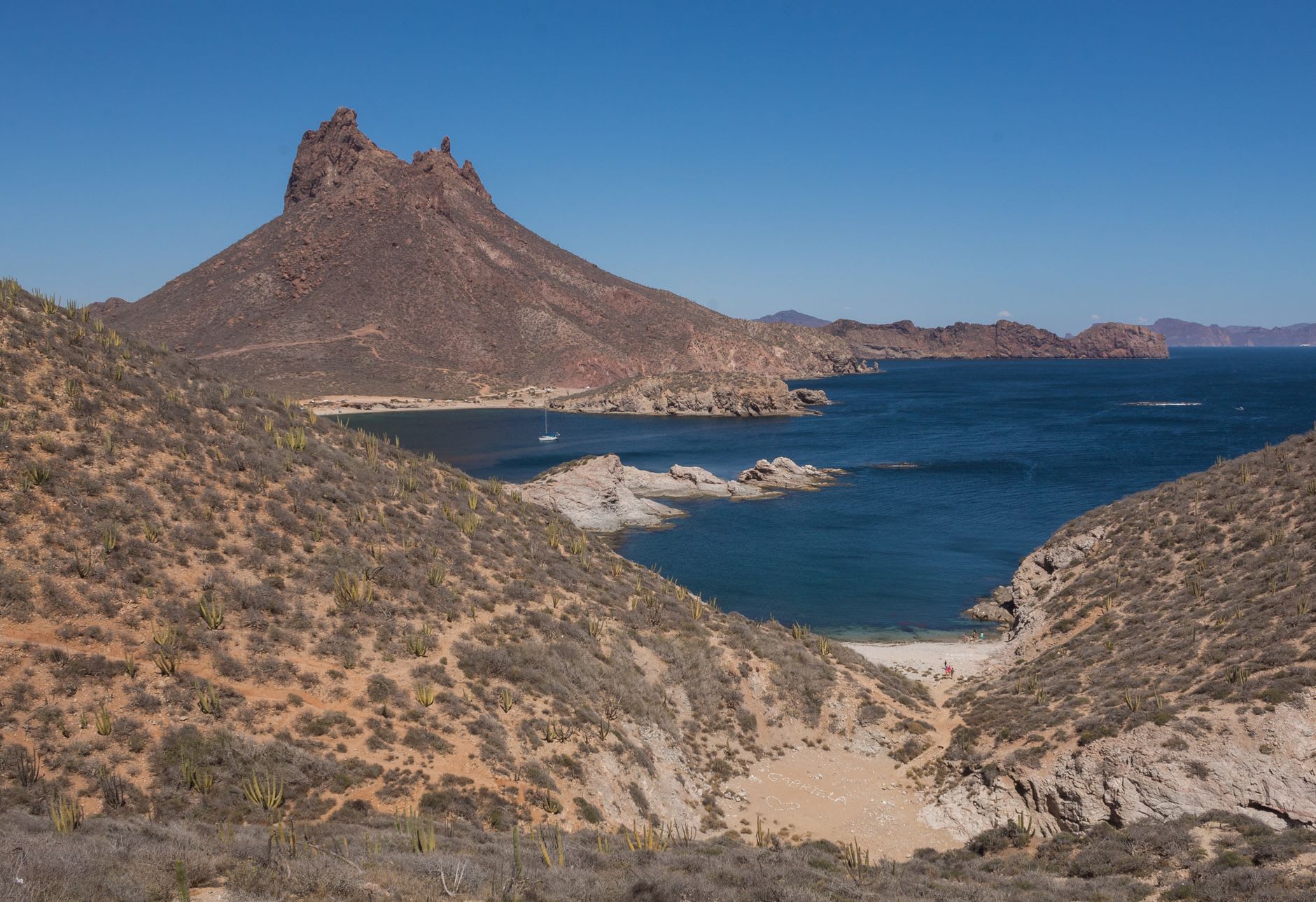
The Snorkeling
The Sea of Cortés has a marine biological richness that comes from the combination of deep cold upwelling water meeting the warm shallow bays of the coast, and San Carlos’s location at the point where these dynamics interact produces snorkeling that is not about color — not primarily — but about population density and diversity.
I rented equipment from a shop near the marina and went into the water at the base of the Tetakawi, where the volcanic rock extends into the bay and provides structure for reef fish. What I found in the first twenty minutes: sergeant majors and damselfish in predictable numbers, but also puffer fish resting on the bottom among the rocks, a small shoal of barracuda hanging in the mid-column completely motionless in the way barracuda do (which is alarming the first time and merely interesting the second), a Mexican hogfish whose colors involve a kind of iridescent lavender that seems designed by someone who had never seen a fish and was inventing one, and what I believe was a spotted moray eel retreating into a crevice but I only saw the tail end and I’m not going to claim certainty.
The water is clear enough that in shallow areas you can see individual sand grains on the bottom and read them the way you read a printed page. This is a function of the Sea of Cortés’s lower productivity relative to the Pacific — less plankton means more transparency, which means you see further and the fish are more visible than they’d be in water with more biological suspension in it. The tradeoff is that the snorkeling is less impressionistic and more specific, which I actually prefer.
There are proper diving operations in San Carlos for more depth, including several offshore sites and a sunken ship. But snorkeling from shore, in the immediate cove at the base of the Tetakawi, was sufficient for multiple hours of engagement and I didn’t feel like I was missing anything that required a tank.
The Bay at Dawn
The stillest hour in San Carlos is before 7am, when the wind hasn’t come up and the bay is flat and the light is coming from low in the east and doing what low morning light does to dark volcanic rock and transparent water. I walked to the beach at 5:50 on my last morning and sat on a rock and watched the light move across the bay for an hour.
The specifics: the Tetakawi goes from dark to rust-red to its ordinary grey-black as the light increases. The water goes from black to dark blue to turquoise in a progression that takes about forty minutes. A great blue heron stood on a rock forty meters to my left for the entire hour without moving except once to look at something in the water, which it decided wasn’t worth pursuing. Two brown pelicans did a low pass over the bay surface, their wingtips inches from the water, in that gliding inspection-flight pelicans do that looks like it should be effortful but clearly isn’t.
There were no other people on the beach. The resort community of San Carlos — which consists of condominiums, a marina, a handful of restaurants, a dive shop, a Pemex station — was not yet awake. In that hour it was possible to be in the bay without the resort community being the context, and the bay is better without that context.
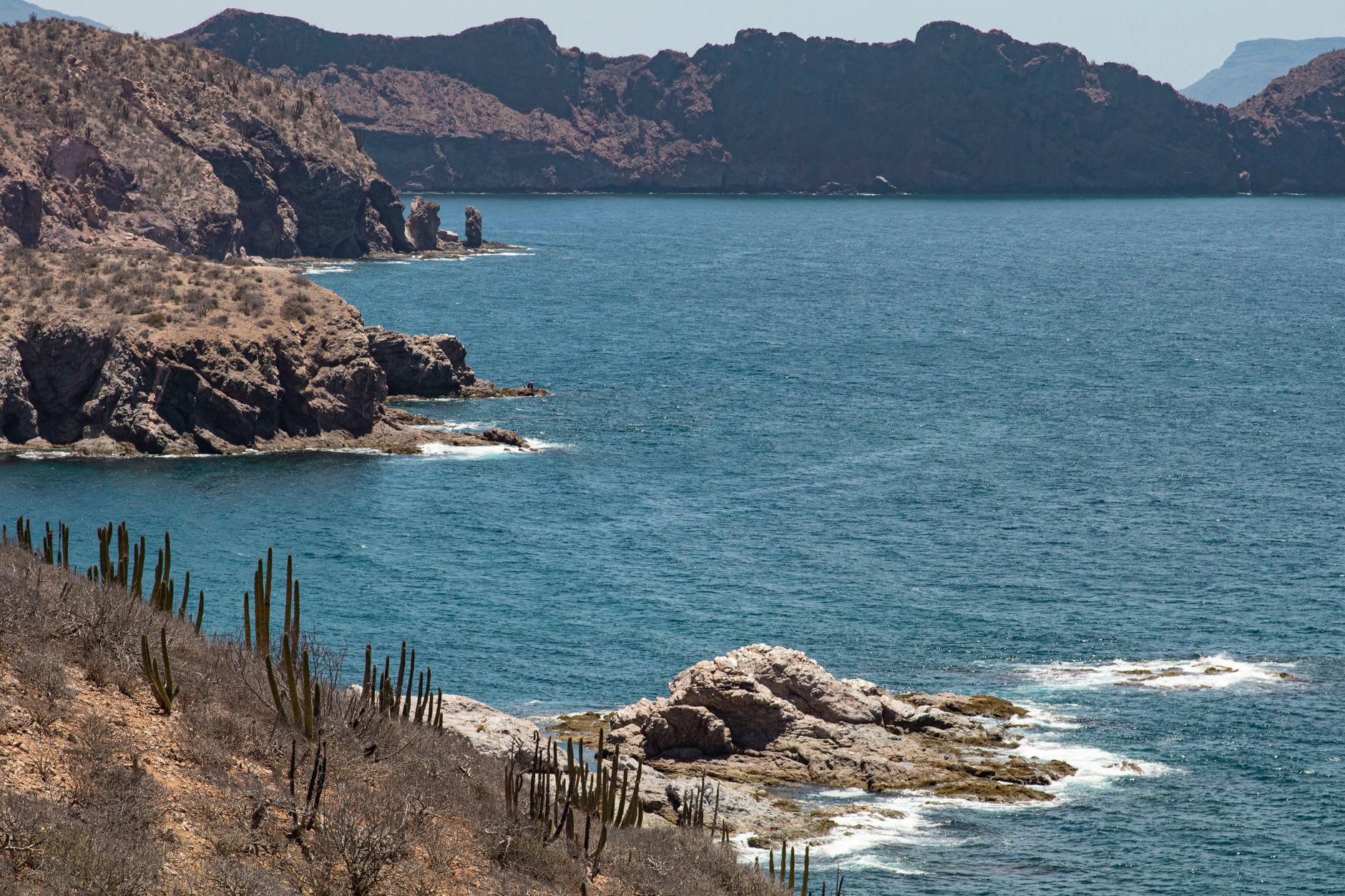
The Town
I should be honest about the town: San Carlos is a small resort community built for and largely populated by Americans and Canadians who winter there or own vacation properties, with a Mexican service population that lives mostly in Guaymas and commutes. The restaurants are decent and overpriced by Mexican standards, the marina has a pleasant café, and the artesanía shops sell the same inventory as every other artesanía shop in Sonora. None of this is exceptional.
What is exceptional is the physical setting, and if you come for the setting rather than the amenities — for the snorkeling, for the Tetakawi, for the dawn on the bay — then the mediocre restaurants are a minor inconvenience and the resort-community atmosphere doesn’t interfere with what you’re actually doing.
Guaymas, 20 minutes south by car, is where real Sonoran food is: the callo de hacha and the chocolate clam (almeja chocolata, another Cortés bivalve) at the market, the tostadas at the fish market, the Sonoran machaca (dried beef with scrambled egg) in the fondas near the bus station. Guaymas is a working port city with no tourist orientation and the food reflects it. San Carlos sends you there for lunch; Guaymas sends you back to San Carlos for the snorkeling.
Practical Notes
San Carlos is 20 kilometers northwest of Guaymas — the Guaymas-San Carlos road is easy and fast. Guaymas has an airport (GYM) with limited direct flights; more practical is to fly into Hermosillo and drive the two hours south, or take the bus from Hermosillo to Guaymas and a taxi to San Carlos.
The Tetakawi trail begins at a small parking area at the base of the peak, clearly visible from the main road through San Carlos. No fee, no formal management. Early morning start is strongly advised — by 10am the heat is significant and the exposed sections of the upper trail become uncomfortable.
Snorkel equipment rentals are available from dive shops near the marina. The best shore snorkeling is in the coves on the west side of the bay near the Tetakawi base. Water temperature runs warm (28-30°C) from June through October; a wetsuit is unnecessary then but advisable from November through April.
Accommodation ranges from condominiums available on rental platforms to a small number of hotels in the resort area. The Hotel Marinaterra is the most established mid-range option with direct bay access. Prices are higher than Guaymas and lower than Los Cabos for comparable quality.