Rioverde / Media Luna
"I rented a snorkel for 50 pesos from a man in a truck and swam in 28-degree thermal water so clear I could count the fish from the surface. Almost no one knows this exists."
The road from San Luis Potosí City to Rioverde crosses a landscape that Mexico does not advertise: dry, flat, the high desert of the Altiplano Potosino, the kind of country where the distances between things are enormous and the sky has room to operate. It is not beautiful in the way that colonial cities or tropical coasts are beautiful. It is beautiful in the way that empty places are beautiful, which requires some time to recognize and rewards the recognition.
I was driving through this landscape on the way to something else entirely when someone — I cannot now remember who — mentioned the Laguna Media Luna as an aside. A thermal spring lagoon. Warm water. Extraordinary clarity. Almost no one outside the region knew it existed. I filed this information away and then, three months later, drove the four hours from Mexico City specifically to see it.
I arrived expecting a pleasant swimming hole. This was an error of imagination.
The Lagoon
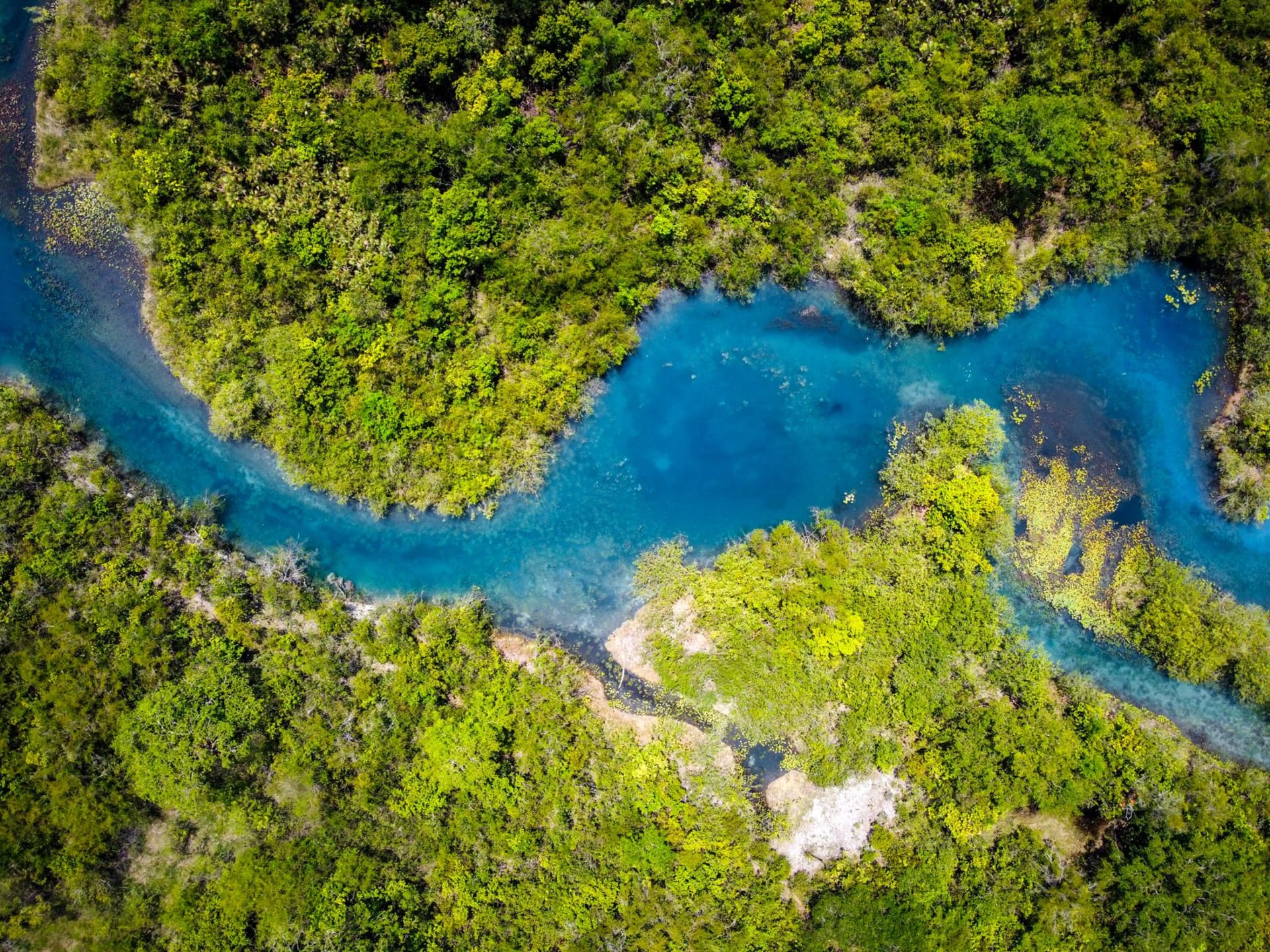
The Laguna Media Luna is named for its shape: a half-moon, or more accurately a kidney, approximately 300 meters long and perhaps 100 meters at its widest. It is fed by underground thermal springs that maintain a constant temperature of 28 degrees Celsius year-round regardless of the season or the air temperature outside — and outside in December, the morning air temperature in this part of San Luis Potosí is cold enough to make the steam rising from the surface in the early morning look dramatic.
The visibility in the lagoon is up to 20 meters in the clearest conditions. In practice this means that standing at the surface on a calm morning, you can see the bottom of the deepest section — 12 meters — with the casual clarity of looking through a window. The bottom is white sand and submerged grasses. The fish — mojarra, catfish, some species I didn’t identify — are visible from above as clearly as fish in an aquarium, moving through the water with the slow purpose of creatures that have no predators and no particular urgency.
I rented a snorkel from a man who had a truck parked near the entrance with snorkel gear piled in the back, the most informal rental arrangement I have encountered in Mexico, which is saying something. The fee was fifty pesos. He handed me a mask and a snorkel with the expression of someone who has done this ten thousand times and finds each transaction equally unremarkable.
The water when I entered was warm in a specific, generous way — not hot spring hot, not pool-heated, but the temperature of a body that has been running at 28 degrees since before anyone was measuring. My body temperature. The world temperature. I put my face in and the lagoon opened up below me.

What You See Underwater
The experience of swimming in very clear water is different from swimming in ordinarily clear water in a way that takes adjustment. In the Mediterranean — in the better spots, the rocky coves in Sardinia or the Calanques — the water can be clear enough to see ten or twelve meters. The laguna Media Luna is that clarity in a contained space, which concentrates the effect.
The fish move through the water column at various depths, and in clear water you see them at depth as clearly as you see them near the surface. A mojarra at eight meters is visible with the same resolution as one at two. The scale becomes strange: you feel simultaneously close to everything and confronted with the depth.
There is also an underwater spring visible in the center of the lagoon — a point at the bottom where the water upwells visibly, creating a slight shimmer in the already-shimmering water, a place where you can watch the source of the whole lagoon emerging from the limestone. I hovered above it for several minutes. It seemed like the most honest point in the place, the thing that explains everything else.
The catfish in the lagoon are large, patient, and entirely unafraid. One of them rested on the bottom below me for an extended period, and I rested on the surface above it, and for a few minutes we had a mutually observational arrangement that felt like the best possible use of both our time.

Getting There and Practical Details
Rioverde is about four hours from Mexico City by car — take the highway toward San Luis Potosí and then east at Ciudad Valles junction. From San Luis Potosí City it is about two hours southeast. There are buses from the SLP Central de Autobuses to Rioverde, from where a taxi or local transportation reaches the lagoon in about fifteen minutes.
The lagoon has an entrance fee and basic facilities: the snorkel man in the truck, a small food stall, changing areas. It is not developed in the resort sense. It is a natural area with access infrastructure maintained at the minimum necessary level, which is appropriate. Arrive in the morning for the best visibility and the warm-water, cold-air combination that makes the steam rise from the surface. The water is warm enough to stay in for hours. I stayed until the light shifted toward evening and visibility dropped, and drove back to San Luis Potosí City with still-damp hair and a strong feeling that I had found something most people hadn’t.