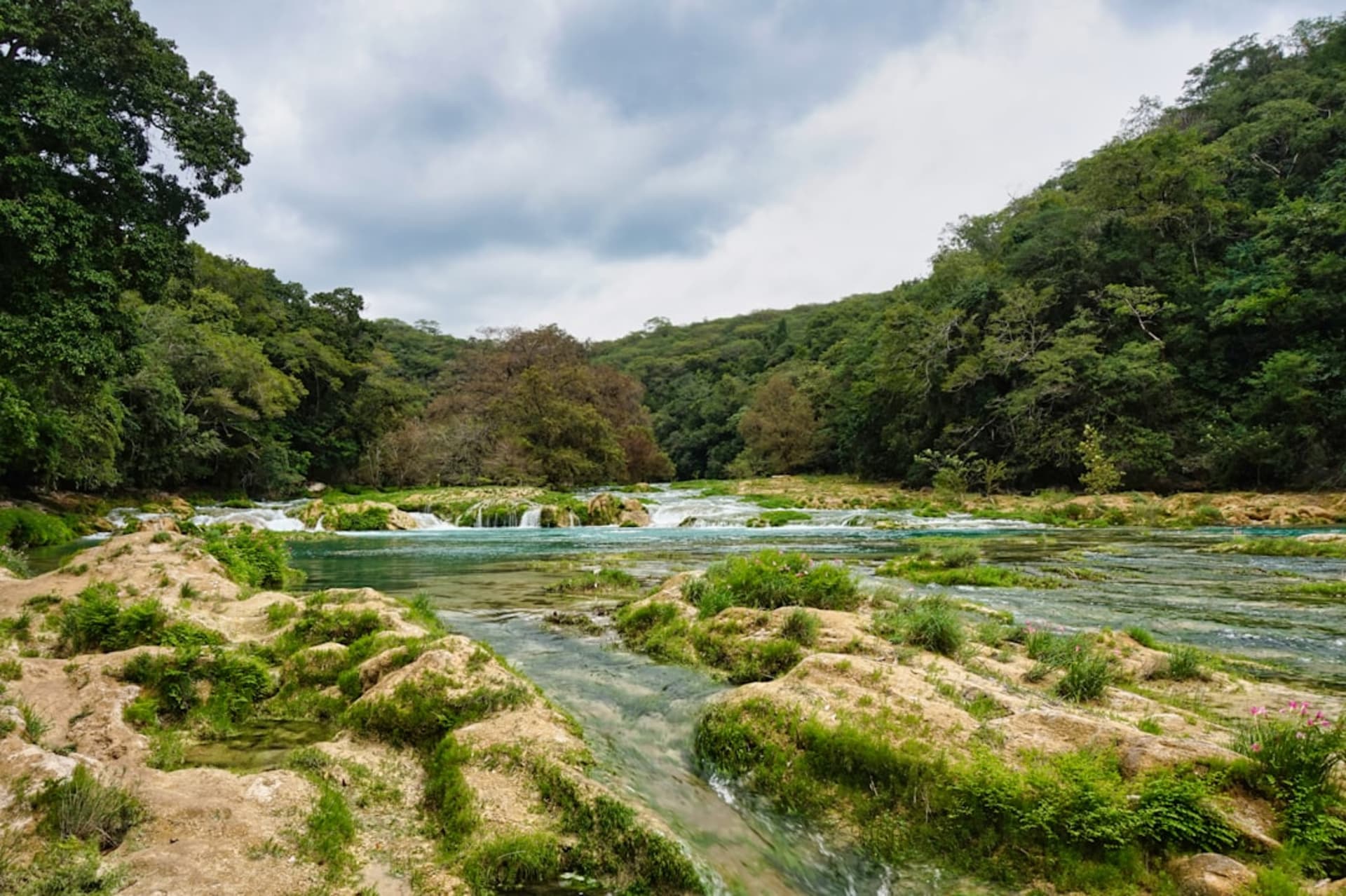
Huasteca Potosina
"The water is that color because of calcium. The limestone dissolves into the water and reflects light differently. The Tamul waterfall pours 105 meters of that color into the river."
The Huasteca Potosina is the northeastern corner of San Luis Potosí state where the Sierra Madre Oriental drops into the Gulf coast lowlands through a series of limestone canyons that the rivers have cut over millions of years. The rivers — the Tampaón, the Santa María, the Verde — carry water that is extraordinarily turquoise: a specific aquamarine produced by high concentrations of dissolved calcium carbonate that scatters light differently from ordinary river water. The effect is the same process that produces the Plitvice Lakes in Croatia or the Río Celeste in Costa Rica. Here it runs through subtropical canyon forest.
The base for the Huasteca is the colonial city of Ciudad Valles (San Luis Potosí state), 300 kilometers northeast of San Luis Potosí city, or the smaller town of Tamasopo. The region requires a rented car or organized tours from Ciudad Valles; public transport reaches the towns but not the individual sites.
The Tamul Waterfall
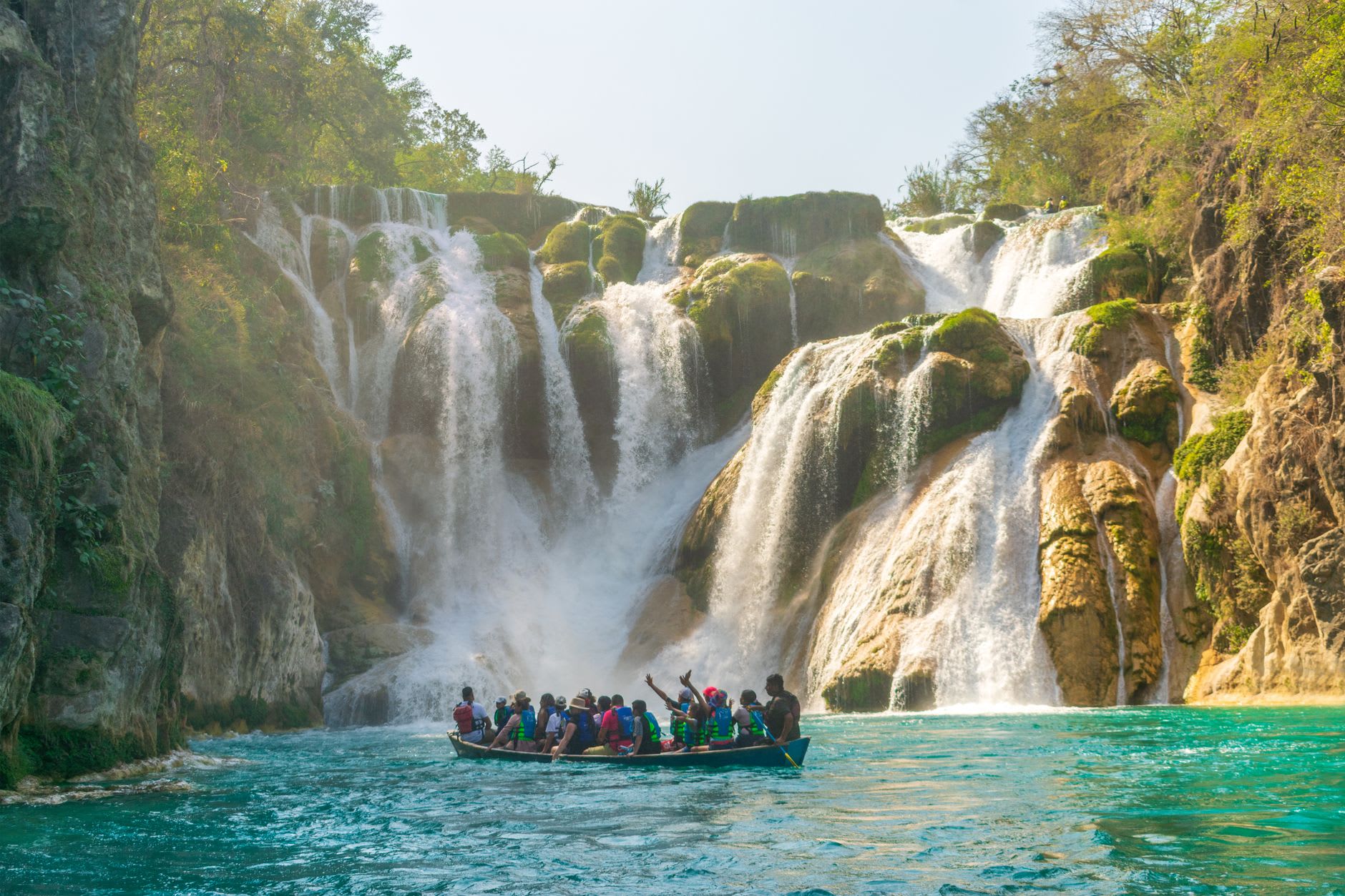
The Cascada de Tamul is the highest waterfall in San Luis Potosí state — 105 meters of the turquoise Río Tampaón water falling into a deep pool at the base of a limestone cliff. What makes Tamul different from other waterfalls of similar scale: the approach is by canoe.
The launch point is the village of La Morena, where dugout canoes with local operators travel 6 kilometers up the Río Tampaón to the waterfall base — a 45-minute journey through a limestone canyon with walls that rise 200 meters on both sides, the turquoise water on either side of the canoe, the canyon forest overhead, and the waterfall audible before it becomes visible around the final bend. The approach is as significant as the destination.
Swimming in the pool at the base of Tamul: the impact of the waterfall creates a circular current that draws swimmers toward the fall and repels them simultaneously. The mist at close range is total.
Xilitla and Las Pozas
Xilitla is a Huastec hill town at 1,100 meters in the cloud forest of the Sierra Madre — cooler than the canyon lowlands, the road up from Ciudad Valles climbing through an abrupt ecological change from subtropical lowland to cloud forest in 90 minutes.
In the forest above Xilitla: Las Pozas, the surrealist sculpture garden built by the English eccentric Edward James (patron of Salvador Dalí and René Magritte) between 1949 and his death in 1984. James purchased 36 hectares of cloud forest near Xilitla, began construction of concrete surrealist structures — towers, staircases that end in midair, gates that open onto nothing, columns of hands reaching from the forest floor — and continued adding structures until his death, employing local workers who eventually became skilled enough in his methods to continue building without his direction.
The structures are now partially reclaimed by the forest — vines and moss on the concrete, the cloud forest growing through the staircases — and the effect is something between a ruin, a dream, and a garden. It is genuinely unlike anything else in Mexico.
The Huastec People
The Huastecos (Téenek) are the indigenous people of this region — a Mayan-language group that separated from the main Maya expansion and remained in the Gulf coast lowlands while the rest of the Maya world moved south. Their separation from the Maya heartland is ancient (estimated 3,500 years); their language and culture are distinct from all other Maya groups.
The Huastec traditions visible in the markets of Ciudad Valles and the towns of the sierra: quechquémitl shoulder garments in geometric embroidery that uses a specific iconographic vocabulary of birds, flowers, and serpents; the Danza del Volador (shared with the Totonac people of Veracruz), in which dancers descend from a 30-meter pole while rotating on ropes; and the huapango musical tradition (violin, jarana, and huapanguera guitar) that is the origin of “La Bamba” and the broader Veracruz-Huasteca son tradition.

Getting there: ADO buses from San Luis Potosí city to Ciudad Valles (4h) or from Mexico City (7h). Car rental in Ciudad Valles to reach the waterfalls and Xilitla. The organized day trips from Ciudad Valles cover the main sites efficiently if a rental car isn’t viable.
When to go: October through May for the clearest water and driest roads. June through September brings rain that raises river levels (sometimes closing sites) and makes the canyon roads challenging. The water is consistently turquoise year-round; the access is easier in the dry months.