Santa María del Oro
"A man at the market in Tepic told me about it in the way people tell you about things they're mildly surprised they're telling a stranger. I understood why when I got there."
I had not planned to go to Santa María del Oro. I was at the Huichol market in Tepic, talking to the man who had explained some of the iconography in the yarn painting I was about to buy, and he asked where I was going next. I said I was not sure — possibly back toward Guadalajara. He said, almost as an aside, that I should drive up to the crater lake in the mountains if I had time. He described it the way people describe things they assume everyone already knows about: briefly, without much elaboration.
I drove up the following morning.
The Caldera
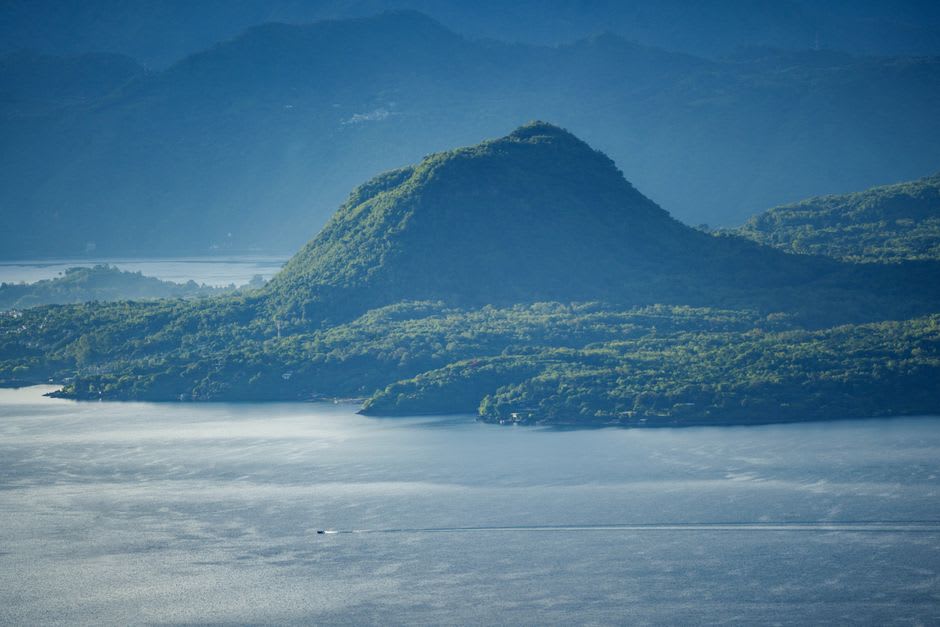
The road to the lake climbs from the Nayarit lowlands through pine forest and agave plantations, winding through the sierra in long curves that gain altitude faster than they seem to. After perhaps forty minutes of this the road crests a ridge and the lake is simply there, below you, filling the entire caldera of an extinct volcano.
It is perfectly round. That is the thing that hits you first — the geometric precision of it, the way a volcanic caldera fills with water and produces a shape that looks designed rather than natural. The water is deep, and the color shifts through the day depending on the sky: in the morning it was a dense green, by midday a saturated blue, by the afternoon when clouds moved in it turned grey-green and then grey. I had arrived at nine in the morning and I stayed until nearly six in the evening, and I watched the color change through the full arc of it.
There were four other people when I arrived: a couple from Guadalajara who had driven up the previous day and were camping at the rim, and two local men fishing from the bank with lines cast into the deep water. By noon a few families from the village at the base of the caldera had arrived and were eating under a palapa. By two o’clock I was again effectively alone.

The Village and the Palapas
There is a small fishing community at the rim of the caldera, a handful of houses and a couple of palapas that serve fish from the lake. I ate at one of them: a plate of pescado frito with rice and tortillas, the fish pulled from the water that morning, fried simply without much intervention. It was the freshest fish I have eaten inland in Mexico.
The woman who ran the palapa was briskly hospitable in the manner of someone who does not see enough visitors to have adjusted her behavior for them but also does not see so few that they are any kind of surprise. She brought the food, she brought more tortillas without being asked, she offered a beer which I accepted. We had a conversation about whether the lake ever smells of sulfur (sometimes, when the weather changes, briefly) and about where I was from (France produced the usual slight recalibration of expectations that it produces in Mexico, followed by a question about whether I found the food here spicy, which I do not).
There are no hotels at the lake. There is no infrastructure to speak of. The couple from Guadalajara had brought everything they needed in a truck and were entirely self-sufficient. I had not planned to stay as long as I did, and by four o’clock I was rationing my water and eating the last of the fruit I had brought in my bag, which was fine. The lake was worth rationing water for.
The Quality of the Silence
I want to say something about the silence, because it was specific and unusual. Mexico is not a quiet country — it is, in my experience, one of the louder countries I’ve spent time in, in the way that places with genuine community life are loud. The markets, the streets, the plazas, the restaurants, the sound of music from passing cars at eleven at night. All of this is part of what I like about living here.
Santa María del Oro was different. The caldera creates a kind of acoustic enclosure — the pine trees absorb sound, the water doesn’t reflect it the way a flat surface in an open landscape would, and the rim is high enough that whatever is happening in the valley below doesn’t reach you. When the families left in the late afternoon and the fishermen reeled in their lines, the silence was total enough that I could hear the water at the edge of the lake making very small sounds against the rock.
There is a French word — dépaysement — that means roughly the disorientation of being far from home, the sense of strangeness that comes from being in a place entirely unlike where you’re from. I felt it at the crater lake in a way I haven’t felt it many times in Mexico. This was somewhere genuinely elsewhere.