Santa María la Ribera
"I found a piece of the 1889 Paris World's Fair sitting in a quiet Mexico City square where old men play dominoes — and I've been going back ever since."
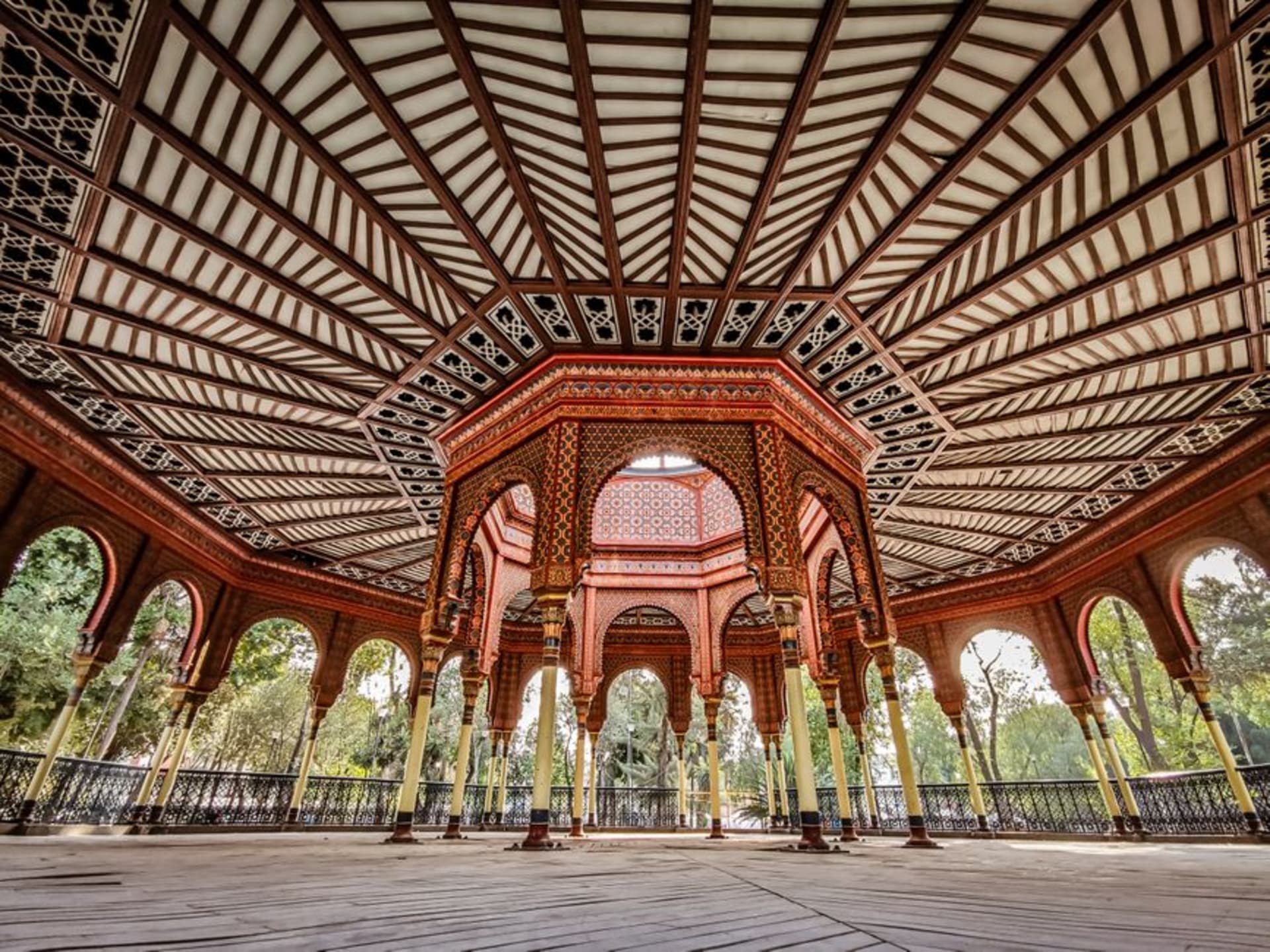
I got to Santa María la Ribera on a Thursday afternoon, killing time before a meeting near Tlatelolco. I walked in from the Metro — Line B, the elevated one that runs through the northern colonias like a train that forgot it was supposed to be underground — and found the Alameda almost by accident. A few men were playing dominoes under the jacarandas. And at the center of all of it, rinsed in blue and green tilework and sitting in the Mexican afternoon with an air of complete composure, was a Moorish iron pavilion built in Paris in 1889. I sat down and did not move for forty minutes.
An Iron Pavilion and What It’s Doing Here
The Kiosco Morisco was built for the same Exposition Universelle that produced the Eiffel Tower. It came to Mexico in 1910 for the centenary celebrations of Independence, spent time at the Alameda Central downtown, and eventually landed here in Santa María la Ribera, where it has been ever since. Nobody around it seems particularly moved by this sequence of events, which is part of what makes it work.
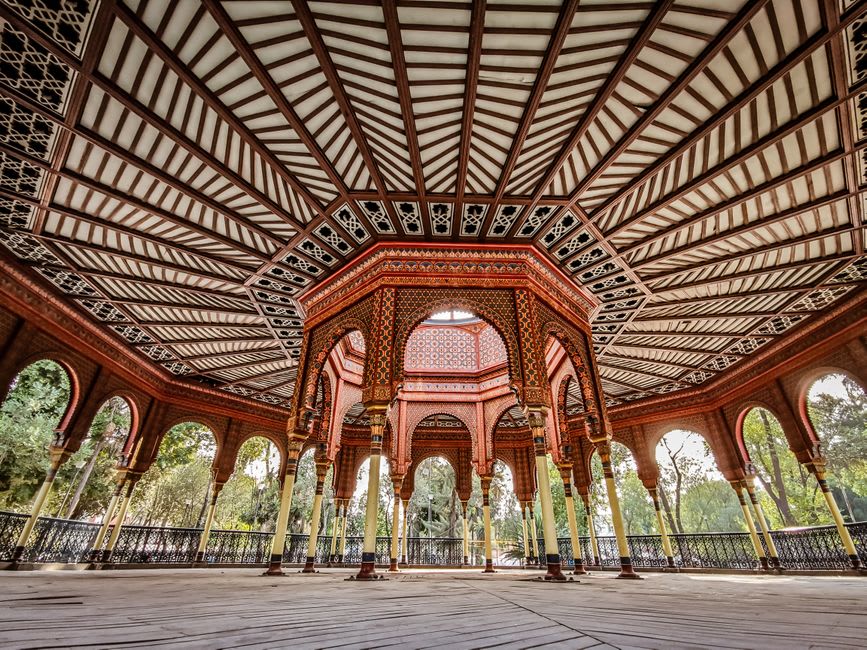
The structure is cast iron, octagonal, with horseshoe arches and geometric tilework in blue, white, and green. Up close, the ironwork is excessive in the best way — columns wound with floral patterns, a roof that spikes and curves in several directions at once. Inside, a small permanent exhibition traces its history. You can pay a few pesos to enter on weekday mornings. I would. The view from inside looking out at the Alameda — the domino players, the jacarandas, a man asleep on a bench — is one of those views that justifies the trip by itself.
The Streets Behind the Square
Santa María la Ribera was Mexico City’s first proper suburb — built out in the 1860s, expanded under Porfirio Díaz, and quietly abandoned by the class that built it sometime in the mid-twentieth century. What they left behind is architectural: Porfiriato facades with Italianate cornices and wrought-iron balconies, many of them now painted in colors nobody would have chosen in 1900.
Walk the streets around the Alameda. The Museo Universitario del Chopo — a prefabricated iron building imported from Europe in 1903, now holding contemporary art — is ten minutes on foot from the square. The Museo de Geología is a 1906 building with stained-glass skylights and rooms of minerals and meteorites; it smells of wood polish and old paper and costs almost nothing to enter. Around the Mercado de Santa María la Ribera, fondas serve comida corrida at noon — caldo de res, arroz rojo, chiles rellenos — for prices that have become genuinely rare in this city.
When to Arrive, What to Order
Come before noon. The Kiosco opens as a museum in the mornings, the market is active, and the Alameda is at its quietest. I eat at the fondas inside the mercado rather than anything with a street-facing sign — the comida del día changes daily and you order by pointing. A bowl of sopa de fideos or a plate of chiles rellenos and you’re set until evening.
Come back around five, when the light turns gold and the domino players settle in earnest. Order a coffee from one of the vendors near the Alameda entrance and sit somewhere with a view of the Kiosco. It doesn’t perform. It doesn’t need to.
Getting There
Line B of the Metro runs elevated through this part of the city; the nearest station is Buenavista, about ten minutes on foot from the Alameda. From the historic center, a taxi or Uber takes roughly fifteen minutes. The colonia works in any season, though the jacarandas along the Alameda bloom in February and March. Weekday afternoons are quieter than weekends — in Santa María la Ribera, that distinction means the difference between deserted and merely calm.