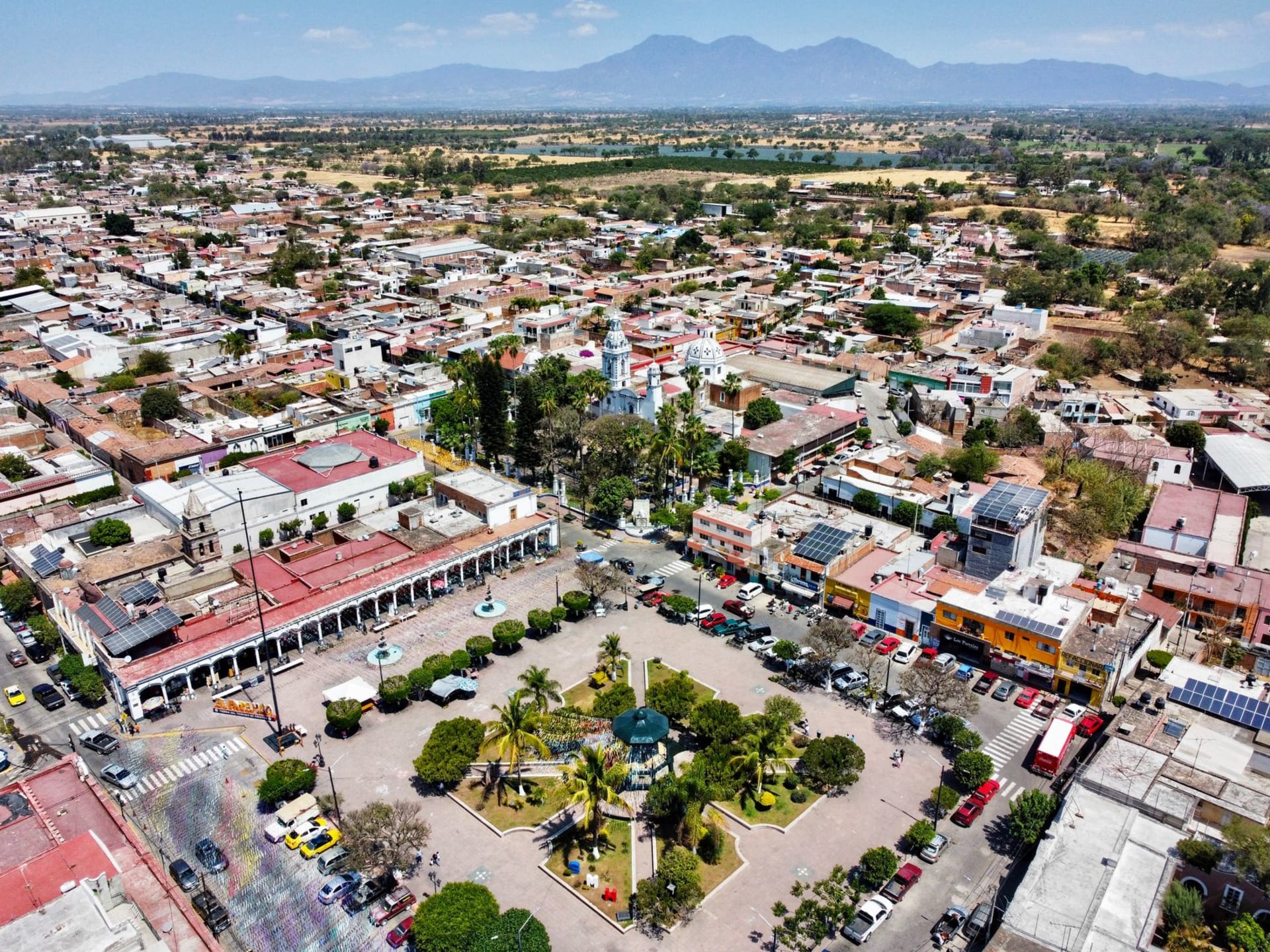
Lagos de Moreno
"Seven baroque churches in one historic center. I don't know whether the Cristeros were right, but I understand why a region that built this would fight to defend it."
Lagos de Moreno announces itself from a distance in the way that the great highland towns of Los Altos do: a church tower appearing above the mesquite scrub on the approach road, then another, then you’re in the historic center and the scale of what the region’s ranching wealth built over three centuries becomes clear all at once. Seven churches in the historic center. I counted them on my second morning because I didn’t believe the number the first time.
The most extraordinary is the Parroquia de la Asunción, the parish church on the main plaza — a full baroque facade in the Churrigueresque manner, which is to say elaborate in a way that French baroque would consider indecorous. The surface is covered in carved stone to an extent that makes you want to know how long it took, and then you realize that you don’t want to know how long it took because the answer will either seem impossibly short or impossibly long, and neither will make sense.
La Roma de México, More or Less
The nickname “la Roma de México” was applied in the nineteenth century and has stuck with the affection that municipal nicknames attract in Mexico, where every town of consequence has one. I spent a day walking between the churches and concluded that the comparison to Rome requires you to imagine Rome at approximately one-fortieth scale and without the ancient-world ruins and with considerably better food. What is true is the density of ecclesiastical architecture per square meter of city, which is genuinely unusual — the Neo-Gothic towers of the Capuchinos church are visible above the rooflines from the south, the baroque towers of the Parroquia from everywhere else, and between them the facades of five other churches mark the corners and streets of the center.
The effect is not oppressive in the way that very Catholic Spanish cities can feel oppressive. Los Altos Jalisco produces a kind of confident, uncomplicated Catholicism that has been here since the Spanish brought it and intends to remain. I attended a Sunday mass at the Parroquia that felt more nineteenth century than twenty-first — long, formal, in Latin at moments, the congregation following along in a way that suggested this was not unusual for them. The priest was old. The pews were full. Outside, after mass, the plaza filled in the way that Mexican plazas have filled after Sunday mass for centuries: families with children, people eating ice cream, the balloon vendor doing modest business.
In France, something like this would be a heritage event, a performance of tradition for tourists. Here it was simply Sunday.

Birria and the Ranching Interior
The birria in Los Altos Jalisco is goat, slow-cooked with dried chiles — guajillo and ancho mainly, plus oregano and cumin and the specific combination that each family develops over generations and adjusts by increment and never quite writes down. It is not the birria that has spread to Mexico City and California and eventually every taquería with aspirations — that version is beef or lamb, served consommé-style, very liquid, made for dipping. The original Los Altos birria is drier, darker, the meat pulled from a clay pot that has been in a slow oven or over charcoal since before dawn.
I found it at a small restaurant three blocks from the main plaza, a place with no sign I could identify, recommended by the man who runs the guesthouse where I was staying, who said to go before ten on Sunday or after two, never between those hours because the wait was long. I went at nine-thirty. The birria arrived in a clay bowl with warm tortillas and a relish of onion and cilantro and a salsa made with chile de árbol that was direct about its intentions. I ate two bowls. The consommé they bring alongside is made from the same pot, with the overnight fat rising to the surface, and it is the kind of thing that makes you understand why people drove four hours from Guadalajara just to eat here.
Los Altos Jalisco is also the heartland of the Cristero War — the 1926-29 Catholic uprising against the Calles government’s anti-clerical laws. Cristero violence was concentrated in exactly this highland ranching country, where the combination of deep Catholic piety, local autonomy, and access to horses and weapons made resistance both instinctive and practical. The war ended in compromise, as Mexican conflicts tend to, but its memory is alive here in a way it isn’t in more secular parts of the country. The churches of Lagos de Moreno were what was being defended.

Getting There
Lagos de Moreno is in the northeastern corner of Jalisco, about 180km from Guadalajara on the highway toward San Luis Potosí and León. Direct buses run from Guadalajara’s main terminal at Los Ángeles; the journey is around two hours. If you’re coming from central Mexico — San Miguel de Allende, Guanajuato, León — Lagos is an easy and worthwhile stop on the way into or out of Jalisco.
Sunday is the day to be here for the market, the mass, and the birria vendors at their best. Weekday mornings give you the churches without crowds, which is its own reward — the Parroquia in particular, with the morning light working its way through the high windows and across the gilded retablos, is something to spend time with when no tour group is present. Lagos de Moreno is not a major tourist destination outside the state; you may find yourself the only foreign visitor in the plaza, which at this point in my time in Mexico I consider a good sign.