Pachuca
"I bit into a paste at a stall near the Reloj Monumental and spent thirty seconds trying to work out why it tasted like something I had eaten before. Then it clicked: it tasted like a Cornish pasty."
Pachuca is the kind of city that takes a few hours to understand. It arrives without ceremony — the bus from Mexico City takes about ninety minutes through the mountains and drops you at a terminal a short taxi ride from the centro — and the centro itself does not announce its qualities immediately. A clock tower, which is the first landmark you see, modeled so closely on the Westminster clock tower that your eye reports an error. A compact historic center with silver-city architecture — colonial churches, baroque facades, the specific ornamental vocabulary of mining prosperity. Market stalls selling pastries from wheeled carts, the vendors calling out names that do not immediately translate. The city sits at 2,400 meters, which means it is cold in the morning in a way that Mexico City, at 2,200 meters, is not quite cold enough to be. The thin air and the silver-grey light give it a distinctive quality that I eventually decided was altitude rather than melancholy, though the two are not entirely unrelated.
I came to Pachuca for the photography museum and stayed for the paste. The paste — I will explain in a moment — is one of the more genuinely surprising foods I have encountered in four years of eating my way through Mexico, and I have encountered some surprising foods. But first the context, because in Pachuca, the paste without context is just a pastry.
The Paste and the Cornish Miners
The silver mines of Pachuca and Real del Monte were among the most productive in New Spain. By the nineteenth century, as independence and the subsequent political chaos disrupted the industry, foreign investment began arriving to modernize the mines. In the 1820s and 1830s, British — specifically Cornish — miners were recruited to bring their expertise to Hidalgo. They came, they stayed, and they brought their food with them.
The Cornish pasty is a working miner’s food: a thick pastry shell, crimped at one edge, filled with a mixture of beef, potato, onion, and turnip, portable and complete as a meal. The Cornish miners made them in Mexico. The Mexican miners’ families learned to make them. Over several generations the recipe adjusted to local ingredients — the filling variations expanded to include sweet versions with fruit, spicy versions with local chiles, bean versions, potato-and-cheese versions — and the crimped edge migrated from the side to the top, and the pastry became slightly richer, and the thing became the Hidalgo paste, which is to the Cornish pasty what the tamal is to the Greek dolmade: related, transformed, thoroughly adopted.
When I bit into a paste at a street stall near the Reloj Monumental — a savory one, beef and potato and chile serrano — and felt the specific sensation of recognizing a food I had not eaten in this form before, it took me a moment to locate the recognition. Then it clicked: a Cornish pasty I ate in Penzance on a cycling trip ten years ago. The same dense, slightly flaky pastry. The same dense filling. The same way of eating it, holding the crimped edge as a handle. Physically identical and entirely different in flavor, which is the most interesting kind of culinary parallel.
The paste shops around the Reloj Monumental and the Mercado La Acocota are the places to eat them. The sweet versions (filled with fruit, dusted with sugar) exist and are fine, but the savory versions are the ones with the historical weight. A good paste vendor will have four or five fillings: beef and potato, cheese and chile, bean and chorizo, tuna (a variant that came from the mining camps’ tin provisions), and sometimes seasonal options. They cost very little and are filling in the specific way of food designed for people doing physical labor.
The City
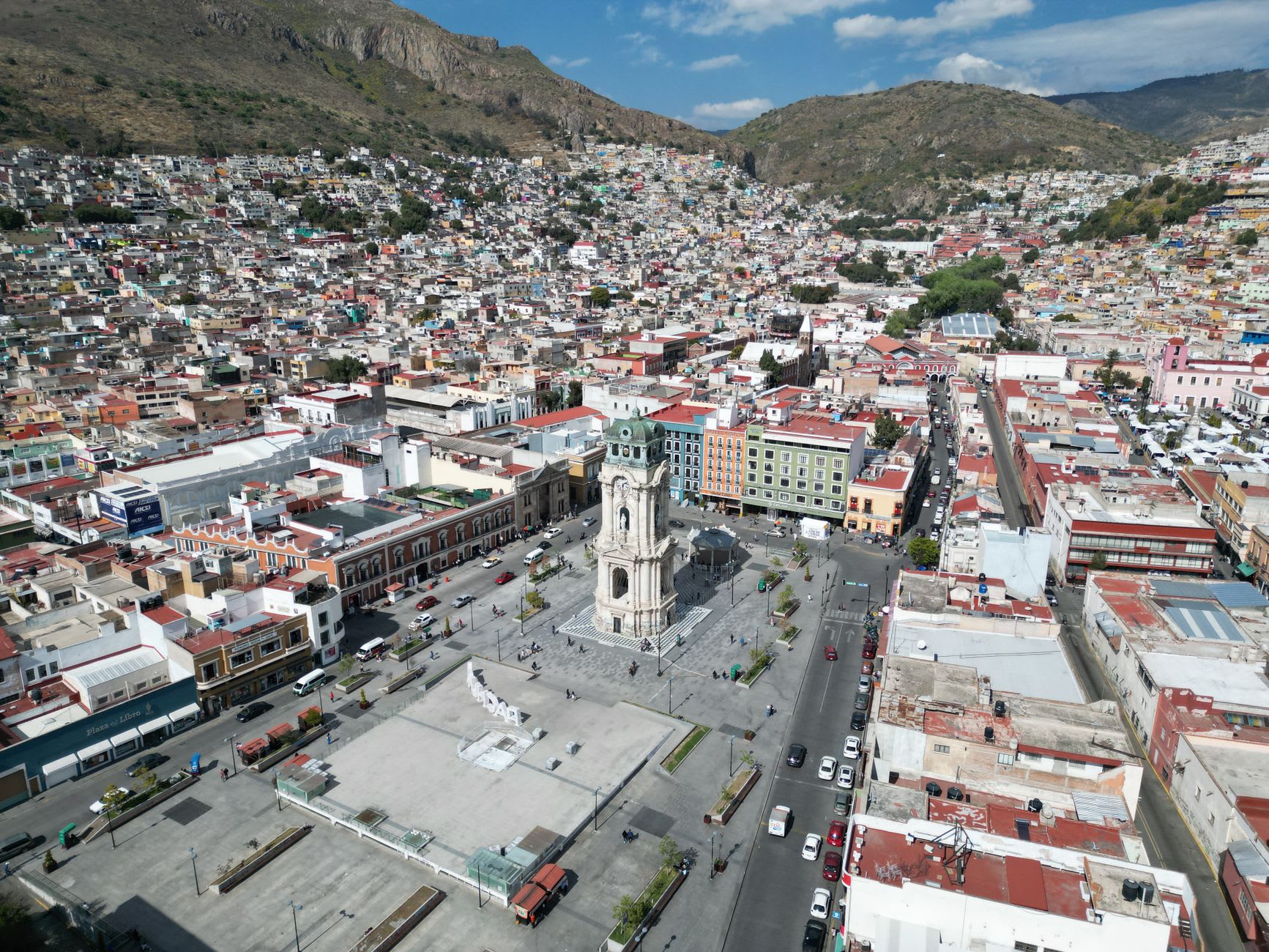
The Reloj Monumental at the center of Plaza Independencia was built in 1904 and given to the city by the local Cornish and Spanish immigrant communities to mark the centenary of Mexican independence (a few years early, as it happened — the centenary was 1910, but Porfirian enthusiasm ran ahead of the calendar). The clock tower is 40 meters high, built in Carrara marble and gray stone, and resembles the Westminster tower with a specificity that suggests not merely inspiration but active reference. It is a strange and magnificent object: a British Victorian clock in a Mexican silver-mining city, donated by immigrants who had made this place their own.
The centro around it is compact and walkable. The Ex Convento de San Francisco, now housing several cultural institutions, is a seventeenth-century Franciscan complex of considerable scale, its cloisters converted to museum and exhibition space. The Palacio de Gobierno on the main plaza has murals documenting Hidalgo state’s history, with particular attention to the mining industry and the independence movement.
The CENART (Centro Nacional de las Artes) photography museum — formally the Fototeca Nacional, housed in the former Casa de Moneda (mint) — is the serious reason to come to Pachuca. The building is extraordinary: a colonial mint complex from the seventeenth century, its thick walls and vaulted rooms converted to gallery and archive space in the 1990s. The permanent collection covers Mexican photography from the daguerreotype era to the present, with particular strength in the period from 1880 to 1950. The archive holds tens of millions of images — it is the national photographic memory of Mexico — and the rotating exhibitions are drawn from collections that most people will never otherwise access.
On my visit, the main gallery showed photographs from the Casasola Archive — the Agustín Víctor Casasola collection documenting the Mexican Revolution. I stood in front of a photograph of Villa’s army crossing a plain in Chihuahua, taken from what must have been a mounted position ahead of the column, and the scale of the thing — the number of men and horses and the flat land going forever behind them — was something that no reproduction had conveyed to me before. Photography at this scale, in this context, in a building that itself is part of the same historical period, produces a different kind of looking.
The Altitude and the Evening
At 2,400 meters, Pachuca has the quality of altitude towns everywhere: mornings that are bracingly cold regardless of season, afternoons that warm to comfortable, evenings that go cold again quickly after sundown. The city is closer to Mexico City than many people realize — ninety minutes on the good road — which makes it a day trip for some. I think it rewards staying the night, mostly for the morning: the light on the colonial facades in the early morning when the plaza is still empty and the paste vendors are setting up their carts, the cold air and the altitude-thinned light, give the city a quality that the afternoon bus passengers miss.
The food beyond the paste tends toward hearty highland cooking: barbacoa de borrego wrapped in maguey leaves and slow-cooked in underground pits (a Sunday tradition, at its best in the markets from six in the morning until it sells out), and chile xicoense — a regional chile dried and used in Hidalgo moles that is different from any chile I have encountered in other parts of Mexico, with a smoky, slightly fruit-forward quality.
Getting there: From Mexico City’s TAPO (Terminal de Autobuses de Pasajeros de Oriente), frequent direct buses run to Pachuca in about 1h30. The Autobuses Teziutlán and Ómnibus lines both serve the route. From the airport, a direct Teziutlán bus runs every hour or so (ask at the terminal in the arrivals area, ground floor). Pachuca’s bus terminal is about 15 minutes by taxi from the centro.
When to go: Year-round, though October through March for the most pleasant weather. The rainy season (May through September) brings afternoon showers but generally clears by evening. The Fototeca is closed Mondays. Sundays are best for the barbacoa experience at the market. The football-history angle (Pachuca FC, the oldest football club in Mexico, descended directly from the Cornish miners’ recreational activities) is well-documented at the team’s stadium museum, open most weekdays.