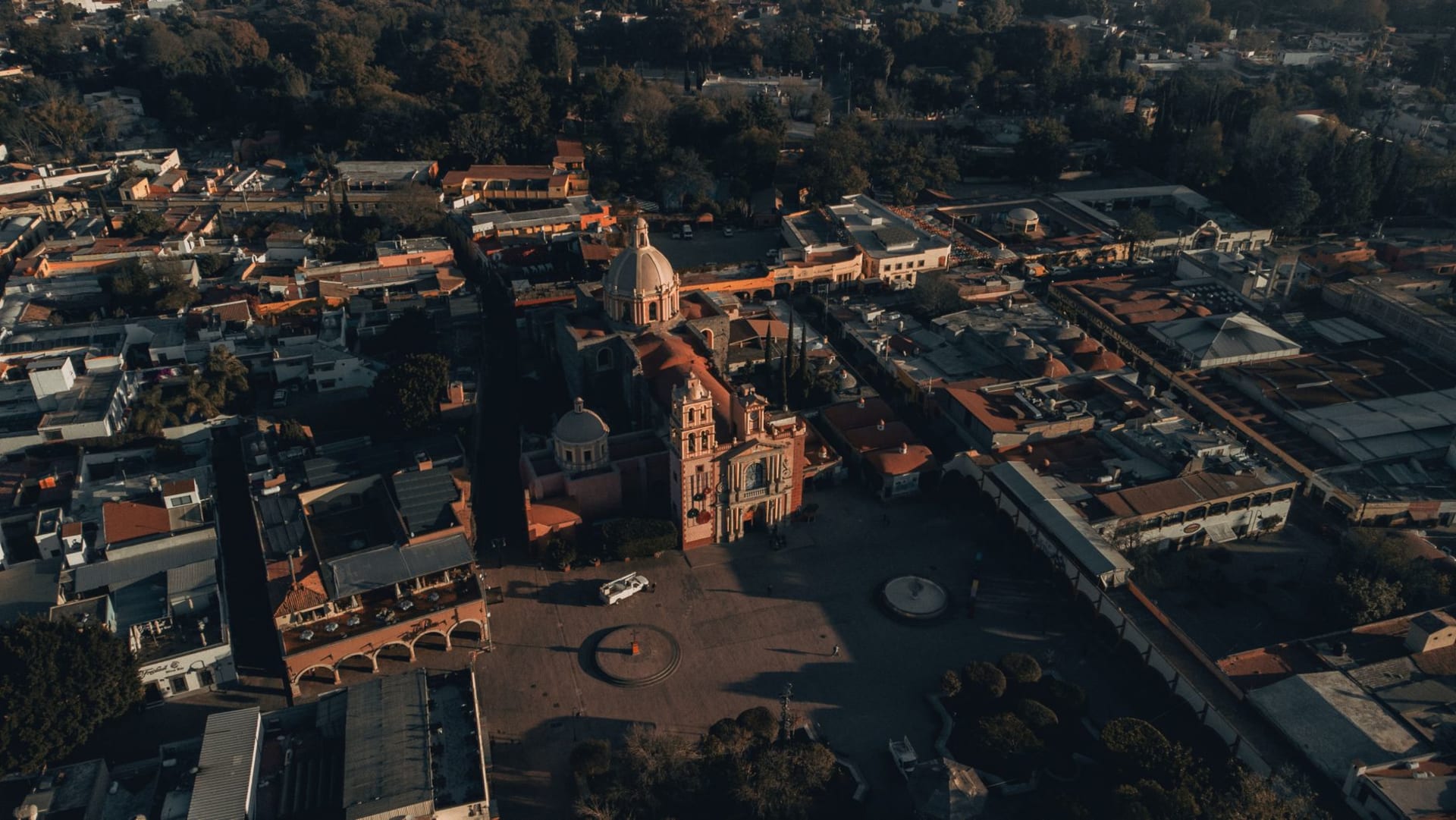
Ixmiquilpan
"I stood in the nave for twenty minutes trying to understand what I was looking at. Otomí warriors fighting abstract vices, in a church. The Augustinians either knew exactly what they were commissioning or had completely lost control of the project."
The murals in the nave of the Temple y Ex-Convento de San Miguel Arcángel in Ixmiquilpan are, as far as I can tell, unique. I don’t mean unique in the way that all things are technically unique. I mean that nowhere else in Mexico — nowhere else in the Catholic world — does a church contain imagery quite like this: Otomí warriors in full feathered battle dress, wielding shields and obsidian-edged clubs, engaged in combat with figures representing the seven deadly sins. The decorative program of the nave is essentially a pre-Hispanic war scene mapped onto a Christian moral framework, executed in a style that references the visual language of the Aztec codices far more than anything you’d find in a contemporary European church.
The Augustinians commissioned this in the sixteenth century. That is the part that doesn’t resolve.
What the Murals Are, and Why They Shouldn’t Exist
I came to Ixmiquilpan having read a brief mention of the murals in a book about colonial Mexico, and nothing in that mention prepared me for actually standing in the nave. You enter through the west portal, let your eyes adjust, and then gradually understand what you’re looking at on the walls around you.
The figures are large. The warriors have the specific posture of Aztec and Otomí codex figures — the stylized combat stance, the decorated weapons, the elaborate headdresses. The monsters they’re fighting are composite, fantastical, not quite like anything from European iconography. The colors have faded over four centuries but the forms are still clear: this is not ambiguous decoration, not some residual indigenous influence sneaking in at the margins. This is a sustained, complex narrative painted across the full length of the nave by someone — or several someones — who knew exactly what they were depicting.
Art historians have proposed various explanations. One school of thought argues that the Augustinian friars deliberately used indigenous visual language to make the concept of spiritual warfare comprehensible to Otomí converts. Another argues that the indigenous artists commissioned to paint the nave simply painted what they knew how to paint, and the friars either couldn’t tell what they were looking at or decided not to interfere. The debate hasn’t resolved because the evidence points in both directions.
I stood there for a long time. There are aspects of the murals that clearly show someone navigating between two visual systems simultaneously — moments where European Catholic iconography and Mesoamerican visual language are genuinely combined rather than simply placed in proximity. Whatever the explanation, someone was thinking hard in this nave in the 1570s, and the thinking was not simple.

The Valley and the Hot Springs
The Valle del Mezquital is a landscape that rewards slowness. The first impression — scrubby, arid, the road through it slightly monotonous — gives way, if you stop and walk, to something more interesting. The maguey plants here are the big ones, agave salmiana, their spines long and their bulk substantial, and they grow among nopal cactus and mesquite in a palette of green and grey-green and dusty brown that has its own austere beauty. The light in the afternoon is harsh and clear and very good.
The hot springs are scattered through the valley. Dios Padre, the most accessible from Ixmiquilpan, is a balneario in the desert — a series of outdoor pools fed by geothermal water, warm year-round, with the cactus and maguey hillsides rising around you. It’s busy on weekends with families from Pachuca and Mexico City, and quiet during the week to the point of having the pools nearly to yourself. I went on a Tuesday in November and shared the main pool with three older women from the valley who were entirely uninterested in my presence, which was exactly right.
The weekly market in Ixmiquilpan has a section devoted to Otomí textiles and basketwork — embroidered pieces in the geometric patterns that are specific to Mezquital Otomí tradition, cactus-fiber products, items made from maguey. I bought a small embroidered piece that I still have on my desk.

Getting There and Around
Ixmiquilpan is about 100km north of Mexico City and 75km north of Pachuca on the highway toward Querétaro. Direct buses run from Mexico City’s Terminal del Norte and from Pachuca. The town itself is walkable; the church is in the center, two minutes from anywhere.
For the hot springs, a taxi from the center takes ten minutes and costs almost nothing. Dios Padre is the most convenient but there are others further into the valley if you have your own transport and want to explore.
The murals are best seen in the morning before tour groups arrive from Pachuca — they are not a major tourist destination and the groups are small, but the light in the nave in early morning, coming in oblique through the west portal, is better for reading the paintings than the flat afternoon light. There is no charge to enter the church. There is never anyone at the door telling you to move along.