Actopan
"I went for the barbacoa at 7am and stayed in the convent until noon. One of those mornings where the plan collapses in the best possible way."
I had planned to spend two hours in Actopan. That was a miscalculation.
The bus from Pachuca drops you in the center of town, which is where the market begins on Sunday mornings — a long street of vendors selling plastic goods and secondhand clothing and grilled elotes, and tucked in among them, the real reason to arrive before eight, the barbacoa. Not the goat barbacoa of Hidalgo’s southern neighbors, not the beef version that ends up in tacos all over Mexico City. Lamb, here. Lamb wrapped overnight in maguey leaves, the century plant of the altiplano, and cooked in a sealed pit in the earth. The maguey leaves soften and steam and give the meat something faintly sweet and green underneath all the smoke.
I found a stall run by a man and two of his sons. The consommé came first in a foam cup — cloudy, deep, fragrant with hierbas de olor and chile — and I drank it standing up while the taco was assembled. The tortillas were handmade and thick. The lamb pulled apart into strands. The salsa was tomatillo and serrano and it was cold against the heat of everything else. I ate three tacos. I meant to eat two.
The Convent That Shouldn’t Exist at This Scale
The Convento de San Nicolás de Tolentino was begun in 1546. It took decades to build and the Augustinians who built it were apparently not modest men. The church itself is a single nave of extraordinary length, the vault painted in geometric patterns, the light coming in narrow and precise from windows placed high up. But the thing that stops you outside, before you enter anything, is the open chapel.
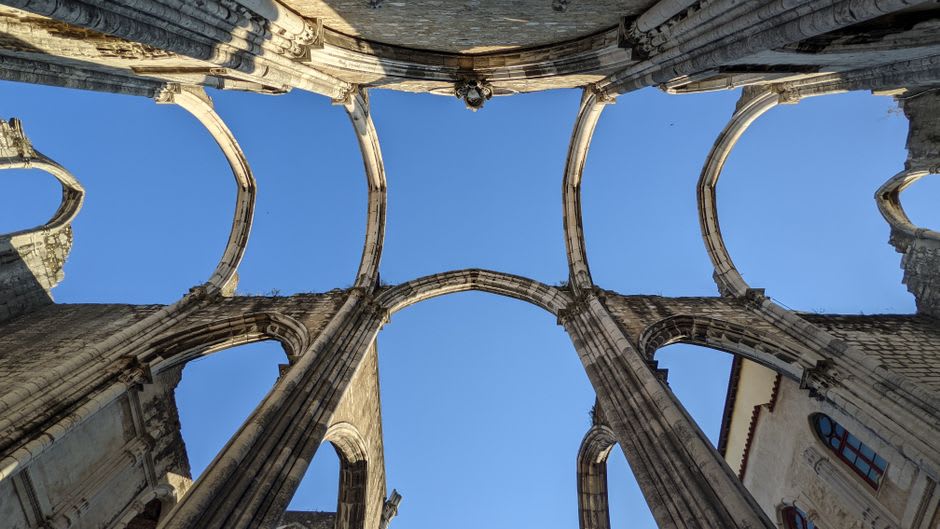
Capillas abiertas — open chapels — were built throughout colonial Mexico in the sixteenth century as a practical response to the numbers. There were not enough enclosed churches, and indigenous converts could not all fit inside, so the Augustinians and Franciscans and Dominicans built large open-air chapels adjacent to the church where mass could be celebrated to an outdoor congregation. Most of them are modest. Actopan’s is not modest. The arch of the Actopan open chapel is enormous, one of the largest in Mexico, and it frames a space that would have held hundreds of people easily. Standing in it, I kept trying to calculate the effort — 1546, semi-arid valley, indigenous labor, the Augustinians pushing for something Rome-scaled in a place that didn’t need to prove anything to Rome.
The cloister is quieter. A square of stone corridors with frescoes on the walls — saints, grotesque decorations, narrative scenes whose symbolism I couldn’t entirely parse. The quality is uneven but there are passages that are genuinely beautiful: a figure in ocher and black with a face that carries real expression, painted by someone who was not just filling wall space.
The Valle del Mezquital
Actopan sits in the Valle del Mezquital, a name that translates roughly as the valley of the mesquite, and which describes the landscape accurately: arid, rocky, the hillsides covered in cactus and maguey and exactly the thorned vegetation you expect. The people here have been Otomí since before the Aztecs organized the region into a tribute system, and the region was considered a backwater even then — the soil is thin, the rainfall scarce, the altitude enough to make the winters cold.
Which makes the scale of the convent more striking, not less. The Augustinians built monumental architecture in a place the empire considered marginal, which either says something about the ambition of the Augustinian order or something about what it takes to convince a conquered population that the new religious system is worth their time. Probably both.
The market winds down by ten on Sunday mornings. By eleven the taco vendors are packing their tables. If you time it right, as I eventually did after two failed attempts on previous trips to Hidalgo, you can eat your barbacoa and still have the convent morning light. I had two hours there on a Tuesday visit in December, almost alone in the cloister, the frescoes to myself.

Getting There
Actopan is about 50km north of Pachuca, Hidalgo’s capital, and easily reached by bus from the Pachuca CAPU terminal — the journey is under an hour. From Mexico City, Pachuca itself is 90 minutes by bus from the Terminal del Norte. Actopan makes a logical pairing with Ixmiquilpan further up the valley; together they constitute a full and worthwhile day in the Mezquital.
If you’re coming for the barbacoa, Sunday is the day. Arrive by seven, accept that the queue at the best stalls moves slowly, and don’t plan anything before nine that requires you somewhere specific. If you’re coming for the convent, any weekday with good morning light is better — fewer people, and the cloister frescoes read better in the quiet.