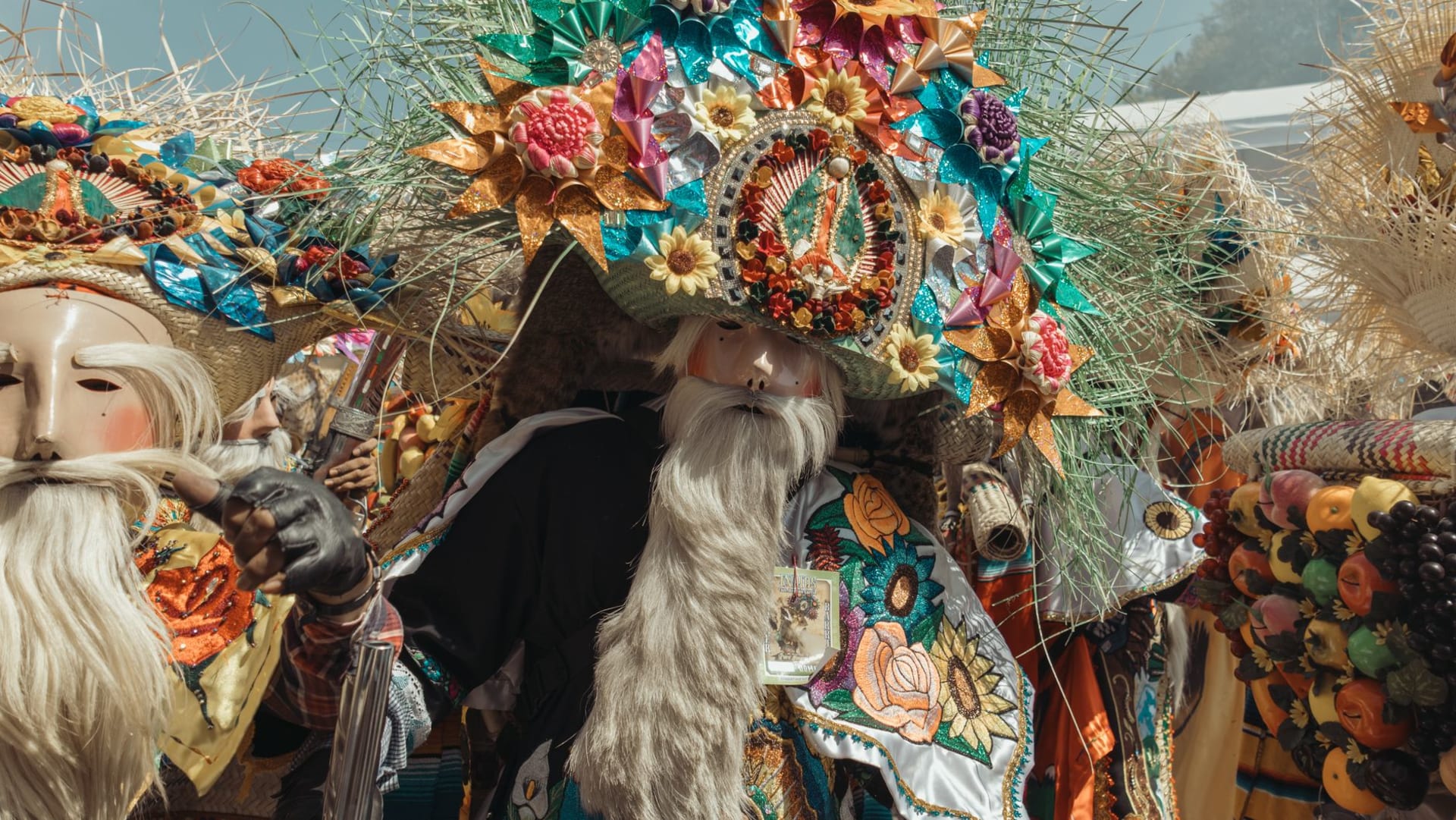
Olinalá
"I watched a man scrape a design into wet lacquer with a cactus thorn and understood, in a way I had not before, what it means to practice something for forty years."
The road to Olinalá from Chilpancingo takes about five hours on a good day, which this was not. The asphalt gives out around Tlapa and the final ninety kilometers wind through the mountains of northern Guerrero on a surface that is optimistically described on maps as a federal highway and is in practice a succession of potholes interrupted by stretches of loose gravel and the occasional optimistic attempt at repair. The mountains are beautiful in the way that remote Mexican mountain ranges often are: pine and oak forest, mist in the higher passes, villages that appear and disappear without warning, a river visible far below in the ravine at various points along the descent. I had a rental car that was not designed for this road and drove it at about thirty kilometers an hour for the last two hours, arriving in Olinalá at three in the afternoon with a headache from the altitude changes and a renewed appreciation for why the lacquerware made here costs what it costs in the capital.
The town is small — around 14,000 people — and sits in a valley at about 1,400 meters, lower and warmer than the mountains surrounding it. The first thing you notice is the smell: linaloe wood (Bursera linanoe), the aromatic hardwood from which the lacquerware is made, has a smell somewhere between incense and resin that permeates the air in the workshop neighborhoods. The second thing you notice is that almost every house with an open door has something being made inside it. This is not a town with a craft quarter or an artisan market district. This is a town where the craft is the economic and social foundation of essentially every family.
The Drive and the Arrival
I will dwell on the drive for a moment because the drive is not incidental — it is part of what makes Olinalá what it is. The town’s remoteness is not accidental. The linaloe tree grows in the dry subtropical forests of specific river drainages in Guerrero and parts of Puebla. The communities that developed the lacquer technique thousands of years ago did so in proximity to the tree. The technique and the tree and the community grew together. Moving the industry would require moving the raw material and the knowledge simultaneously, which does not happen. So Olinalá stays in Olinalá, and Olinalá stays five hours from the nearest significant city, and the lacquerware comes out through traders and galleries and the occasional journalist or collector willing to make the drive.
The town’s daily rhythm is organized around the workshops. In the morning, the wood is being carved and shaped. In the afternoon, the lacquer layers are being applied and allowed to dry. In the evenings, in the dry season, the scraping happens — the cactus-thorn work that incises the design into the dried lacquer surface, revealing the layers beneath in colors that depend on the depth of the scratch. The technique requires patience on a geological scale: a single piece of serious quality may require fifteen or twenty lacquer applications, each dried and polished before the next is applied, a process that takes weeks for a single box.
The Craft
The rayado technique — the scratched design method — is what distinguishes Olinalá lacquer from any lacquerwork I have seen elsewhere. The approach differs from Japanese or Chinese lacquerwork in its use of mineral pigments (as opposed to synthetic) and in the specific character of the design vocabulary: geometric borders, floral interiors, animal figures, all organized according to aesthetic principles that predate the Spanish period and have been maintained through the colonial and independence and modern eras with modifications but without fundamental rupture.
The craftsman whose workshop I spent the most time in — an older man who spoke little Spanish and considerably more Nahuatl, communicated through his son who had been to school in Tlapa — was working on a series of large trays. He had applied the base lacquer (chia oil mixed with mineral pigment, in a deep cinnabar red) and was in the scratching phase. The cactus thorn he used was from a species called uña de gato (cat’s claw cactus), which produces thorns of a specific hardness and fineness that no other tool he had tried had matched. The scratch is made at a specific angle, using the side of the thorn rather than the point, so that it removes a ribbon of the outer lacquer layer rather than simply puncturing it. The motion is something between drawing and sculpting — controlled, rhythmic, impossibly precise at the scale he was working.
He was making a repeating geometric border pattern around the edge of the tray. The pattern was identical on all four sides and connected at the corners without adjustment. I watched him work for twenty minutes without interruption. He did not look up.
His son told me later that his father had been doing this work since he was eleven years old. He was now in his mid-fifties. The technique had been passed from grandfather to father to him. He would pass it to his own son, now twelve, who was in the next room painting smaller pieces with chia-oil lacquer from a shallow bowl, using a fingertip. The boy looked up and gave me the frank assessment of the visiting stranger that children perform, decided I was acceptable, and went back to his work.
What to Buy
The range of Olinalá lacquerware is wide: small boxes (cajitas) that fit in a jacket pocket, medium jewelry boxes with hinged lids and mirror interiors, large decorative trays, furniture-scale pieces (tables, wardrobes) that require freight shipping, and the gourds (jicaras) that are the oldest form, painted and lacquered in the traditional manner. The price range is correspondingly wide.
The best pieces to buy in Olinalá itself — rather than through galleries in Mexico City, which add significant markup — are the mid-range objects: boxes of substantial size and visible quality, trays that are clearly hand-made rather than machine-carved and hand-painted. There are also mass-produced pieces that are distinguishable from the quality work by their uniform appearance and synthetic pigments; these are much cheaper and correspondingly less interesting. Ask to see the underside of any piece you are considering — quality pieces are lacquered on all surfaces, including the base, because the craftsmen know the piece will be examined.
I bought a medium box in black with gold and red geometric design, paying a price that I knew was fair because I had looked at comparable pieces in three workshops before committing. It is on my desk in Mexico City and I look at it every morning. The design in the lacquer, when the light catches it at the right angle, has a depth that I still cannot fully account for — a quality of the mineral pigments and the oil lacquer together that gives the surface an inner luminosity.
Getting there: From Chilpancingo (capital of Guerrero), take the road via Tlapa toward Olinalá — about 5h by car or 6-7h by second-class bus. From Puebla city, the northern route via Izúcar de Matamoros and Huamuxtitlán is slightly faster by road (about 4h30). There is no airport near Olinalá; it is an overland destination. A 4WD vehicle is not strictly necessary but is considerably more comfortable for the mountain road sections.
When to go: November through April for the driest conditions and most reliable road quality. The rainy season (June-September) can make the mountain roads genuinely difficult and occasionally impassable. December and January are pleasant in the valley — warm enough to work without a coat during the day. The town has two small hotels; reserve in advance, as accommodations are limited.